
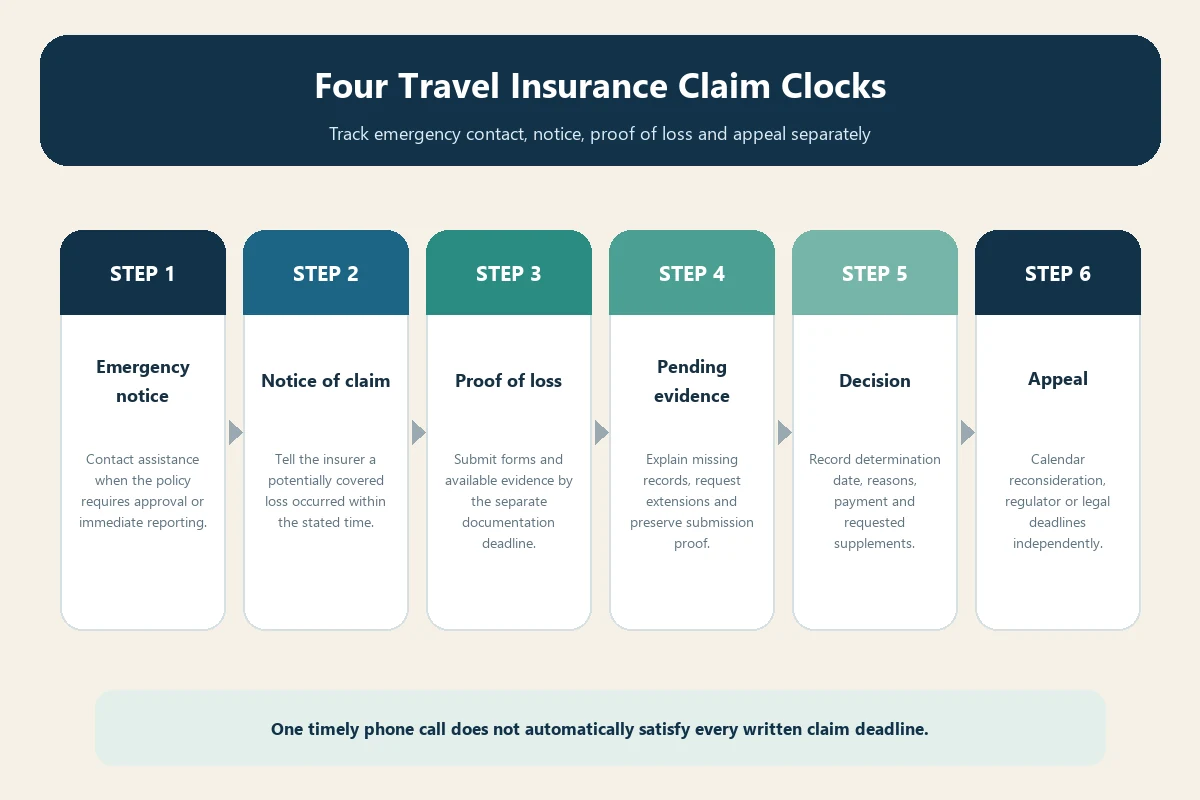
A travel insurance notice of claim proof of loss deadline search often produces one confident number. That is dangerous. Travel claims can involve several separate clocks, and the controlling time comes from the current policy certificate, the benefit involved, applicable law, and the facts of the loss. Emergency assistance notification, notice of claim, proof of loss, appeal, and lawsuit-limitation provisions do different jobs.
The safest practice is to notify the insurer promptly, document the date and method, submit available proof before the stated deadline, and identify any outstanding records. Do not wait for a hospital, airline, tour operator, Medicare, or another insurer to finish its process before protecting the travel-policy claim.
Key takeaways
- Notice of claim tells the insurer that a potentially covered loss occurred.
- Proof of loss supplies the facts and documents needed to evaluate the requested benefit.
- Emergency notice or preauthorization can be a separate requirement, especially for evacuation.
- Appeal and legal-action deadlines can run independently after a denial.
- There is no safe universal deadline; read the exact certificate issued for the trip.
What is notice of claim?
Notice of claim is the initial communication that identifies the insured traveler, policy, event, date, and type of benefit that may be requested. It allows the administrator to open a file, assign a claim number, provide forms, and explain where documents must go. Notice can be required within a stated period or as soon as reasonably possible, depending on the contract and governing rules.
Opening a case with an assistance line may or may not satisfy formal claim notice. A conversation about finding a doctor is not automatically the same as reporting a trip cancellation claim. Ask for a claim number and written confirmation identifying each benefit opened.
What is proof of loss?
Proof of loss is the evidence supporting the claim. It can include a signed claim form, itinerary, proof of payment, cancellation invoice, refund statement, physician documentation, police report, carrier delay record, itemized medical bill, Explanation of Benefits, receipts, and a narrative linking the event to the policy benefit.
The word “proof” does not mean the claimant must know the final approved amount. It means the insurer receives sufficient facts and records to evaluate the loss under the certificate. When a document is still pending, submit the available packet on time, list what is missing, explain why, and request written instructions for supplementation.
Emergency notification and preauthorization
Medical evacuation, repatriation, security assistance, and some nonemergency treatment can have notification or approval requirements that operate before an expense is incurred. A traveler who independently books an air ambulance may face a different issue than a traveler who promptly notified the assistance company but later submits receipts.
Use the 24-hour assistance number as soon as reasonably possible in a serious event. If the traveler cannot call, a companion, clinician, tour operator, or family member can try. Document medical incapacity, lack of communications, and every attempted contact. Immediate medical care should never be delayed merely to complete insurance paperwork, but the policy’s coordination rules still need attention.
The four deadline clocks
- Assistance or authorization clock: can begin when emergency services, evacuation, or treatment is needed.
- Notice-of-claim clock: begins when the loss occurs or becomes known under the contract wording.
- Proof-of-loss clock: governs the completed form and supporting evidence.
- Appeal or legal-action clock: can begin with an adverse decision or after proof was due.
A fifth clock may belong to another organization. Airlines, cruise lines, hotels, credit-card issuers, health plans, Medicare, and medical providers all have their own filing or dispute periods. A pending supplier refund does not automatically suspend the insurance deadline.
Why one online number is unreliable
Policies are issued by different insurers, for different benefits, in different states, and under changing forms. A number quoted from one plan may refer to notice rather than proof, calendar days rather than business days, or a deadline measured from the event rather than the end of the trip. State law can also affect wording and enforcement.
Use the declarations and certificate tied to the actual purchase. Search within the document for “notice of claim,” “claim forms,” “proof of loss,” “time of payment,” “appeal,” “legal action,” “limitations,” and the specific benefit. If the marketing summary conflicts with the certificate, ask the administrator and insurer for a written explanation.
When does the clock begin?
The trigger is contract-specific. A cancellation loss may arise when the trip is canceled, not when the traveler later learns the final supplier refund. A medical claim may involve the treatment date, while an interruption claim may involve the date the trip ended early. Delay benefits may use the scheduled departure, delay threshold, or end of the delay.
Write down the earliest plausible trigger and work from that conservative date until the insurer confirms otherwise. Do not rely on the day the traveler returned home or finally assembled receipts unless the certificate expressly uses it.
How to give defensible notice
Use the channel named in the certificate: portal, email, telephone, or postal address. Include the insured’s name, policy or plan number, booking reference if relevant, event date and location, a short factual description, benefits potentially involved, and reliable contact information. Avoid speculation about diagnosis, fault, or coverage.
Save a portal confirmation, sent-email copy, certified-mail tracking, call log, and representative name. A screenshot without the URL, date, or claim number can be hard to authenticate. Download the full submission when the portal permits it.
Submit proof in organized modules
Start with a one-page index. Group records by benefit: cancellation, interruption, delay, medical, evacuation, baggage, or rental vehicle. Within each group, order documents by date. Label original cost, supplier refund, other-insurance payment, credit, deductible, and remaining amount. This mirrors the workflow in our travel insurance claim documentation guide.
For secondary medical coverage, add the first payer’s full EOB or denial and follow our Explanation of Benefits guide. If the event ended the trip, keep the evidence for trip interruption separate from the medical invoice.
What if a document will arrive late?
Do not let the perfect packet delay notice. Send the claim form and available proof, identify the missing document and the organization responsible, state when it was requested, and ask whether the claim will remain open. Follow up before the deadline. Examples include an airline disruption letter, final cruise refund, foreign medical record, police report, death certificate, or health-plan EOB.
If the insurer grants an extension, obtain the new date and conditions in writing. An adjuster’s informal statement that “there is plenty of time” is less useful than a dated message tied to the claim number.
Late notice versus late proof
These are distinct issues. A traveler might report the event immediately but submit a hospital translation later. Another traveler might have complete receipts but fail to open the claim until months afterward. The certificate and applicable law determine the effect of delay, including whether prejudice, impossibility, or reasonable cause matters.
Explain facts rather than making a legal conclusion. Describe hospitalization, incapacity, lack of access, postal failure, delayed provider records, or another concrete reason. Attach evidence and request a written coverage decision. For a significant disputed loss, consider an attorney or licensed professional in the relevant state.
After a denial: another set of dates
A denial should identify the policy provision, facts, and review or appeal instructions. Calendar the earliest appeal deadline immediately. Request the complete claim file or missing-document list when available, address the stated reason, and submit a concise chronology with new evidence. Our guide to common travel insurance claim denials can help organize the response.
Do not assume an internal appeal pauses a contractual or statutory legal-action limit. Ask the insurer in writing and obtain jurisdiction-specific advice when the amount warrants it. A state insurance regulator can explain complaint procedures but does not act as the traveler’s private lawyer.
Special deadline traps
- Multiple benefits: medical notice may not open baggage or interruption claims.
- Multiple insureds: each traveler may need a form, authorization, or signature.
- Supplier credits: an unsettled refund should be disclosed, not used as a reason to wait.
- Another insurer: waiting for its EOB does not normally stop the travel clock.
- Portal status: “submitted” may mean uploaded, not accepted as complete proof.
- Corrected loss: later refunds or bills require a supplemental reconciliation.
Build a claim calendar
Create columns for requirement, policy wording, trigger date, calculated due date, submission channel, sent date, confirmation, outstanding items, and follow-up date. Include the assistance call, notice, proof, first-payer claim, supplier refund request, appeal, and any regulator complaint. Store the certificate and confirmation files with the calendar.
For seniors coordinating Medicare and travel coverage, use our Medicare coordination workflow. Each payer’s clock belongs on the same calendar, but each submission needs its own evidence.
FAQ
Does calling the assistance company count as notice of claim?
Not always. Ask whether a formal claim was opened for every relevant benefit and obtain a claim number.
Can I send more documents after proof of loss?
Often a claim can be supplemented, but the certificate and adjuster instructions control. Submit available proof on time and identify outstanding records.
Is there always a 90-day proof-of-loss deadline?
No universal number is safe. Use the issued certificate and applicable law for the specific benefit.
What if the portal fails?
Capture the error, try another approved channel, contact the administrator promptly, and preserve timestamps and confirmation.
Bottom line
Notice of claim and proof of loss are separate duties, and neither should be confused with emergency authorization or appeal. Open the claim promptly, calendar every clock, submit organized proof by the earliest defensible date, and supplement missing third-party documents in writing. The actual certificate—not a generic web answer—controls the workflow.
Sources
- NAIC — Travel Insurance Model Act
- NAIC — What to Know About Travel Insurance
- New York DFS — Travel Insurance
- California Department of Insurance — Travel Insurance Guide
- Washington Office of the Insurance Commissioner — Travel Insurance
- NAIC — State Insurance Departments
Reviewed August 16, 2026. This article is general educational information, not legal advice or a substitute for the issued policy, applicable law, or an insurer’s written claim decision.
