
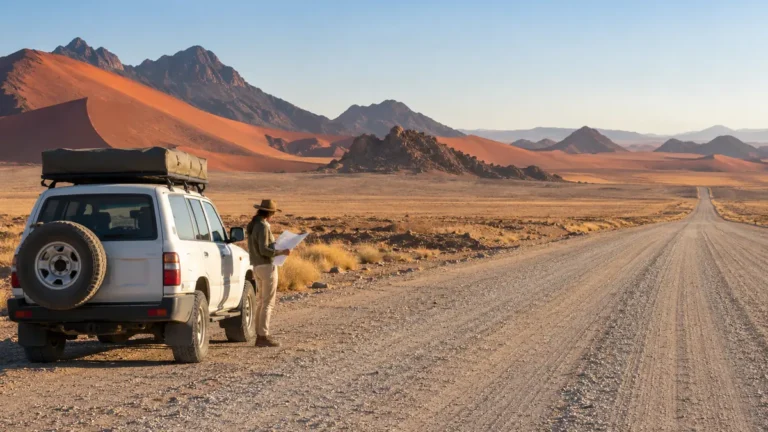
Travel insurance for Namibia should be compared against the road trip you will actually take. A few nights in Windhoek create one set of exposures; a loop through Etosha, Kunene or Damaraland, the Atlantic coast, and Namib-Naukluft adds long road sectors, mixed surfaces, remote lodges, park rules, rental-contract exclusions, and greater distance from suitable medical care.
This guide is for visitors traveling from the United States. It shows how to separate the travel policy from the vehicle contract, trace a medical transfer from a remote stop, and keep the evidence that a disruption or claim may require. It does not recommend an insurer, rental company, road, or activity.
Namibia insurance checklist
- Write the trip as dated road legs, not one destination.
- Read the travel policy and rental agreement as separate contracts.
- Map the route from incident location to suitable medical care.
- Check each park, guided activity, hike, flight, and border segment.
- Plan for payment at the point of care and later reimbursement.
- Reconfirm entry, health, park, and road information before departure.
Planning information reviewed October 7, 2026. Official requirements, health notices, roads, park access, services, and insurance terms can change. Verify each against your departure date and issued documents.
Start with a route ledger
Build a simple table with one row for every day. Record the overnight location, next stop, planned surface, approximate driving time supplied by a current route source, fuel point, rental restrictions, prepaid booking, and how you would contact help. Add domestic or regional flights and any separately ticketed international connection. This is not a promise that the route will be passable; it is the structure needed to ask useful insurance questions.
The Namibia Roads Authority describes a national network containing about 8,400 kilometers of surfaced road, 26,024 kilometers of gravel road, 13,773.8 kilometers of earth road, and 330.1 kilometers of salt road. Those figures explain why surface type belongs in the plan. They do not tell you the condition of a particular section on a particular day.
A country-wide label hides the handoffs that matter. A tire loss on a remote gravel leg, a late arrival at a lodge, a missed flight after a long drive, and an illness far from Windhoek are different events governed by different documents. The route ledger lets you test each one before buying.
Four contracts can sit around one rented vehicle
A U.S. travel plan commonly addresses the traveler: emergency medical costs, eligible cancellation or interruption, baggage, and certain delays. It is not a substitute for local motor liability. The rental agreement deals with the hired vehicle and may include a damage waiver subject to an excess and exclusions. A card benefit may cover some damage if its conditions are satisfied. Roadside assistance or recovery can be a fourth service.
Check the rental wording for tires, glass, undercarriage, roof, water, sand, unauthorized roads, driving after dark, single-vehicle incidents, towing, recovery, loss of use, and the required incident procedure. Then read our general guides to the self-drive safari contract stack and rental cars and travel insurance. Those pages own the general rules; this Namibia page applies them to a destination route.
A vehicle problem is not automatically a covered trip event
A puncture, cracked windscreen, mechanical breakdown, or recovery bill can be outside a travel policy even when it disrupts a prepaid stay. A cancellation or interruption benefit normally requires a named reason, and inconvenience alone is not enough. Ask the insurer whether a documented collision, road closure, or rental breakdown is a covered trigger, and ask the rental company who arranges assistance and who pays.
If a problem occurs, contact the rental assistance channel, photograph the vehicle and surroundings without creating a roadside hazard, obtain the required police or incident record, and preserve messages, invoices, location data, and the rental company’s decision. Do not promise payment or arrange an expensive recovery until you understand the contractual process, unless immediate safety requires action.
Design a medical pathway for the remote legs
The current U.S. Department of State Namibia advisory says many visitors travel far from emergency and medical services. It describes adequate facilities in Windhoek and other major towns, says rural care may be below U.S. standards, and notes that hospitals and clinicians often require cash or advance payment. It also says patients bear the costs of transfers and strongly recommends supplemental medical-evacuation cover.
Turn that warning into a route-specific chain:
- How would you reach the nearest point that can provide first care?
- Which facility can assess the problem, and how will it be paid?
- Who decides that transfer to another facility is medically necessary?
- Must the assistance company authorize and arrange the movement?
- Does the policy transport to the nearest adequate facility or somewhere else?
Ground transport, a transfer between hospitals, air ambulance, search and rescue, and later travel home are not synonyms. They can fall under different benefits or outside the plan. Compare the wording with our guide to medical evacuation limits and authorization, paying close attention to who selects the destination.
Prepare for payment and records
Coverage does not guarantee direct billing. The traveler may need a practical way to pay, then file for reimbursement. Save an itemized bill, proof of payment, clinical note, diagnosis, prescription, referral, and every communication with assistance. The cash-payment hospital receipt checklist explains why a card slip by itself may not establish an eligible medical expense.
If someone is admitted, the priorities are care and communication. When reasonably possible, call the insurer’s assistance number and follow the sequence in what to do when hospitalized abroad. Carry the policy number and assistance contact on paper as well as on a phone.
Health planning changes with the route
The CDC Namibia traveler page currently identifies malaria transmission in specified regions while reporting no transmission in Windhoek. It also tells travelers to check what their existing health coverage will pay abroad, evaluate separate travel-medical and evacuation protection, plan access to care, and bring appropriate medicines.
Do not reduce that to “Namibia has malaria” or “Windhoek does not.” A route through several regions needs advice based on the exact places, season, health history, and current CDC guidance. A qualified travel-health clinician should make medicine and vaccination recommendations. Insurance can address some eligible consequences of illness; it does not replace prevention or make an excluded condition covered.
The CDC page currently says yellow-fever vaccine is not required for direct travel from the United States, but specified travel or a long airport transit through a yellow-fever-risk country can trigger an entry requirement. Review the whole flight path. Also ask the U.S. plan what it pays outside the country; the gaps described in how U.S. health insurance works abroad help show whether the travel plan will be primary or supplemental.
Park access affects the feasible itinerary
The Namibia environment ministry’s park-permit FAQ says most national parks issue permits at their gates, while certain Namib-Naukluft areas require advance permits. It prohibits leaving indicated roads or the vehicle in parks and says Khaudum National Park requires a convoy of at least two vehicles.
Those rules matter before insurance enters the picture. An itinerary that conflicts with access or convoy requirements is not repaired by buying a larger policy. Confirm the permit issuer, opening conditions, vehicle requirements, route restrictions, guide requirements, and contingency for a closure. Keep official closure or permit evidence if a change later causes a claimed cost.
List activities by name
A Namibia itinerary may include guided game drives, hiking, dune excursions, sandboarding, quad biking, hot-air ballooning, scenic flights, kayaking, or camping. A policy may treat each differently. Some plans cover an activity only when it is recreational, guided, below a stated height or grade, performed with required equipment, or purchased with an upgrade.
Search the certificate for the activity itself, the broader hazardous-activity definition, and exclusions involving motorized recreation, aviation, professional participation, alcohol, or failure to follow local rules. Use the questions in our adventure-sports exclusion guide, then obtain written clarification for the issued policy when the wording is unclear.
Medical treatment, evacuation, search and rescue, personal equipment, supplier cancellation, and third-party liability can still be separate issues. An activity being “covered” in one section does not activate every other benefit.
Entry permission and insurance do different jobs
A Namibia Ministry of Home Affairs fact sheet dated March 31, 2025 lists U.S. citizens among the nationalities subject to the visa-on-arrival regime from April 1, 2025. Procedures, eligible entry points, charges, and documents can change, so use the current ministry instructions rather than preserving an old fee or form in a trip checklist.
A visa permits entry. It does not pay a claim, certify a route, or prove medical coverage. Likewise, an insurance certificate does not replace a visa. If an entry problem could cause cancellation, read the policy carefully: lacking the correct document is commonly distinct from an unexpected covered event.
Connect road days to flight and lodge bookings
Leave realistic margins between a long driving day and a nonrefundable flight. If tickets are separate, one airline may have no duty to rebook a missed onward segment. The policy may require delay by a covered common carrier or another named reason, which a late self-drive arrival might not satisfy. Our guide to missed connections on separate tickets sets out the evidence and contract questions.
Also distinguish delay, interruption, and cancellation. A late arrival, an early return, and a trip that never starts use different benefits and timing rules. The comparison in trip delay versus interruption and cancellation helps identify which section to read before assuming that every unused lodge night is reimbursable.
Evidence to collect while the facts are fresh
| Event | First record | Supporting record |
|---|---|---|
| Vehicle incident | Rental-company case number | Photos, police record, repair or recovery invoice |
| Road or park closure | Official notice | Original route, supplier response, refund decision |
| Medical care | Clinical report | Itemized bill, payment proof, assistance communications |
| Evacuation or transfer | Medical necessity and authorization | Transport invoice, origin, destination, timing |
| Flight disruption | Carrier delay or cancellation statement | Tickets, rebooking, refunds, reasonable receipts |
| Stolen property | Police report | Ownership proof, rental or carrier report, insurer notice |
A screenshot can support a file but rarely replaces the primary record. Ask the party that controlled the event—the airline, park authority, rental company, clinician, or police—for a dated document. Submit refunds and credits along with the claimed loss so the same cost is not counted twice.
Compare plans with Namibia-specific questions
- Does the coverage territory include every country and transit point?
- What medical limit, deductible, and reimbursement process apply?
- Who authorizes evacuation, and to what kind of facility?
- Is search and rescue separate from medical transport?
- Which planned activities are included, upgraded, or excluded?
- Which self-drive disruption reasons activate trip benefits?
- What waiting period and definition govern a missed connection?
- Which prepaid costs are nonrefundable and eligible to insure?
- What pre-existing-condition rules and purchase deadlines apply?
Read the full policy, schedule, and endorsements issued for the purchaser’s state. Marketing comparisons are useful for narrowing choices, but the issued wording controls.
Frequently asked questions
Does travel insurance cover a Namibia rental 4×4?
Usually not in the way motor insurance does. A travel plan may include limited rental-vehicle damage or trip benefits, but local liability, damage waivers, exclusions, excesses, roadside assistance, and recovery come from other contracts. Compare each document against the intended roads and vehicle.
How much medical evacuation cover is enough?
There is no universal Namibia number. The useful comparison starts with the remote point, likely first facility, possible onward destination, transport modes, policy limit, and authorization terms. A high headline limit is weaker than clear coverage for the actual chain.
Is malaria treatment covered?
An eligible unexpected illness may fall under emergency medical coverage, subject to the policy’s definitions, exclusions, pre-existing-condition rules, and documentation. That does not answer whether preventive medicine is covered or whether failure to follow medical advice affects a claim. Ask a clinician about prevention and the insurer about wording.
Will insurance pay when a road or park closes?
Only when the cause and loss satisfy a covered reason and other conditions. An official closure establishes what happened; it does not by itself promise reimbursement. Obtain the notice, request supplier refunds, preserve the original itinerary, and document reasonable alternatives.
The practical decision
Choose travel insurance for Namibia only after the policy survives the exact route: every road leg, remote-care handoff, rental exclusion, park rule, activity, prepaid booking, and flight connection should have an identified contract and evidence plan.