

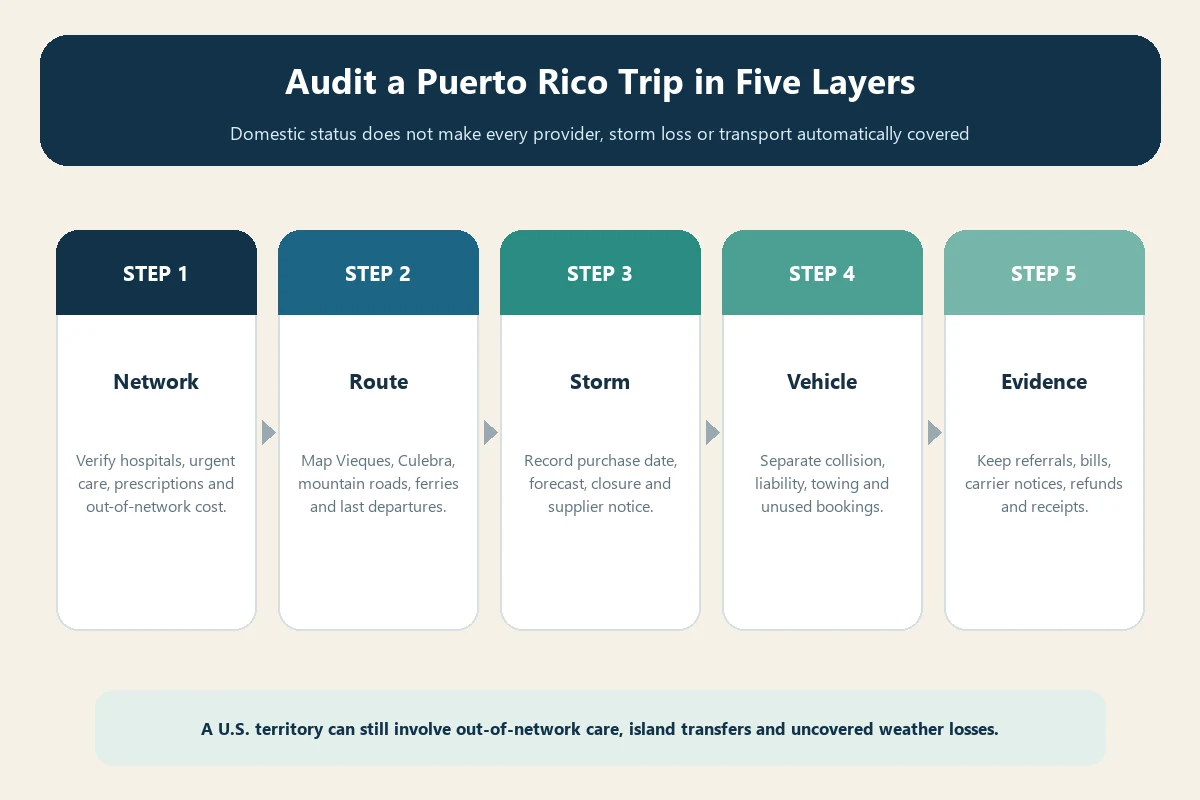
Travel insurance for Puerto Rico trip costs should be tested against U.S. health-plan networks, hurricane timing and the route from an island or mountain community to appropriate care. Puerto Rico is a U.S. territory, but domestic status does not make every doctor in network, every ferry connection protected or every storm loss reimbursable. Build the plan around the actual route and contracts.
Key takeaways
- Verify the exact hospitals and urgent-care facilities in the health plan network.
- Map Vieques, Culebra and mountain routes as separate transport problems.
- Check hurricane purchase timing, carrier thresholds and lodging terms.
- Separate rental-car collision, liability, towing and trip disruption.
- Keep provider referrals, official alerts, refunds and replacement receipts.
Planning information reviewed August 16, 2026. Provider networks, ferry and flight schedules, storm alerts, rental terms and insurance wording can change. Verify current information for the exact traveler, route and dates.
Start with the domestic-status question
Puerto Rico is part of the United States for Medicare’s travel-coverage definition. The official Medicare travel coverage page includes Puerto Rico and the U.S. Virgin Islands with the states and other U.S. territories. That answers a geographic question; it does not confirm that a particular doctor accepts a traveler’s plan or that a non-Medicare network reaches every municipality.
Ask an employer plan, marketplace plan, Medicare Advantage plan or other insurer four separate questions: Is the facility participating? Is emergency care handled differently from scheduled care? Does the plan require notice or authorization? What cost sharing applies? Save the current provider-directory result and obtain a reference number for any plan-specific answer.
The U.S. trip insurance guide separates medical coverage from trip protection. The health-plan travel audit provides useful questions even though Puerto Rico is domestic: network reach, balance billing, ambulance rules and reimbursement remain plan-specific.
Verify the provider, not just the insurance card
Search the plan directory for the traveler’s actual dates and likely locations. Record an emergency department, urgent-care option, pharmacy and specialty hospital near each overnight stay. Call the facility to confirm participation, then ask the plan to confirm the same legal provider name. Directory listings and front-desk statements can disagree.
Distinguish a true emergency from follow-up care after discharge. Federal or plan emergency rules may protect the initial evaluation differently from a scheduled specialist visit, imaging appointment or prescription refill. Ask who must authorize follow-up and whether a mainland clinician can send records electronically.
Travel insurance should be evaluated after this health-plan audit. It may add accident and sickness expense, evacuation or trip benefits, but some products are secondary to the domestic plan. The primary versus secondary medical guide explains which payer receives the bill first and what denial or explanation-of-benefits document the second payer may require.
Check prescriptions and telehealth before travel
Confirm whether the domestic plan’s pharmacy network includes a convenient Puerto Rico location and whether a refill can be transferred. Carry medication in labeled packaging with enough reserve for a delayed return. Record generic names, dose, prescribing clinician and allergies offline.
Ask the plan whether its telehealth service can treat a member physically located in Puerto Rico. Clinician licensing, platform availability and prescription rules may differ from an ordinary call at home. A video visit can help with advice but cannot replace local examination, imaging or emergency treatment.
If medicine is lost or damaged, call the plan and prescribing office before buying a replacement when the situation allows. Keep the prescription, pharmacy receipt and any carrier property report. Travel-insurance baggage coverage, a health-plan pharmacy benefit and emergency medical coverage can require different evidence for the same episode.
Map Vieques and Culebra as separate itineraries
An overnight on Vieques or Culebra adds ferry or small-aircraft schedules, ground transfers at both ends and fewer fallback departures. List every ticket, operator, departure point, check-in deadline and last service. Record whether the ticket is refundable and whether the carrier is treated as a common carrier under the policy.
For medical planning, identify the first local facility, then ask how a patient who needs higher-level care normally reaches the main island. A routine passenger ferry, scheduled flight, Coast Guard response and medically equipped aircraft are not interchangeable. Do not assume an evacuation benefit pays for any transport the traveler chooses independently.
Ask the assistance team who assesses medical necessity, selects the receiving hospital and approves the movement. If ordinary service is unavailable, determine whether an added hotel night or replacement flight fits delay, interruption or neither. Keep the original schedule and the carrier’s written reason for the change.
Build a main-island medical route
A stay in San Juan differs from a beach town, central mountain municipality or remote trail. Record the realistic drive time to care in daylight and after heavy rain. Include the location of the traveler’s rental car, the person able to drive and a licensed transport alternative.
For a serious condition, ask whether the likely receiving facility is elsewhere in Puerto Rico or on the U.S. mainland. The medical evacuation limit guide distinguishes transfer to an adequate facility from a traveler’s preference to return home. Look for medical-necessity language, insurer control, receiving-facility acceptance and companion benefits.
Save a concise medical summary offline. Include diagnoses, allergies, generic medication names, treating clinicians and consent contacts. Spanish-language support can help with a handoff, but the traveler should still request copies of clinical notes, imaging, prescriptions and discharge instructions.
Use official hurricane information by date
Puerto Rico’s official emergency-management hurricane page identifies the Atlantic season as June 1 through November 30 and directs the public to government bulletins. The National Hurricane Center preparedness hub explains watches, warnings and hazard preparation. These sources establish what officials communicated; they do not by themselves establish an insurance benefit.
Create a storm chronology with the policy purchase, first trip payment, forecast development, named-storm date, watch or warning, airport or port action, carrier cancellation, lodging notice and traveler decision. Benefits often depend on a defined event and timing. Buying after a storm becomes known may leave that storm outside coverage.
The weather-delay insurance guide connects official evidence to carrier and time thresholds. Read the actual definition of severe weather, natural disaster, mandatory evacuation, destination uninhabitability and common-carrier delay instead of relying on a hurricane-season label.
Separate outage inconvenience from covered loss
A power, water or mobile-service interruption can be disruptive without satisfying a policy trigger. Ask the lodging provider what remains operational, whether the property is open, whether it will issue a refund and whether authorities ordered an evacuation. Preserve each answer in writing.
If the traveler changes hotels voluntarily, record the safety or habitability reason and contact the insurer first when practical. A preferred room, generator noise or limited amenities may be treated differently from an official closure or property that cannot be occupied. Claim only the eligible balance after supplier credits.
Classify the loss by timing. Cancellation generally concerns a covered event before departure; interruption concerns unused arrangements and added return travel after departure; delay concerns waiting costs after a defined threshold. The delay, interruption and cancellation guide maps expenses to those three buckets.
Audit the rental car as its own contract
Confirm collision or loss-damage protection, liability, theft, glass, tires, towing, roadside service and replacement procedures. A credit-card benefit may exclude certain vehicle types, rental lengths or roads. The rental company can also impose duties that a travel policy does not waive.
Photograph the vehicle, fuel level and agreement at pickup and return. Save police or roadside reports and ask who authorizes towing. The rental-car coverage guide separates damage to the vehicle from injury, third-party liability and unused trip bookings; the same separation is useful on a domestic territory trip.
If a storm or road closure prevents return, contact the rental company immediately. Added rental days, a one-way fee and a missed flight may fall under different contracts. Obtain the supplier’s refund or credit decision before submitting the remaining loss.
Compare policies with one complete scenario
Hold traveler ages, dates, prepaid costs and route constant. Include two nights in San Juan, a Vieques stay, a rental car, a hurricane warning, a canceled ferry and a medical condition needing transfer to the main island. Give every insurer the same facts.
- Is the medical benefit primary or secondary to the U.S. health plan?
- Who authorizes inter-island and mainland medical transport?
- Does the scheduled ferry meet the common-carrier definition?
- Which storm event and timing can trigger cancellation or interruption?
- What rental-car losses are included or excluded?
- Which notices, refunds and medical records must accompany a claim?
Build the evidence file before departure
Store the health-plan card, provider checks, policy certificate, assistance number, itinerary, ferry and flight contracts, rental agreement, lodging terms and medical summary offline. Give a companion access and a clear role.
During an incident, record the location, time, provider, official alert, carrier action, insurer instruction and each payment. Keep itemized bills rather than card slips alone. The travel insurance claim guide provides a chronology for coordinating the health plan, travel insurer and suppliers without duplicate reimbursement.
For a child or traveler who needs assistance, include consent, guardian contacts and the adult authorized to travel with the patient. Ask about companion lodging, dependent return and bedside travel as distinct benefits. A medical transport approval does not automatically pay every family member’s new itinerary.
Bottom line
The strongest Puerto Rico plan begins with domestic network verification and then fills specific gaps: island transport, hurricane-triggered trip costs, rental obligations and medically necessary movement. Confirm each provider and contract before travel, then preserve the timing and evidence that connect a real event to a defined benefit.
