
Travel insurance for the Bahamas matters because Medicare and most U.S. health plans usually pay nothing outside the United States, outer islands have only small clinics, and a serious case may need evacuation to Florida. The Bahamas is close, but a medical or storm problem on a small cay can still involve a boat, a domestic flight and an international medical flight, each with its own approval. This guide shows how to check medical access, classify every vessel, time a purchase against hurricane season and keep the evidence a claim needs.
Key facts
- Medical care is available on New Providence and Grand Bahama; outer islands have small clinics and limited care.
- Serious illness or injury may require evacuation to the United States, and providers may expect cash payment.
- Medicare usually does not cover health care outside the U.S., so a domestic plan is not a substitute.
- The Atlantic hurricane season runs June 1 to November 30, with most activity between mid-August and mid-October.
- Boating is unevenly regulated in the Bahamas; some operators may be unlicensed or uninsured.
- CDC advises reviewing your health plan and considering travel health and medical evacuation insurance for The Bahamas.
Key takeaways
- Map medical access separately for Nassau, Grand Bahama and outer islands.
- Classify scheduled ferries, charters, tour boats and private vessels.
- Verify how a patient reaches major-island or U.S. care.
- Buy before a storm becomes foreseeable under the policy.
- Keep schedules, closures, medical records, refunds and approvals.
Planning information reviewed August 16, 2026. Medical services, boat schedules, airport operations, storm alerts and policy wording can change. Verify current information for every island and date.
Map medical access island by island
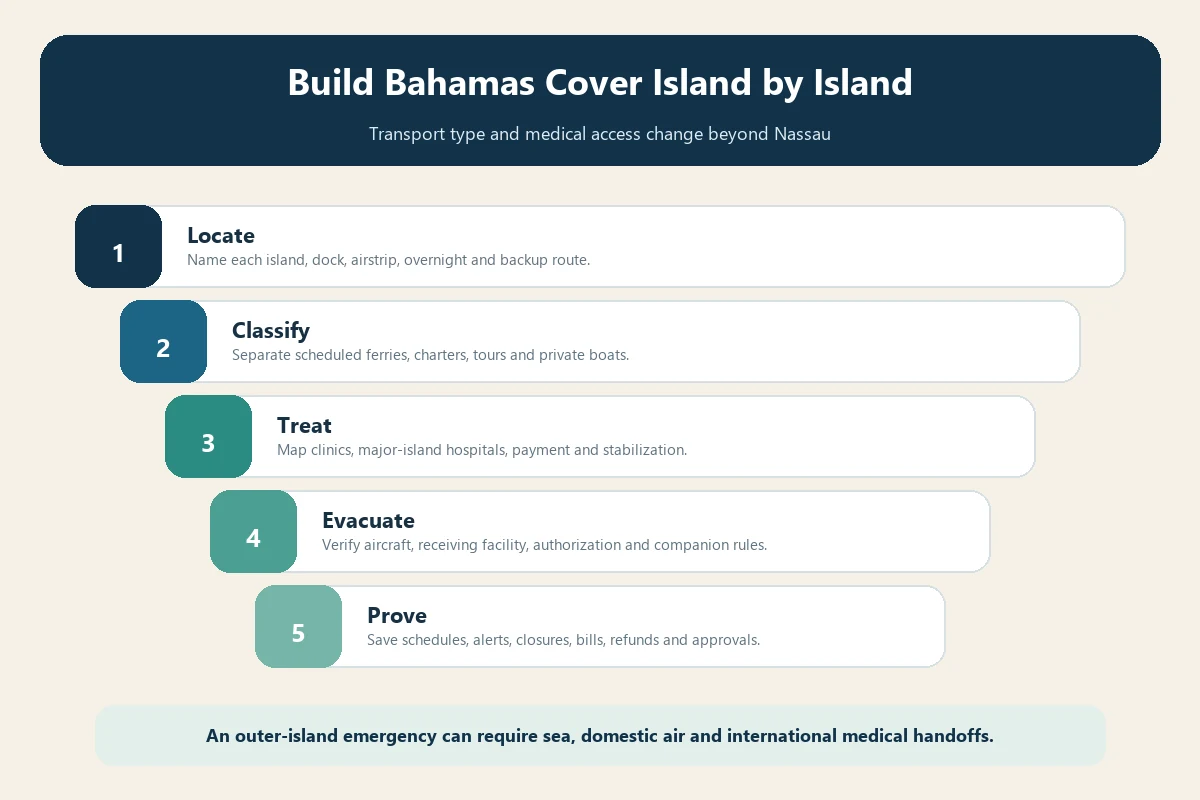
List each airport, dock, island, cay, hotel, boat operator, domestic flight and prepaid activity. Record the latest departure, weather alternative, baggage rules and first nonrefundable payment. Identify realistic care for every overnight.
The U.S. Department of State’s official Bahamas travel information says medical care is available on New Providence and Grand Bahama, while outer islands have small clinics and limited care. Serious illness or injury may require evacuation to the United States, and providers may expect cash payment.
Identify the first realistic medical facility
An outer-island clinic may stabilize a patient without providing surgery, imaging or specialty care. Ask the lodging and insurer where a serious case is usually evaluated and how transport is arranged. Record the time to the dock or airstrip and an alternative when it is closed.
Call the U.S. health plan about foreign care, reimbursement, claims and authorization. The health insurance abroad guide helps identify where domestic network and payment assumptions fail.
Carry a medical summary and prescriptions offline. Store enough medication in hand baggage for an extended island delay.
Separate domestic medical movement from U.S. evacuation
A patient may move by small boat or aircraft to Nassau or Grand Bahama before an international medical flight is considered. Ask whether the first movement is ambulance, rescue or evacuation and who authorizes it.
Confirm the receiving facility, aircraft, companion arrangements and whether the policy ends transport at the nearest appropriate care. The remote evacuation guide provides a decision-authority checklist.
Classify every vessel before purchase
A scheduled ferry, water taxi, excursion boat, fishing charter, dive boat and private yacht may receive different treatment. Ask whether a common carrier must publish a schedule, hold a license or sell tickets to the public. Save the operator and timetable.
The ferry travel insurance guide explains carrier definitions, missed connections and documentation in a method that applies to Bahamian routes. Do not assume that a private charter is a ferry because it moves passengers between islands.
Audit boat-operator safety and eligibility
The State Department warns that boating is unevenly regulated and some operators may be unlicensed or uninsured. Record the legal operator, vessel, captain, communications, safety equipment, passenger count and cancellation terms. Ask who monitors weather and who can stop the trip.
For jet skis, diving, fishing or snorkeling, check the activity by exact name. The adventure-activity exclusion guide helps test motorized, depth, supervision and equipment clauses.
Separate private-boat and passenger risks
A traveler on a private vessel may need hull, liability, towing and crew coverage that a personal travel policy does not provide. Ask whether arrival by private boat changes carrier-delay or baggage eligibility. Check entry, clearance and marina requirements separately.
If the traveler is only a charter passenger, keep the charter agreement, passenger list, payment and cancellation wording. An operator refund reduces the remaining insured loss.
Track storm timing from purchase to departure
The Bahamas hurricane season generally runs from June through November, though storms can occur outside that period. Airports and seaports may stop operations well before expected impact, and outbound seats can sell out. Buy coverage before a storm becomes named or otherwise foreseeable under the contract.
The U.S. National Hurricane Center publishes official preparedness guidance and tropical advisories. The Bahamas Department of Meteorology provides current local forecasts and warnings. Save the product affecting the exact island, port or flight.
Distinguish watch, closure and evacuation
A storm watch, marina instruction, ferry cancellation, airport closure, hotel closure and mandatory evacuation are different facts. Record the issuer, boundary, time and supplier response. Safety comes first even when a policy trigger is uncertain.
The weather-delay coverage guide connects a notice to the policy’s covered cause and minimum delay. A voluntary early departure may be treated differently from an official evacuation.
| Event | First wording to inspect | Evidence |
|---|---|---|
| Outer-island illness | Medical and evacuation clauses | Diagnosis, location and provider plan |
| Medical boat or aircraft | Transport authority and endpoint | Medical necessity and approval |
| Scheduled ferry canceled | Common-carrier delay | Published schedule, notice and refund |
| Private charter canceled | Supplier terms and listed causes | Charter contract and refund response |
| Airport shutdown | Delay, interruption or evacuation | Official closure and replacement itinerary |
Classify each storm expense by timing
A covered event before U.S. departure may be cancellation. After travel starts, unused hotel nights and added return transport may be interruption. Waiting for a replacement carrier can be delay. Each benefit has its own limit and documentation.
The delay, interruption and cancellation guide maps expenses by event time. Request refunds, credits and rebooking first.
Protect separate tickets and last departures
An outer-island flight, ferry and U.S.-bound ticket may be purchased separately. Record the minimum connection, last daily departure and backup lodging. Ask whether the missed-connection benefit requires a defined common carrier.
If a transfer fails, contact the next supplier immediately and obtain its change, no-show or refund statement. Save the original and actual times.
Test assistance with an outer-island case
Give each insurer the same scenario: a U.S. traveler develops a serious condition on an outer island, needs stabilization, domestic transport and possible evacuation to Florida. Ask who identifies care, approves each stage and helps with cash payment.
Then test a private-charter cancellation and a scheduled-ferry cancellation. The assistance line versus claims guide distinguishes incident coordination from later reimbursement.
Audit the airstrip and aircraft constraint
An outer-island evacuation does not begin with a generic promise to fly. Ask which airstrip can accept the proposed aircraft, whether night operations are possible and what weather or runway limits apply. A local clinician may recommend transfer while the available aircraft cannot safely arrive until daylight. The policy comparison should address what assistance does during that gap.
Small scheduled aircraft can also have strict passenger, medical-equipment and baggage limits. Confirm whether a stretcher case requires a dedicated aircraft and whether a companion can travel on the same movement. If bags must remain behind, ask whether collection or forwarding is addressed separately. These details affect both timing and out-of-pocket cost.
Record the island, airstrip, nearest clinic, alternate departure point and last scheduled flight in one table. Use exact dates because schedules and daylight windows vary. During a disruption, save both the original operating schedule and the carrier’s written reason for the change.
Plan communications beyond the hotel lobby
A private villa, fishing cay or boat anchorage may have weaker service than Nassau. Download the policy, assistance instructions, medical summary and contact numbers before leaving reliable internet. Store coordinates and the name of the closest dock or landing point; an island name alone may be too broad for a response team.
Choose a shore contact who knows the route and missed-check-in time. For a boat day, record the vessel name, registration, captain, operator, departure dock and expected return. Ask the operator how it contacts emergency services when mobile data fails. A satellite device can improve communication, but it does not replace the insurer’s authorization rules or the local emergency response.
Separate cruise, land and private-vessel arrangements
A traveler who sleeps on land, joins a cruise for one segment and charters a private boat may have three different supplier contracts. List each payment, cancellation rule and carrier type. Confirm whether the itinerary is treated as one trip and whether a missed cruise departure, unused villa night or private-charter loss fits a defined benefit.
Ask what happens if a cruise line transports the patient to one island but the insurer recommends a different hospital. The cruise operator’s decision, a port authority closure and a travel insurer’s medical authorization are separate records. Keep all three when they affect the same expense.
For families, verify minor-child escort, dependent return and companion lodging conditions. A parent accompanying the patient may leave another child on a different island or ship. A useful policy comparison identifies who can travel, which fares are eligible and what documentation must be obtained before booking.
How to compare Bahamas travel insurance policies
Hold ages, dates, costs and routes constant. Include Nassau, one outer island, a scheduled ferry, a private excursion, medical evacuation, an airport closure and unused lodging.
- How are outer-island clinics and cash payment handled?
- Who approves domestic and international medical transport?
- Which boats qualify as common carriers?
- Are the exact water activities eligible?
- When does a storm become foreseeable?
- What closure, evacuation and notice evidence is required?
Build the island evidence file
Save coordinates, medical notes, itemized bills, proof of payment, transport approvals, vessel schedules, flight notices, official warnings, hotel closures, refunds and replacement receipts. Keep an incident timeline and every case number.
The travel insurance claim guide provides an evidence sequence. Disclose other reimbursement and claim only the remaining eligible loss.
Bottom line
The strongest Bahamas plan reflects the island chain rather than a single national label. Verify medical capacity, vessel type, last departure, storm timing and the authorized path to U.S. care before paying for a remote stay.
Sources and further reading
- The Bahamas – Traveler view | Travelers' Health | CDC — CDC advises reviewing what your health plan covers abroad and considering travel health and medical evacuation insurance because emergency care may not be available or meet U.S. standards; carry a list of local doctors and hospitals.
- Travel outside the U.S. | Medicare — Medicare usually does not cover health care while traveling outside the U.S.; you pay all costs in most cases, with narrow exceptions such as a ship within 6 hours of a U.S. port.
- Tropical Cyclone Climatology | National Hurricane Center — The Atlantic hurricane season runs June 1 to November 30; the peak is September 10, with most activity between mid-August and mid-October.
