
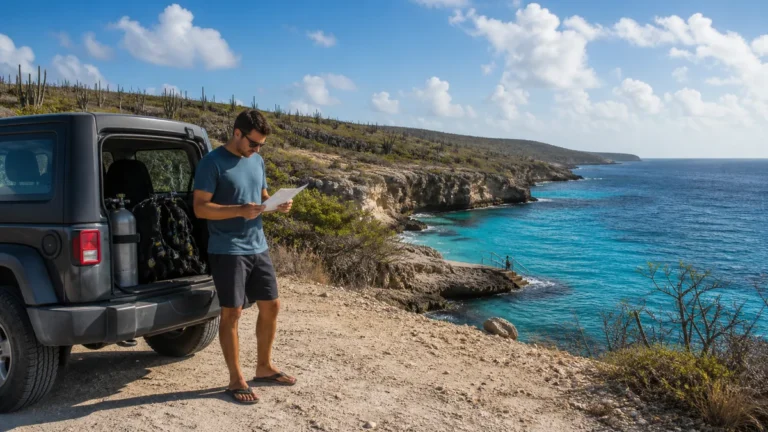
Travel insurance for Curaçao from USA trips should connect the exact dive plan to cash medical care and the insurer’s choice of evacuation destination. Curaçao can stabilize many travelers, but some specialist services are not available on the island. A serious case may involve transfer to Colombia or, when authorized, the United States.
Key takeaways
- Check scuba eligibility by certification, depth, supervision and gases.
- Identify realistic local care, payment and specialist limits.
- Ask when transfer goes to Colombia versus the United States.
- Use official marine warnings for the actual coast and dive time.
- Keep logs, medical records, transport approvals, bills and refunds.
Planning information reviewed August 16, 2026. Provider services, chamber arrangements, marine conditions, entry processes and policy wording can change. Verify current assistance and operator information for the exact dates.
Map every dive and coast stop
List the airport, lodging, rental car, shore entries, boat dives, operator, onward island and return flight. Record the certification, maximum depth, last dive time and realistic medical access for each site. Add the first nonrefundable payment.
The U.S. Department of State’s official Curaçao travel information says quality medical care is limited compared with U.S. expectations and some surgical specialties are not represented. It explains that critically ill patients needing unavailable services are normally transferred to Colombia, while transfer to the United States can occur when authorized by insurance or funded privately.
Audit the exact dive profile
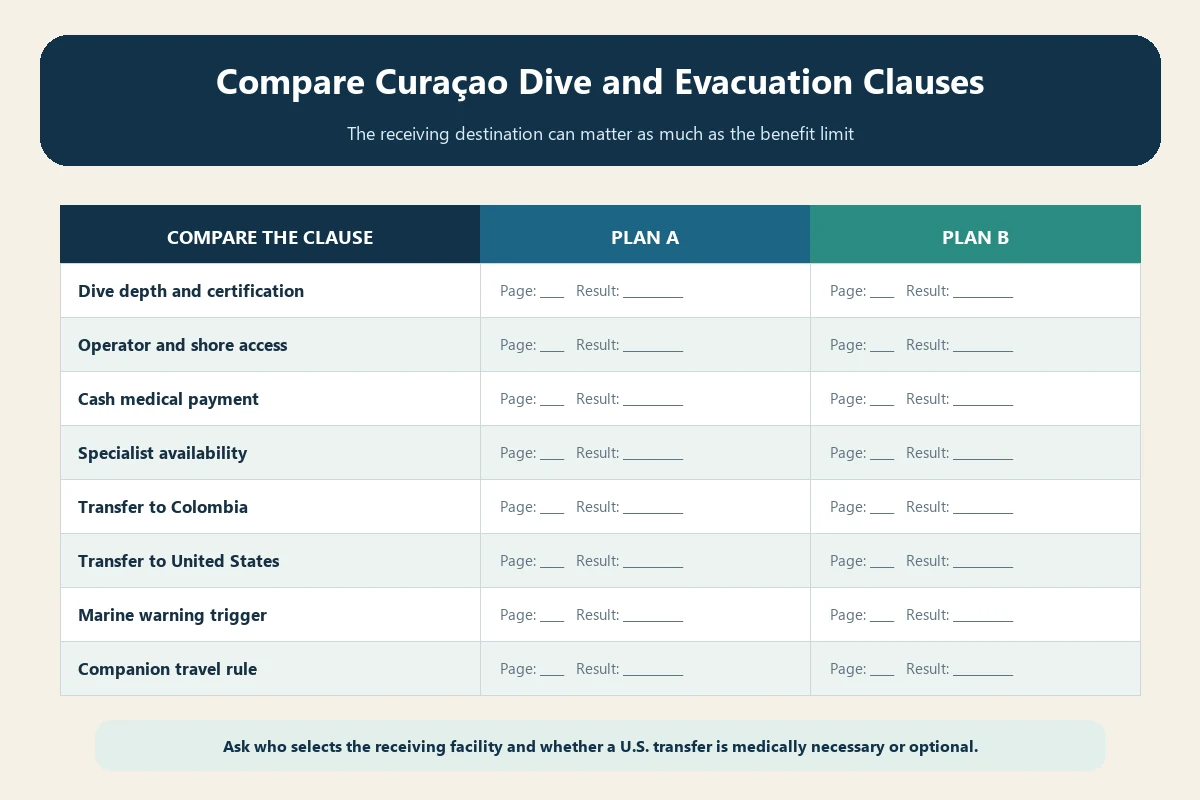
Give the insurer the certification, planned depth, supervision, number of dives and whether the itinerary includes wreck, night, freediving, rebreather or technical activity. Add shore entries, cliff access and any boat charter.
Check exclusions for diving beyond certification, solo activity, technical gases, instruction, paid work, competition and alcohol. Ask whether an adventure endorsement is required and whether rescue, medical care, chamber treatment and equipment share one maximum. The adventure-activity exclusion guide provides a clause-level test.
Follow operator and certifying-agency guidance. An eligible sport does not permit an unsafe entry, closed site or dive beyond training.
Verify shore access and operator response
Record the operator’s legal name, guides, oxygen, communications, boat, entry point and cancellation terms. For independent shore diving, note parking, steps, surface conditions, buddy plan and how responders reach the site.
Ask which provider evaluates a suspected decompression illness and how the traveler moves from the coast. Keep the briefing, waiver and dive log. Operator liability, dive-membership services and travel insurance are separate contracts.
Map Curaçao medical care before an emergency
Identify the hospital or clinic appropriate for initial assessment and ask the assistance company whether it has a relationship there. Confirm upfront payment, accepted methods, itemized records and any guarantee-of-payment process.
Call the U.S. health plan about foreign emergency treatment, reimbursement, claim forms and authorization. The health insurance abroad guide helps expose provider and payment gaps.
Carry a medical summary, allergies and prescriptions offline. The local selection of medication can be narrower than in the United States, so bring enough for delays in original packaging.
Ask who selects Colombia or the United States
Do not assume that evacuation means a flight home. The policy may authorize transport to the nearest appropriate facility, which could be in Colombia. A later repatriation to the United States may be evaluated separately.
Ask who determines medical necessity, chooses the facility and verifies acceptance. Confirm aircraft type, companion rules and whether stabilization, international transfer and later return use one limit. The remote evacuation guide provides an authority checklist.
Understand primary and secondary payment
A primary travel medical benefit may review eligible expenses before a U.S. plan, while a secondary benefit can require the domestic insurer’s decision first. Neither guarantees that the Curaçao provider accepts the card or that an aircraft departs immediately.
The primary versus secondary medical guide distinguishes claim order from direct payment. Record the deductible, currency conversion and documentation required.
Use official marine warnings by coast
The Meteorological Department Curaçao publishes current weather, marine forecasts and warnings. Conditions can differ between sheltered southern and western water and exposed northern or eastern coasts. Save the issue time, code, coast and wave information for the dive window.
A caution statement, operator cancellation, closed site and voluntary decision are different facts. Follow safety instructions first. For insurance, identify the defined event and actual booking effect.
The U.S. National Hurricane Center provides official tropical cyclone preparedness information. Distant systems can affect waves or flights even when Curaçao avoids direct impact.
Separate marine disruption from medical transport
| Event | First wording to inspect | Evidence |
|---|---|---|
| Dive injury | Medical and scuba eligibility | Dive log, operator report and diagnosis |
| Transfer to Colombia | Evacuation endpoint and authority | Medical necessity and facility acceptance |
| Later U.S. return | Repatriation or continued evacuation | Approval, itinerary and medical clearance |
| Boat cancellation | Supplier terms and carrier definition | Schedule, notice and refund |
| Rough-sea warning | Delay or cancellation covered cause | Official code, coast and operator response |
A dive boat can be a tour craft rather than a common carrier. An aircraft used for medical evacuation is not the same as an ordinary onward flight. Classify each service before assigning a benefit.
Audit the rental route and shore parking
Confirm permitted roads, park or private-property access, third-party liability, collision protection, tires, towing and replacement procedures. Photograph the vehicle and agreement. Do not leave passports or dive electronics visible at remote parking.
The rental car abroad guide separates vehicle damage, theft, towing, injury and unused bookings. A capable-looking jeep does not authorize prohibited terrain.
Classify weather and connection costs
A covered event before departure may fall under cancellation. Once the trip begins, unused arrangements and added transport may be interruption. Waiting for a replacement flight can be delay. Request supplier refunds and credits first.
The weather-delay coverage guide connects an official notice to a threshold or carrier cancellation. The delay, interruption and cancellation guide maps the remaining cost by timing.
Protect the final dive and flight window
Place each dive, surface interval, medical check and flight on one timeline. Follow operator, certifying-agency and clinician guidance about flying after diving. Leave margin for a late boat or cautious no-fly interval.
If symptoms appear, stop diving and record the profile, onset time, oxygen and medical restriction. Written clinical advice not to fly differs from an undocumented voluntary change.
Test the assistance line with two destinations
Give each insurer the same scenario: a certified diver develops symptoms after an eligible recreational dive and needs a specialty service unavailable on Curaçao. Ask which provider assesses the patient, who approves the aircraft and how Colombia versus the United States is selected.
Ask about language support, guarantee of payment, companion travel and weak mobile service. The assistance line versus claims guide distinguishes coordination from later eligibility review.
Audit specialist capacity, not just hospital distance
A nearby emergency department can stabilize a patient without providing the specialist service the case ultimately needs. Before travel, ask the insurer how its medical team verifies local capability, obtains a receiving physician and decides whether waiting for a scheduled flight is medically reasonable. Record whether the plan requires the receiving facility to accept the patient before an air ambulance can depart.
Build a one-page capacity worksheet with four columns: suspected condition, local stabilization, missing specialty and realistic receiving destination. For a dive trip, include hyperbaric assessment, imaging, critical care and the ability to treat complications after recompression. For a cardiac or neurologic emergency, record the specialty the State Department says may be unavailable locally. This makes the coverage comparison about an actual care pathway rather than a large evacuation limit alone.
Ask who pays when the first proposed hospital has no bed, declines the case or asks for a deposit. A medically necessary transfer can still require separate approvals for the sending physician, aircraft, ground ambulance and receiving hospital. Keep each acceptance, refusal and authorization in the incident chronology.
Prepare a shore-entry rescue card
Shore diving creates a different response problem from a staffed boat. Save the precise entry point, nearest road access, parking landmark, operator number and emergency contact offline. A popular beach name may not identify the ladder or cove where a diver surfaced. Share the planned exit time and a missed-check-in rule with someone who is not underwater.
The rescue card should also list certification level, recent dives, gas used, allergies, medication and the location of oxygen. If symptoms begin, preserve the computer log and write the first symptom time before memory becomes uncertain. Do not let a discussion about reimbursement delay local emergency instructions.
Check territorial and companion logistics
A Curaçao itinerary may add Bonaire, Aruba or a connection through another country. Confirm that the policy territory, trip dates and covered trip cost include every paid segment. Ask whether a new destination changes assistance access, sports eligibility or the insurer’s preferred receiving country.
If a patient is transferred to Colombia while a companion remains on Curaçao, ordinary travel costs can multiply quickly. Compare benefits for bedside travel, companion transport, lodging, dependent return and return of baggage. Note the required relationship and medical certification for each benefit; they do not automatically follow from approval of the patient’s evacuation.
Carry passport copies, medication names by generic name and a payment method usable outside the original destination. The operational question is not only whether an evacuation is covered, but whether the traveler and companion can complete the cross-border handoff without losing documents, medication or proof of authorization.
Build the evidence chronology
Save the dive profile, operator report, symptoms, medical records, itemized bills, payment proof, receiving-facility acceptance, transport approval, marine warning, carrier notice and supplier refund. Record every case number and instruction.
The travel insurance claim guide provides a sequence for coordinating the U.S. plan, travel insurer and suppliers without duplicate reimbursement.
Bottom line
The strongest Curaçao plan connects dive eligibility and local payment to an authorized specialist destination. Verify whether the likely route is Colombia or the United States, then document the marine conditions, medical need and every decision in that chain.