
Travel insurance for Barbados from USA trips should solve three practical problems before departure: upfront medical payment, patient-funded transfers and storm-related trip costs. The island has regional medical capacity, but a serious case can still require lengthy ground response or evacuation. Add water activities and carrier timing to the same route audit.
Key takeaways
- Confirm hospital deposits, accepted payment and insurance guarantees.
- Budget and authorize ambulance, hospital transfer and evacuation separately.
- Check the exact watersport, boat operator and safety requirements.
- Connect storm losses to official alerts and supplier actions.
- Keep estimates, itemized bills, approvals, refunds and receipts.
Planning information reviewed August 16, 2026. Medical payment practices, transport availability, activity operations, weather alerts and policy terms can change. Verify the exact route and dates.
Map care before comparing policy limits
List the arrival airport, every lodging location, planned road trips, boat days and medical considerations. Identify an appropriate first facility and a higher-level hospital for each overnight. Record estimated drive time in daylight and at night, plus a licensed transport alternative.
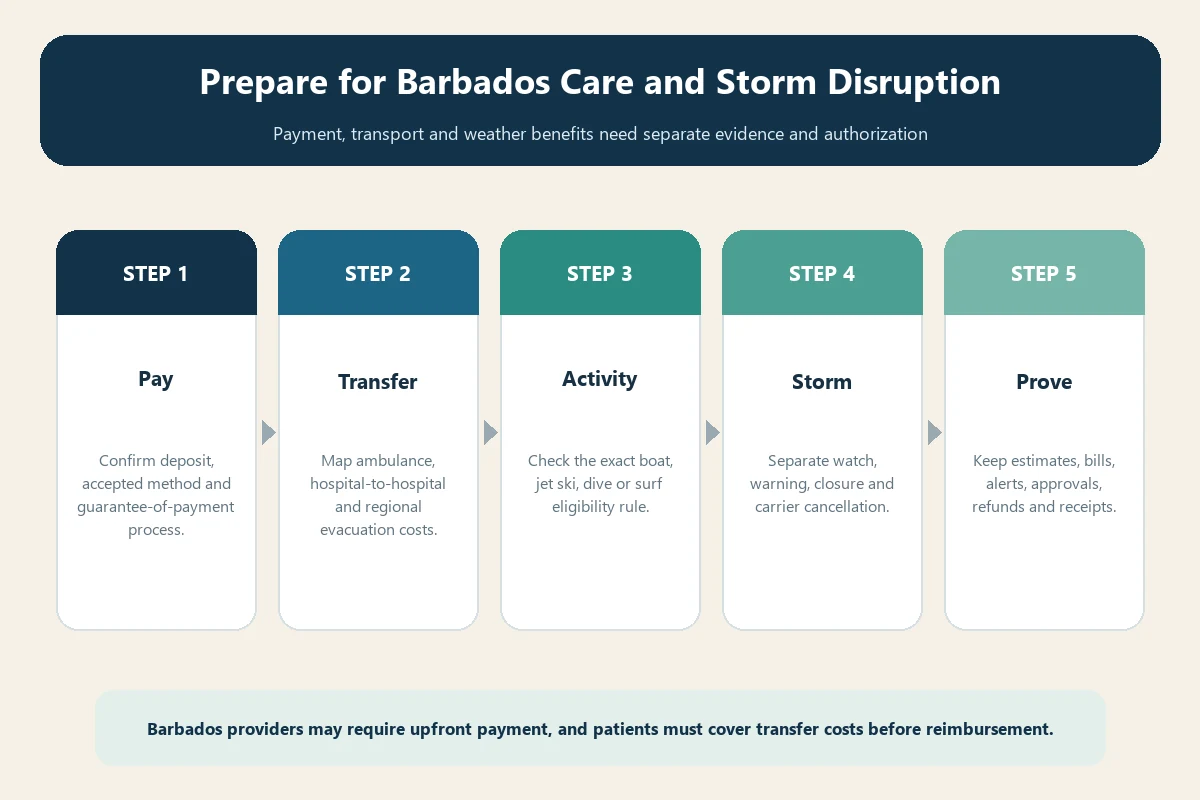
The current U.S. Department of State Barbados travel guidance says medical care is good for the region, but transport can take hours. Its health section also states that hospitals and doctors require upfront payment before service or admission, and patients must cover transfer costs to or between hospitals.
Those facts make a large emergency-medical limit only the beginning. Ask how the policy handles a deposit, guarantee of payment, transfer authorization and later reimbursement. The health insurance abroad guide provides questions for testing a U.S. plan before relying on it overseas.
Ask about payment before a medical emergency
Contact likely private facilities or ask the lodging provider for current practices. Confirm the deposit amount or estimate method, accepted cards or cash, currency, proof of insurance and refund process. Ask whether the facility accepts an insurer’s guarantee of payment and how long approval normally takes.
A travel policy may reimburse eligible care without persuading the hospital to admit a patient without payment. Keep financial flexibility, but avoid carrying unsafe cash. Give a companion secure access to the payment method, policy and consent information in case the patient cannot manage the transaction.
Request an itemized estimate before nonurgent treatment. At discharge, obtain the clinical note, diagnosis, prescriptions, final itemized bill, proof of payment and deposit reconciliation. A card receipt alone rarely establishes what service was medically necessary.
Control currency and deposit reconciliation
Ask whether an estimate is quoted in Barbadian or U.S. dollars and which exchange rate the provider uses. Save the original charge, card statement and any foreign-transaction fee as separate records. Do not convert every amount manually on the claim form without preserving the source document.
Determine whether a card transaction is a temporary authorization, completed charge or open-ended guarantee. At discharge or transfer, obtain a document showing how the deposit was applied. If part is refundable, record the amount, method and expected date, then keep the later card statement.
An insurer normally evaluates the traveler’s actual unreimbursed loss. Submitting the original deposit after a partial release can overstate the claim. Maintain a small ledger with provider invoice, deposit, final charge, refund, health-plan payment and remaining balance.
Separate ambulance care from transfer logistics
The State Department notes limits on what ambulance attendants may do during transport. That makes the first call and destination important. Ask the assistance team whether it maintains local provider and transport contacts, but follow local emergency instructions rather than delaying urgent care for coverage confirmation.
Break a serious case into four stages: response to the traveler, transport to the first facility, transfer to a higher-level hospital and possible regional or U.S. evacuation. Ask who selects the receiving facility, who confirms a bed, which physician certifies need and whether the companion can travel.
The emergency medical evacuation guide distinguishes a medically necessary move to adequate care from a traveler’s wish to fly home. Check insurer control, destination language, medical escort, companion travel and return-home benefits.
Test assistance with a payment-and-transfer case
Give each insurer identical facts: a traveler near the south coast needs urgent assessment, the facility requests payment before admission and the clinician later recommends transfer. Ask which calls must occur, how a guarantee is issued and what to do if the hospital will not wait.
Then ask about a case outside the main tourist corridor at night. How does assistance locate transport? Can it arrange interpretation? What happens when the receiving hospital has no capacity? Record each answer by benefit rather than accepting a general promise of “24-hour help.”
The assistance line versus claims guide explains the handoff between coordination and reimbursement. Preserve the case number, representative name, instruction and time of every call.
Audit water activities by exact facts
Barbados trips often include snorkeling, diving, surfing, jet skis, sailing or party cruises. The State Department warns that tourism safety inspections can be uneven and specifically advises careful assessment of recreational water activities. Confirm the operator’s legal name, safety briefing, equipment, guide qualifications and emergency plan.
Read exclusions for underwater activity, motorized watercraft, racing, professional participation and alcohol. A beach rental and guided excursion may be evaluated differently. The adventure activity exclusions guide shows how to match the real activity to definitions and optional coverage.
For a boat day, classify the vessel as scheduled carrier, excursion craft or private charter. Record the route, passenger list, weather cancellation term and last safe return. If an incident occurs, preserve the operator report, witness contacts and treatment referral.
Build storm evidence from official sources
The official Barbados Meteorological Services site publishes forecasts, bulletins and marine information. The National Hurricane Center preparedness hub explains watches, warnings and tropical cyclone hazards. Use these sources with airline, cruise, hotel and tour notices.
Create a dated chronology: first trip payment, policy purchase, forecast development, named-storm date, watch or warning, airline action, lodging closure, evacuation instruction and traveler decision. A hurricane-season booking is not automatically a covered loss, and coverage purchased after a storm becomes foreseeable may exclude that storm.
The weather-delay guide connects official information to carrier and time thresholds. Ask the policy about severe weather, natural disaster, mandatory evacuation, destination uninhabitability and common-carrier delay.
Classify closures and replacement costs
A beach closure, rough-sea cancellation, airport delay and uninhabitable hotel create different records. Ask the responsible supplier for its decision and refund in writing. Do not treat a forecast, voluntary change and carrier cancellation as the same trigger.
Before departure, a defined covered reason may support cancellation of prepaid nonrefundable costs. After departure, unused arrangements and added return travel may be interruption. Waiting for replacement transport may be delay after a threshold. Use the delay, interruption and cancellation guide to assign each receipt by timing.
Supplier refunds, credits and card reversals reduce the claimed amount. Preserve both the original booking and the final refund decision, even when the supplier says processing will take weeks.
Audit road travel and the rental agreement
Barbados drives on the left. Confirm the driver eligibility, local permit process, liability, collision protection, theft, tires, towing and replacement rules. Record whether narrow rural roads or certain surfaces affect the rental contract.
The rental-car abroad guide separates vehicle damage from traveler injury and unused bookings. Photograph the vehicle and agreement, obtain police or roadside documentation and contact the rental company before arranging nonemergency towing.
Prepare the evacuation document packet
A regional or U.S. medical transfer may require passport details, clinical records, receiving-facility acceptance and immigration or aviation coordination. Carry a valid passport even when a cruise itinerary permits another document; an emergency return by air can require it. Store encrypted copies where a companion can reach them.
Ask the assistance team who obtains medical clearance, selects the aircraft and coordinates the ground ambulance at each end. Confirm whether the patient needs a visa or transit permission for a proposed regional receiving country. Do not purchase an ordinary flight for a patient who may require oxygen, a stretcher or medical escort without clinician and carrier approval.
Record the sending physician, receiving physician, bed acceptance, aircraft operator and authorization number. If the first destination declines the case, preserve that refusal and the reason a different facility was chosen. These records explain both necessity and added distance.
Give a companion a payment role
Assign one person to speak with clinicians and another to track estimates, deposits and insurer calls. Provide consent, allergies, policy number and secure payment access. Ask about companion airfare, bedside lodging, dependent return and return of baggage before booking replacement travel.
A companion’s hotel or flight is not automatically eligible because the patient’s transfer is approved. Request written instructions and note any medical certification requirement. Keep the patient’s transport bill separate from the companion’s commercial itinerary.
Compare policies with one Barbados scenario
Use identical traveler ages, dates and prepaid costs. Include a coastal hotel, rental car, guided watersport, hospital deposit, inter-hospital transfer, medical evacuation possibility and storm-canceled flight.
- How does assistance handle upfront payment and proof of insurance?
- Who approves each ground or air transport stage?
- Are the exact water activities and operators eligible?
- Which official storm event can trigger a trip benefit?
- What vehicle losses are included or excluded?
- Which records and notification deadlines control the claim?
Build the claim chronology
Keep the provider estimate, diagnosis, itemized bill, deposit proof, reconciliation, transport record, receiving-hospital acceptance, activity report, official alert, supplier notice, refund and replacement receipt. Record currency and the actual card conversion.
The travel insurance claim guide provides a sequence for coordinating the U.S. health plan, travel insurer and suppliers. Disclose every reimbursement and submit only the eligible balance.
If the U.S. plan must review first, obtain its explanation of benefits or written denial. Label every record with service date and provider. This prevents an ambulance receipt, hospital deposit and evacuation estimate from being treated as duplicate or unexplained charges.
Bottom line
The strongest Barbados plan connects access to payment, transport authority and appropriate care. Verify the deposit process, build each transfer stage, audit water activities and preserve official storm timing. That operational detail matters more than a generic list of high limits.
