
Travel insurance coordinates with Medicare according to the travel policy’s “other insurance” clause, Medicare’s own payer rules, the service location, and any Medicare Advantage or Medigap contract. Do not submit every bill to every insurer at once. Identify who must decide first, obtain the Explanation of Benefits or denial, calculate the remaining eligible balance, and then submit the secondary claim with the first payer’s determination.
This article is educational, not legal, medical, billing, financial, or insurance advice. Coordination rules vary by service and contract. Ask Medicare, the plan, and travel insurer to confirm the order in writing for the actual claim.
Key takeaways
- “Primary” means first in the claim sequence, not automatically better or more generous.
- Original Medicare, Medicare Advantage, Medigap, employer, retiree, credit-card, and travel policies can have different roles.
- A secondary insurer commonly needs the first payer’s EOB or denial.
- Foreign hospital, local ambulance, evacuation, trip interruption, and baggage can follow separate payer paths.
- Total reimbursement cannot exceed the eligible loss.
Reviewed: August 16, 2026.
Coordination of benefits is an order
Medicare describes coordination of benefits as determining who pays first when a person has Medicare and other health coverage. The first payer processes the claim under its rules. A second payer can consider the remaining eligible amount under its own contract.
Secondary does not mean it pays every unpaid dollar. It can apply a separate deductible, limit, exclusion, allowed amount, or proof requirement.
Travel insurance “other insurance” clause
Read the certificate’s other-insurance, coordination, excess, primary, secondary, recovery, and subrogation sections. A policy can make emergency medical secondary to other valid coverage while treating evacuation or trip cancellation differently.
The declarations or sales comparison should not replace the full clause.
Original Medicare domestic care
For eligible care in the United States, Original Medicare may be the first health payer, subject to Medicare coverage and cost sharing. The travel policy can require the Medicare Summary Notice before considering remaining eligible expenses.
A domestic trip cancellation or baggage claim is not submitted to Medicare because Medicare is health coverage, not trip protection.
Original Medicare foreign care
Original Medicare generally does not cover health care outside the United States except for narrow border, Alaska-through-Canada, residence, and cruise situations. When no exception applies, a Medicare denial or proof of noncoverage may still be required by a secondary travel policy.
Our Medicare in Europe guide explains the foreign baseline.
Narrow foreign exception
If a service might fit Medicare’s foreign hospital rules, the beneficiary may need CMS-1490S because the foreign provider is not required to file. Medicare’s determination can affect Medigap and travel-insurance processing.
Do not request a blanket denial without explaining the service, location, route, and exception. The contractor needs the relevant facts.
Medicare Advantage
A Medicare Advantage plan replaces Original Medicare’s claim administration for enrolled services and can add plan-specific worldwide emergency, urgent, or transportation benefits. Use the plan’s claim process and Evidence of Coverage.
A national insurer can issue many different MA contracts. Submit the exact plan’s EOB or denial to the travel insurer.
Medigap
Medigap supplements Original Medicare and certain plans have a limited foreign emergency benefit. It is not a Medicare Advantage plan. A Medigap carrier may need the Medicare decision or may process foreign emergency charges under its own instructions.
Ask whether Medicare, Medigap, or the travel policy receives the foreign claim first. Prior Medigap foreign claims can reduce a lifetime maximum.
Employer and retiree coverage
An active-employment or retiree plan can coordinate with Medicare under federal and plan rules. The employer plan may cover foreign care, use a global assistance vendor, or remain secondary. Do not assume retiree coverage follows active-employment rules.
Contact the benefits administrator and Medicare’s Benefits Coordination & Recovery Center as appropriate. Keep the group plan EOB.
TRICARE, VA, and other government benefits
Military, veterans, Medicaid, and other government programs have their own eligibility and foreign-care rules. A travel insurer’s “other insurance” clause can still require their decision. Confirm with the program rather than assuming Medicare controls.
A benefit available only at specific facilities may still require documentation of noncoverage or access.
Credit-card travel benefits
A credit card can cover trip delay, cancellation, baggage, rental collision, or limited emergency services. It is not normally a replacement for Medicare medical coverage. The card benefit can be excess and require use of the card for the booking.
Disclose the card benefit and obtain its payment or denial when the travel policy requires it.
Primary travel medical coverage
A policy described as primary can allow the traveler to submit eligible medical expenses directly without first seeking payment from another health insurer. It still applies its own deductible, exclusions, and allowed charges and can seek recovery from another source under the contract.
Primary status does not guarantee direct billing or broader coverage. Our primary versus secondary travel medical guide explains the basic comparison.
Secondary travel medical coverage
A secondary policy commonly requires the primary payer’s EOB or denial. If Medicare does not cover the foreign care, the travel insurer can ask for proof. If Medicare pays part, the travel insurer evaluates the remaining balance.
Secondary coverage can still be valuable, but the claim has an extra step.
Explanation of Benefits is not a bill
An EOB or Medicare Summary Notice shows how a payer processed charges, what was allowed, what it paid, and what may remain. It does not itself prove the provider’s current balance or the traveler’s payment.
Keep the itemized provider bill, EOB, and proof of payment as separate documents.
Foreign denial letter
When Original Medicare clearly does not cover a foreign service, ask the travel insurer what proof it accepts. It might require a Medicare Summary Notice, written Medicare response, policy evidence, or another document. Do not assume a phone note is enough.
Submit only truthful claims. Do not file CMS-1490S for obviously unrelated services merely to manufacture a denial without insurer guidance.
Direct billing does not settle coordination
A travel assistance company can guarantee payment to a foreign hospital before all payer order is resolved. The insurer can later coordinate or seek another payer’s decision. The traveler can remain responsible if the claim is excluded.
The direct-billing guide explains authorization versus final adjudication.
Local ambulance and hospital
An ambulance supplier and hospital can issue separate claims. Medicare may cover a qualifying domestic ambulance while the travel policy addresses an excluded distance, but only under each contract. A foreign local ambulance can follow the travel medical benefit.
Keep run sheets and provider-specific EOBs.
Medical evacuation is a separate lane
Evacuation benefits often operate as an arranged service rather than reimbursement after another insurer. The travel insurer can require its assistance company to approve and coordinate transport. Medicare ambulance rules focus on covered origins, destinations, and medical necessity, not general repatriation.
Do not delay emergency stabilization while resolving payer order. For later transfer, contact assistance before arranging it when reasonably possible.
Trip interruption after medical care
The hospital bill, new flight, companion hotel, and unused tour follow different benefits. Medicare may process the medical service but never the unused cruise cabin. Submit each expense to the proper payer.
The trip interruption guide explains the cost ledger.
Build a payer table
| Expense | Potential first payer | Second document |
|---|---|---|
| Domestic hospital | Medicare or MA | Travel policy EOB review |
| Foreign hospital | Travel policy or plan-specific coverage | Medicare/MA denial if required |
| Medigap foreign emergency | Contract-specific | Travel policy balance review |
| Evacuation | Travel assistance benefit | Other coverage if clause requires |
| Unused trip | Supplier refund, then interruption | Card benefit if applicable |
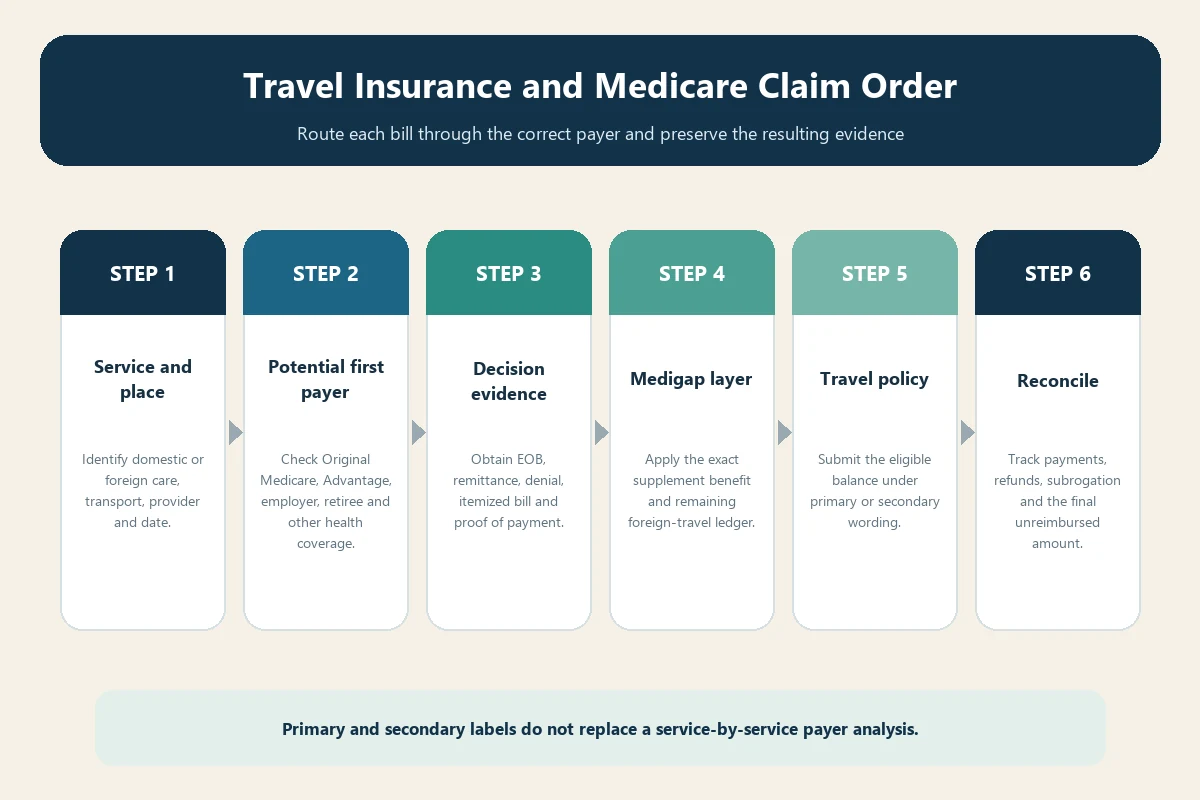
Claim sequence
- Seek medically necessary care.
- Notify travel assistance as soon as reasonably possible.
- Identify all potential payers.
- Confirm claim order in writing.
- Submit the itemized bill to the first payer.
- Obtain EOB or denial.
- Calculate the remaining provider balance.
- Submit the second claim with the first decision.
- Report later refunds or payments.
- Reconcile total recovery with actual eligible loss. Keep a deadline log for every payer; waiting for one decision does not automatically extend another insurer’s notice, proof-of-loss, appeal, or filing period.
Document packet
- All insurance cards and certificates
- Itemized provider bills
- Medical and transport records
- Proof of payment
- Medicare Summary Notice or plan EOB
- Medigap or employer EOB
- Travel insurer claim and correspondence
- Currency and translation records
- Supplier refunds and credits
- Final provider balance statement
The claim documentation guide helps index the file.
Questions to ask
- Is emergency medical primary or secondary?
- Which other insurance must decide first?
- What proof of Medicare foreign noncoverage is accepted?
- Does Medigap receive the claim before the travel policy?
- How does Medicare Advantage change the order?
- Is evacuation coordinated separately?
- Can assistance guarantee payment before the EOB?
- How are deductibles and coinsurance treated?
- What happens if another payer responds after the claim is paid?
- Which deadlines apply while waiting for the first payer?
Three coordination examples
U.S. emergency during a domestic trip
A traveler with Original Medicare and a secondary travel medical policy receives emergency treatment in another state. The provider usually bills Medicare first when it accepts Medicare. After Medicare processes the service, the Medicare Summary Notice shows the approved amount, Medicare payment, and patient responsibility. The traveler then sends that notice, the itemized provider bill, proof of any payment, and the travel insurer’s claim form to the secondary carrier. The carrier applies its own eligible-expense definition, deductible, exclusions, and limits. It does not simply pay every dollar shown as patient responsibility.
Overseas hospital where Medicare does not apply
A traveler is treated in a country outside the United States and none of Medicare’s narrow foreign-care exceptions fits. The hospital may require a deposit or full payment. The travel policy may still ask for evidence that Medicare provides no benefit for the loss. That evidence might be the Medicare publication describing foreign limits, a written payer response, or a formal claim decision, depending on the certificate and adjuster instructions. Get the insurer’s direction in writing before sending a Medicare claim that is certain to be rejected or before assuming that no denial is necessary.
Medicare Advantage emergency abroad
A Medicare Advantage plan may include worldwide emergency or urgent-care benefits, but the rules are plan-specific. The traveler should contact the number on the plan card, follow any notification requirements, and ask whether the foreign provider must submit a claim or the member must request reimbursement. When travel insurance is secondary, its adjuster will commonly need the plan’s EOB or denial. A generic statement that Medicare does not cover foreign care is insufficient when the traveler’s private Medicare Advantage contract may provide it.
Why eligible expenses can differ between payers
Coordination does not mean every payer uses the same definition of a covered expense. Medicare may approve a medically necessary professional service under its rules while a travel policy evaluates whether the event was sudden, unexpected, during the covered trip, and outside an exclusion. Conversely, a travel policy might cover an overseas emergency that Original Medicare generally does not. Each payer can also use different fee allowances, deductibles, coinsurance, network rules, benefit maximums, and documentation standards.
This is why claimants should keep the original billed amount, contractual adjustment, allowed amount, amount paid by the first payer, patient responsibility, and any provider refund as separate figures. Do not alter a receipt to show only the balance. A clean reconciliation lets the next adjuster see exactly how the remaining amount arose and reduces requests for clarification.
Do not confuse noncoverage with nonpayment
A zero payment can have several meanings. The service might be excluded, the deductible may not have been met, the provider may need to correct coding, the claim may be missing information, or the expense may be payable by another insurer first. Read the reason codes and remarks on the EOB or Medicare Summary Notice. A secondary carrier may treat a true coverage denial differently from a pending claim, a duplicate submission, or an amount applied to a deductible.
If the first decision appears incorrect, ask whether the travel claim can remain open while an appeal or corrected claim is pending. Preserve every deadline. Keep a deadline log for every payer; waiting for one decision does not automatically extend another insurer’s notice, proof-of-loss, appeal, or filing period.
When a provider sends a refund later
Coordination continues after the initial claim payment. A hospital may later correct a bill, Medicare or another plan may reprocess a claim, or the provider may refund an overpayment. Notify the travel insurer when a later payment changes the net loss. The policy may contain recovery, reimbursement, or subrogation provisions that prevent payment above the eligible expense. Keep the check stub, revised account ledger, and updated EOB so the adjustment can be traced.
Protect the medical and trip-benefit records separately
A medical emergency can trigger several policy benefits, but they require different evidence. Travel medical reimbursement may need clinical records and an EOB. Medical evacuation may require advance coordination by the assistance company. Trip interruption may require proof that a physician advised the traveler to stop the trip, plus unused bookings and new transportation receipts. Do not place all costs on one unexplained spreadsheet line. Label each charge by patient, date, provider, currency, benefit requested, first payer, and current status.
Before travel: create a coordination sheet
- List Original Medicare or the exact Medicare Advantage plan and member-services number.
- List Medigap, employer, retiree, credit-card, and travel policies separately.
- Record whether the travel medical benefit describes itself as primary, secondary, or excess.
- Save claim addresses, online portals, time limits, and assistance numbers offline.
- Ask what evidence is accepted when a foreign expense is outside Medicare coverage.
- Confirm whether preauthorization or assistance-company approval is required for evacuation.
These questions should be answered from current plan and policy documents, not from a sales-page summary. If wording conflicts, request a written explanation from the relevant administrator and retain it with the certificate.
FAQ
Does Medicare always pay before travel insurance?
No. The service, location, Medicare arrangement, and travel policy determine order.
What if Medicare does not cover care abroad?
The travel insurer can still require documentation of noncoverage before processing a secondary claim.
Can both policies pay the full bill?
No. Coordination prevents recovery above the eligible loss.
Is evacuation part of Medicare coordination?
It can involve another-insurance clauses, but travel evacuation and Medicare ambulance coverage are distinct benefits and workflows.
Bottom line
Coordinating travel insurance with Medicare is a document sequence. Identify the payer for each expense, obtain the first EOB or denial, submit the eligible balance to the next payer, and reconcile every later payment. Treat evacuation, trip interruption, and baggage as separate lanes.