
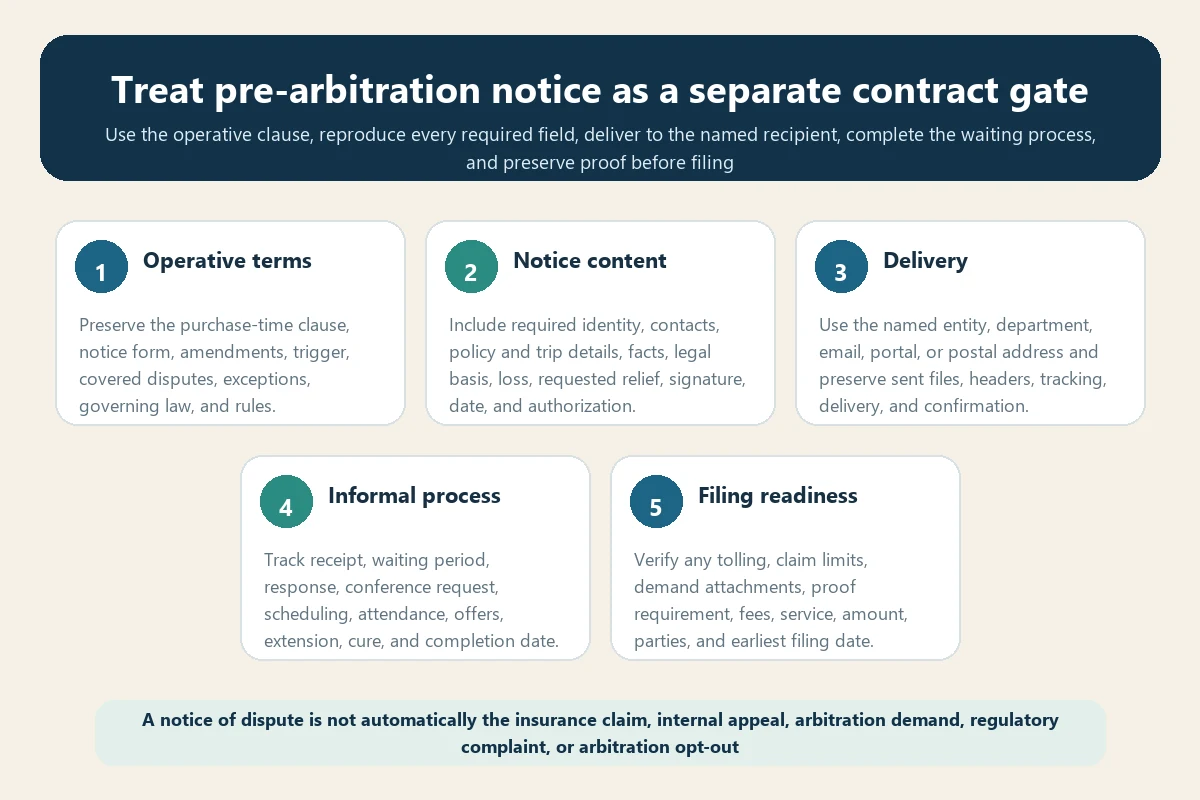
Travel insurance arbitration notice of dispute requirements can create a separate contractual step before an arbitration demand is filed. The clause may specify individualized content, a personal signature, a named recipient, a delivery method, a waiting period, and an informal conference.
This notice is not automatically the insurance claim, internal appeal, arbitration demand, regulatory complaint, or arbitration opt-out. This U.S. consumer guide explains how to build a compliant and provable notice record; it is not legal advice.
Begin with the purchase-time dispute terms
Preserve the policy or certificate, plan description, booking terms, website terms, confirmation email, amendments, claim correspondence, and incorporated arbitration rules. Identify which entity issued each document and which terms the purchaser accepted.
Search for “notice of dispute,” “informal resolution,” “pre-arbitration,” “condition precedent,” “mandatory conference,” and “individualized notice.” Use the operative version, not today’s webpage.
Separate the notice from the insurance claim
An insurance claim asks for benefits under the policy and usually requires proof of loss. A notice of dispute describes an unresolved controversy and seeks informal resolution before arbitration. One submission may not satisfy the other.
Preserve claim number, benefit, denial, appeal result, and dispute notice as separate indexed documents.
Separate the notice from an internal appeal
An internal appeal asks the insurer to reconsider a claim determination under its appeal process. The arbitration clause may require an additional notice after that appeal, before a demand can be filed.
Map each prerequisite, recipient, deadline, and completion event. Do not assume that sending an appeal to a claims examiner reaches the legal-notice address.
Separate the notice from the arbitration demand
The arbitration demand starts the administered case and triggers filing requirements and fees. A pre-dispute notice ordinarily precedes that filing and may need to be attached as proof of compliance.
The arbitration demand guide covers party identification, clause attachment, claim statement, relief, service, fees, and filing confirmation.
Identify whether the step is mandatory
Read verbs, conditions, exceptions, consequences, and severability language. “Must” or “condition precedent” may signal a mandatory step, while encouragement to negotiate can operate differently.
Do not decide enforceability from wording alone. Governing contract law, federal arbitration law, the proper decision-maker, substantial performance, prevention, waiver, cure, and prejudice arguments may matter.
Study an insurance-platform example
Credible Insurance’s published terms illustrate a detailed informal process: individualized notice, specified contact information, personal signature, authorization when represented, named delivery channels, proof responsibility, and a waiting period before arbitration or litigation.
This is an example of why exact compliance matters, not a template for another insurer or platform.
Copy the required identity fields
Requirements can include full legal name, mailing address, email, telephone number, account email, policy or certificate number, booking reference, trip dates, and claimant relationship. Use consistent names across the policy, claim, notice, and demand.
Include only necessary personal information and use a secure permitted channel. Never add full payment-card or medical identifiers unless required and appropriately protected.
Describe the dispute precisely
State the policy benefit, covered event, claim submission, insurer decision, disputed exclusion or requirement, key evidence, internal appeal, and remaining disagreement. Use dates and document references.
A concise chronology is more useful than a long narrative. Separate facts, policy language, legal theory, and requested resolution.
Calculate the requested relief
List unpaid benefit, policy limit, deductible, prior payment, refund, credit, interest, statutory amount, fees, costs, and nonmonetary request separately. Explain the source of each amount and avoid double recovery.
The requested relief in the notice should reconcile with the later demand or explain any change.
Use any required personal signature
Some clauses require a personally signed verification rather than counsel’s signature. Others require authorization allowing account information to be shared with a representative during negotiations.
Identify whether electronic signature is accepted and preserve the signed original, final PDF, filename, and creation date.
Send to the named recipient
The required recipient may be a legal department, registered agent, dedicated email, postal address, or portal—not the claims adjuster. Reproduce the legal entity, department, attention line, and address exactly.
If multiple companies are involved, determine whether separate notices are required. The insurer, administrator, booking platform, and travel supplier may have different clauses.
Follow the permitted delivery method
If email is permitted, preserve the sent item, full headers, attachments, server response, and bounce status. For postal delivery, preserve the notice, envelope, postage, tracking, delivery event, and signature where available. For a portal, preserve screenshots and confirmation numbers.
Using an extra method can create backup evidence but may not cure failure to use the mandatory channel.
Prove receipt or sending as required
Some clauses start the waiting period on receipt; others use sending or delivery. Quote the trigger and record its date, time, and time zone.
Create a one-page proof index containing the operative clause, final notice, transmission, delivery, response, and calculated completion date.
Calculate the waiting period carefully
Identify calendar or business days, weekend and holiday treatment, extensions, earliest filing date, and any agreement to continue discussions. Do not assume every contract uses 30 or 60 days.
The arbitration timeline guide helps put receipt, negotiation, conference, cure, completion, and demand dates on one control ledger.
Prepare for an individualized conference
A clause may allow or require telephone or video discussion with the consumer personally present, with counsel if represented. Record who may request it, scheduling duties, attendance, confidentiality, and completion rules.
Prepare a settlement range, nonmonetary options, policy citations, evidence gaps, and authority to resolve. Do not disclose privileged advice unnecessarily.
The arbitration settlement guide helps preserve deadlines, separate negotiation materials, define authority, document terms, and avoid treating an informal offer as a final resolution. Confirm any agreement in a complete signed writing.
Document good-faith participation
Preserve scheduling emails, proposed dates, attendees, occurrence or nonoccurrence, agreed extensions, and a neutral completion note. Protect confidential settlement communications under applicable rules.
The AAA’s Consumer Due Process Protocol guide encourages mediation and other informal resolution while recognizing their voluntary and flexible character. Contract-specific mandatory steps should still be analyzed separately.
Track any cure request
If the recipient identifies missing fields, signature, authorization, or delivery defects, preserve the response and cure promptly. State whether the supplement relates back to the first notice without assuming the legal result.
Keep every version and do not overwrite the original record.
Do not assume limitations are tolled
Some clauses expressly toll specified limitation periods during informal resolution. Others do not. Identify contractual, statutory, policy, court, and arbitration deadlines separately.
Quote the tolling language, start event, end event, covered periods, and any exclusions. Obtain case-specific advice when a right may expire.
Check exceptions for small claims or emergency relief
A clause may exempt small-claims filing, provisional court relief, injunctions, or specified disputes from pre-notice. Others apply the notice to every forum. Read the exceptions before filing.
The small-claims option guide helps audit amount, parties, venue, service, timing, and control of any pending arbitration.
Identify who decides notice sufficiency
The contract may assign compliance disputes to a court or arbitrator. A delegation clause, current administrator rules, and governing law can affect the decision-maker.
The Insurance Information Institute’s published terms of use provide an example stating that a court decides notice sufficiency. Again, use only the operative clause for the actual dispute.
Prepare the demand attachment packet
Before filing, assemble the arbitration clause, notice, delivery proof, response, conference record, waiting-period calculation, any cure, and a declaration or chronology if needed. The document exchange checklist helps index and protect the supporting record. Redact unrelated sensitive information.
Confirm current demand form, fees, service, party names, amount, and requested relief.
Keep settlement and merits records distinct
Informal settlement discussions may be protected or inadmissible, while policy and claim evidence remains part of the merits. Store negotiation materials separately from the demand exhibits.
A failed negotiation does not prove coverage, bad faith, or entitlement to the requested amount.
Avoid common notice-of-dispute mistakes
- Using current terms instead of purchase-time terms.
- Treating the insurance claim or appeal as the dispute notice.
- Sending to an adjuster instead of the named recipient.
- Combining several consumers in an individualized notice.
- Omitting a signature, authorization, or required identifier.
- Using an unapproved delivery channel.
- Calculating the waiting period from the wrong event.
- Ignoring a required conference or cure response.
- Assuming all deadlines are automatically tolled.
- Filing a demand without the compliance proof packet.
Final notice-of-dispute checklist
- Preserve the operative clause, forms, and amendments.
- Identify mandatory language, exceptions, and decision-maker.
- Copy every identity, policy, trip, and dispute field.
- State facts, policy basis, loss, and requested relief clearly.
- Complete signature and representative authorization requirements.
- Use the named recipient and permitted delivery method.
- Preserve sending, receipt, response, and cure evidence.
- Complete the waiting period and any conference.
- Verify tolling and every independent deadline.
- Attach a clean compliance packet to the later demand.
A professional notice of dispute is a traceable contract event, not a generic complaint letter. It reproduces the operative requirements, states an individualized dispute and remedy, reaches the correct recipient, completes the informal process, and leaves durable proof for any later filing.
