
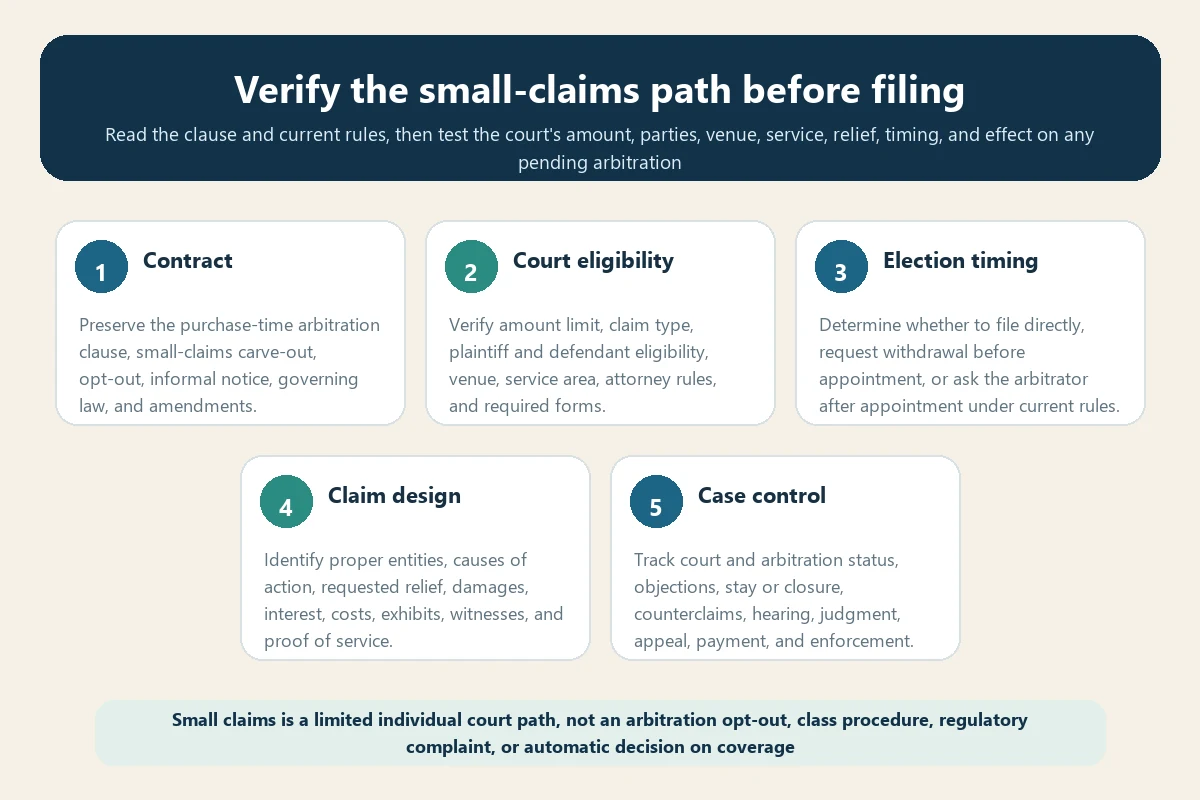
Travel insurance arbitration small claims option language may allow an eligible individual dispute to proceed in small-claims court instead of arbitration. That permission does not create court jurisdiction; the chosen court’s current amount, party, venue, service, and claim rules still control.
The timing of the election also matters, especially if an AAA case has already begun or an arbitrator has been appointed. This U.S. consumer guide provides a document-first framework, not legal advice or a recommendation that one forum is always better.
Start with the operative arbitration clause
Preserve the policy or certificate, plan description, booking terms, assistance agreement, confirmation email, amendments, and incorporated rules. Identify which entity issued each document and which clause governs the dispute.
Quote the small-claims language exactly. Note amount, individual-only wording, court location, appeal or transfer consequences, informal notice, and whether either party may elect the option.
Read current AAA Rule R-9
The current AAA Consumer Arbitration Rules state that either party may take a qualifying claim directly to an appropriate small-claims court without first filing with AAA. The rule also addresses elections after an arbitration is filed.
Use the edition governing the actual case. Do not rely on an older rule number, summary, or forum practice.
Understand the 2025 procedural change
AAA’s official 2024–2025 rules update explains that disagreements about whether a claim should be withdrawn to small claims are now decided by an arbitrator rather than through an AAA administrative determination.
This distinction matters. Before an arbitrator is appointed, the rule provides one route; after appointment, a disputed request can require an arbitrator’s decision.
Separate direct filing from transfer after filing
Direct filing means starting in a qualifying small-claims court before initiating arbitration. Transfer or withdrawal means an arbitration already exists and a party asks that the dispute proceed in small claims.
Record the arbitration filing date, answer date, appointment date, court filing date, notices, objections, fees, and rulings. Avoid creating two active cases over the same claim without addressing case control.
Verify the court’s monetary limit
Small-claims limits vary by state, court, claimant type, and sometimes claim category. Calculate principal damages, statutory damages, interest, attorney fees, costs, and requested nonmonetary relief as the court requires.
Do not reduce a claim casually to fit the limit. Determine whether filing waives recovery above the cap and document the decision.
Check claim-type eligibility
Some courts limit small claims to money judgments or exclude particular claims, injunctions, declaratory relief, defamation, class claims, assigned claims, or complex matters. Travel insurance disputes can involve contract, statutory, or claim-handling theories with different requirements.
Use the court’s official forms and instructions. Identify every element and requested remedy before filing.
Identify the proper plaintiff
The purchaser, cardholder, named insured, covered traveler, beneficiary, estate, or assignee may have different rights. Match the claimant to the policy benefit and alleged loss.
Preserve the declarations page, itinerary, payment record, beneficiary designation, assignment, and probate documents where relevant.
Identify the correct defendant
A travel protection package may involve an insurer, underwriter, administrator, producer, booking platform, assistance company, and travel supplier. The company that denied the claim may not be the only or proper defendant for every theory.
Use legal names, state registrations, policy roles, contracts, and denial correspondence. Do not serve a brand name when the court requires a legal entity and registered agent.
Establish venue and personal jurisdiction
Check where the defendant resides or does business, where the contract was made or performed, where the loss occurred, and any contract venue provision. Small-claims venue rules are local and specific.
The U.S. Department of Transportation’s consumer page, Air Travelers: Tell It to the Judge, recommends researching local small-claims courts and notes that procedures and attorney participation vary. It concerns air travel generally, so use it as orientation rather than insurance-specific authority.
Plan service before filing
Determine permitted service methods, registered-agent details, address, service deadline, proof requirements, and costs. Some courts arrange service; others require the claimant to do so.
Build a service packet with summons, complaint, exhibits, instructions, tracking, affidavit, and court acceptance. Defective service can delay or end the case.
Complete any mandatory informal notice
The arbitration clause may require a pre-dispute notice, negotiation period, individualized demand, or specified recipient before either arbitration or small claims. Determine whether the carve-out excuses or preserves those steps.
The arbitration demand guide helps distinguish an arbitration filing from a contractual notice of dispute. Use the document title and recipient required by the actual clause.
Prepare a concise insurance claim theory
State the policy benefit, covered event, exclusion disputed, required proof, claim history, denial rationale, appeal, amount, and relief. Tie each fact to an exhibit.
Small claims is simplified, not evidence-free. Preserve the issued policy rather than relying only on marketing summaries.
Build the damages worksheet
Separate covered loss, policy limit, deductible, prior payment, refund, credit, mitigation, interest, statutory amount, filing fee, service cost, and any other requested item. Avoid double recovery.
The worksheet should reconcile exactly to the amount on the court form and explain any cap or abandoned excess.
Organize exhibits and witnesses
Create an indexed packet: declarations page, policy, itinerary, receipts, carrier records, medical documents where necessary, claim form, insurer requests, submissions, denial, appeal, correspondence, and damages summary.
Redact unnecessary personal and medical information according to court rules. Confirm whether witnesses may appear remotely or require subpoenas.
Compare arbitration and court procedures
Compare filing cost, service, location, remote access, attorney participation, evidence rules, information exchange, hearing format, decision timing, available relief, appeal, confidentiality, and enforcement. Use current official sources.
The arbitration cost guide separates administrator fees from party expenses. A lower filing fee does not alone determine total burden.
Account for counterclaims and transfer
A defendant may raise a counterclaim, challenge venue, contest eligibility, remove or transfer where permitted, or seek arbitration. Determine how those actions affect the small-claims court’s authority and the arbitration case.
Preserve every response and order. Do not assume the initial filing guarantees the case stays in that forum.
Study a current travel-related example
In Maggi v. International Travel Network, the federal court noted that the arbitration clause preserved an individual small-claims exception while analyzing formation and unconscionability.
The example shows that small-claims language can affect enforceability analysis, but the result depends on the actual contract, court, claim, and governing law.
Do not confuse small claims with opt-out
An arbitration opt-out rejects the arbitration agreement under a contractual process. A small-claims option preserves a limited court path for an eligible individual claim even when arbitration otherwise applies.
The opt-out guide covers deadline, notice, delivery, proof, and scope. Keep the records separate.
Do not confuse small claims with a complaint
A state insurance department complaint asks a regulator to review conduct within its authority. Small claims asks a court to decide an individual case and enter available relief.
The complaint versus arbitration guide helps map regulatory and private tracks. One process may not pause another’s deadline.
Control parallel cases
If arbitration is pending, notify the administrator and other party as required, request the correct closure or ruling, and preserve fee consequences. If court is pending, disclose related matters when required.
Track case numbers, status, deadlines, hearings, orders, and settlement discussions in one ledger.
Keep every deadline on separate rows
A court filing may not pause the policy’s suit limitation, an arbitration answer, an internal appeal, a statutory period, or a contractual notice deadline. Record the authority for every claimed stay or extension rather than assuming one forum controls the other.
The arbitration timeline guide helps track triggers, due dates, service, objections, hearings, and rulings. Add the small-claims filing, service deadline, response date, hearing, appeal period, judgment, and enforcement dates to the same master chronology.
Plan judgment and enforcement
Before filing, identify how judgments are entered, appealed, paid, recorded, or enforced. Confirm whether the defendant has an agent, assets, or payment process in the jurisdiction.
A judgment does not always produce automatic payment. Preserve satisfaction documents and avoid duplicate enforcement.
Avoid common small-claims mistakes
- Assuming the arbitration clause itself creates court jurisdiction.
- Using an outdated monetary limit or court form.
- Naming a brand instead of the proper legal entity.
- Filing in a convenient but improper venue.
- Ignoring pre-dispute notice and service rules.
- Starting court and arbitration without case control.
- Missing the significance of arbitrator appointment timing.
- Seeking relief the small-claims court cannot award.
- Submitting an unorganized or over-redacted evidence file.
- Confusing small claims with opt-out or regulatory complaint.
Final small-claims option checklist
- Preserve the operative contract and current arbitration rules.
- Quote the small-claims carve-out and timing language.
- Verify amount, claim type, parties, venue, and service.
- Identify the proper plaintiff and defendant.
- Complete required informal notice.
- Build a reconciled damages worksheet.
- Organize exhibits, witnesses, and privacy redactions.
- Coordinate any pending arbitration and court case.
- Track counterclaims, transfer, hearing, and judgment.
- Preserve appeal, payment, and enforcement deadlines.
A reliable small-claims election joins two rule sets: the contract and arbitration rules that permit the path, and the court rules that make the case eligible. Both must be satisfied, documented, and coordinated with the underlying travel insurance proof.
