
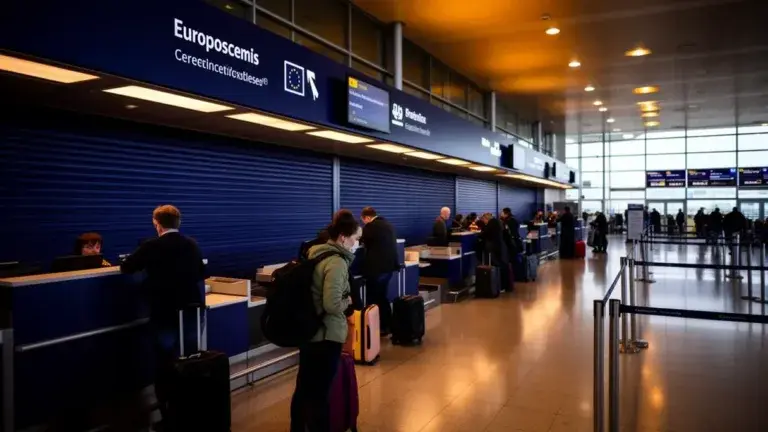
Most comprehensive travel policies do include strike as a covered event for trip cancellation, trip delay and missed connection. What decides an airline strike claim is almost never whether strikes are mentioned in the wording, but whether the strike was already publicly known before your policy took effect. Insurance covers the unforeseen, and once industrial action has been announced or reported it is treated as a known event, which excludes it for any policy bought afterwards.
That makes the timing of your purchase, rather than the timing of your flight, the controlling fact. A policy bought the week before a strike is called usually responds. A policy bought after the union announced the dates usually does not, even though both travelers face identical disruption.
The known-event rule and how the cut-off is set
The exclusion typically reads along the lines of losses arising from an event that was known, publicised or foreseeable before the policy effective date. Applied to industrial action, insurers generally look for the point at which the action entered the public domain. Depending on the wording, that can be the date a union announced a ballot result, the date formal notice of a strike was given, or the date it was widely reported.
Some plans define this explicitly, stating that strike cover applies only where the policy was purchased before the strike was advertised or before notice of intent was given. Where the definition is explicit, there is little room for argument. Where it is not, the question becomes an evidential one about what was public and when, which is a weaker position for a claimant.
Why the policy effective date is not always the purchase date
Cancellation cover usually starts on the day after purchase or on a stated effective date, while medical and delay cover often start on the departure date. A strike announced in the gap between those two dates can therefore be treated differently by different benefits within the same certificate. Check which date governs each benefit rather than assuming a single start date applies throughout.
| Scenario | How policies usually treat it |
|---|---|
| Strike announced or reported before your policy effective date | Typically excluded as a known or foreseeable event |
| Strike called after your effective date, and it cancels your flight | Typically falls to cancellation or delay, if strike is a listed cause |
| Air traffic control or ground handler strike, not your airline’s staff | Usually assessed the same way; the foreseeability test still governs |
| You cancel because a strike might be called | Usually not covered without a Cancel For Any Reason upgrade |
| Airline reroutes you and you arrive late but complete the trip | Delay benefit at most, subject to the waiting period |
Where strike cover actually sits in the policy
Strike is not a standalone benefit. It appears as a listed cause inside several benefits, each with its own test.
- Trip cancellation. Usually requires the strike to cause a complete cessation of services by your carrier for a stated period, not merely a reduced schedule or the risk of one.
- Trip delay. Requires the delay to exceed the plan’s waiting period and reimburses additional meals, accommodation and local transport rather than the value of lost time.
- Missed connection. Requires an inbound service to run late by more than a stated minimum, causing you to miss a departure.
- Trip interruption. Applies if the strike occurs after you have departed and makes continuing the trip impossible.
The relationship between these benefits is set out in our comparison of delay, interruption and cancellation.
What remains excluded even when strike cover exists
- Cancelling pre-emptively. Deciding not to travel because a strike may be called is a personal choice, not a cessation of services. Without a CFAR upgrade, that is generally an uninsured decision.
- Amounts recovered elsewhere. Anything the airline refunds, rebooks or pays for is deducted. Insurance covers the unrecovered balance, not the original ticket price.
- Expenses the carrier provided. Meals and hotel rooms supplied by the airline are not additional out-of-pocket costs.
- Delays below the waiting period. A long, expensive wait that finishes short of the stated hours produces nothing.
- Airline insolvency. Financial failure of a carrier is a different peril from industrial action and is excluded from many plans or treated under a separate, often optional, benefit.
- Consequential losses. Missed meetings, lost earnings and non-refundable items unconnected to the covered benefit are generally outside the cover.
The wider set of clauses that operate alongside these is in our standard exclusions guide.
The airline’s obligations come first
Before the insurer is involved, the carrier’s own duties apply, and most policies expect you to pursue them. Under US carrier practice, cancellation or a significant schedule change generally entitles a passenger who declines the alternative to a refund of the unused fare, and carriers publish their own commitments for care during controllable disruptions.
For flights departing the EU, and for flights into the EU on an EU carrier, air passenger rights rules require the airline to offer rerouting or a refund and to provide care such as meals and accommodation during a long delay, regardless of the cause. Whether additional cash compensation is payable depends on whether the disruption counts as an extraordinary circumstance, and in that analysis courts have distinguished between strikes by an airline’s own staff and external actions such as air traffic control strikes. The UK operates a comparable regime. These are the airline’s obligations, not your insurer’s, and claiming them first is normally a precondition of the insurance claim rather than an alternative to it. Our guide to cancelled flight claims covers the order of recovery in more detail.
Documentation a strike claim needs
- Written confirmation from the carrier stating the cause of the cancellation or delay and the actual scheduled and revised times.
- Evidence of what the airline refunded, rebooked or provided, including any vouchers.
- Your original booking confirmation showing the date of purchase.
- Your policy documents showing the effective date, which is what establishes the strike was unforeseen at the time.
- Itemized receipts for every additional expense claimed.
The proof of purchase date is the item travelers most often omit and the one most likely to settle the foreseeability question in your favor. If you are buying while industrial relations at your carrier are already tense, our guide to purchase timing and deadlines explains which cover starts when.
What this means: Buy before industrial action becomes public, keep proof of the purchase date, and treat the airline as the first payer. Once a strike has been announced, a new policy will not cover it, and the only pre-departure route left is a Cancel For Any Reason upgrade bought inside its own purchase window.
Frequently asked questions
Does travel insurance cover an airline strike announced after I booked but before I insured?
Usually not for that strike. The reference point is the policy effective date, not the booking date, so a gap between booking flights and buying insurance is exactly where cover is lost. Buying the policy close to the first trip payment removes this gap and also preserves access to time-sensitive upgrades.
Are air traffic control strikes treated differently from airline staff strikes?
For insurance purposes the analysis is usually the same, since what matters is whether the action was publicly known before your policy took effect and whether it caused a cessation of your carrier’s services. The distinction between an airline’s own staff and third parties matters more for airline compensation regimes than for the policy wording.
If the airline rebooks me on a later flight, do I have a claim?
Possibly, but only for costs you actually incurred and were not reimbursed for, and only if the wait exceeded the delay benefit’s waiting period. If the airline covered your meals and accommodation, there are no additional out-of-pocket expenses to claim, whatever the length of the delay.
Can I cancel and claim if I think the strike will spread?
Not under a standard policy. Cancellation benefits respond to events that have occurred, not to the risk that they might, and pre-emptive cancellation is treated as a personal decision. A Cancel For Any Reason upgrade is the only common mechanism that pays a share of costs in that situation, and it must be bought in advance.
