
Travel insurance lightning flight cancellation coverage depends on the booked flight’s documented consequence—not merely on lightning near an airport. A thunderstorm can stop exposed ramp work, block a route, trigger a ground stop, divert an aircraft, or require inspection after a suspected strike. Each path creates different evidence and may lead to delay rather than cancellation.
This U.S. guide explains how to preserve the safety alert, operational response, carrier decision, policy terms, airline remedy, and net expense. It is educational, not meteorological, aviation, workplace-safety, mechanical, legal, medical, or insurance advice.
Lightning cancellation coverage at a glance
- Save the thunderstorm alert, lightning location, airport, route, and time window.
- Separate a ramp shutdown from an airspace reroute or aircraft inspection.
- Get the airline’s final reason and preserve every operational transition.
- Compare the first known threat with policy purchase and effective times.
- Apply cancellation, delay, connection, diversion, or interruption correctly.
- Use airline refunds and claim only documented loss that remains.
Reviewed August 17, 2026.
Lightning creates several different airport disruptions
Lightning is usually one hazard within a thunderstorm. The same storm can also produce heavy rain, hail, turbulence, wind shear, damaging wind, flooding, or a tornado. The airline may therefore use “thunderstorms,” “convective weather,” or “ramp closure” rather than “lightning” in its delay code.
A good claim does not force one label onto every stage. It records the lightning alert, what activity stopped, what happened after reopening, and the final reason the booked flight departed late or canceled.
Personal and worker safety comes first
The National Weather Service’s lightning safety guidance says no place outside is safe when thunderstorms are nearby. When thunder is heard, people should move to substantial shelter or an enclosed metal-topped vehicle and remain sheltered after the last thunder.
Passengers should follow airport and airline instructions and stay out of restricted outdoor areas. Do not walk onto an exposed ramp, leave safe shelter, or drive into a severe storm to preserve an itinerary or collect evidence.
Why airlines stop ramp work
Ramp workers perform baggage handling, fueling, catering, pushback, maintenance support, and aircraft servicing outdoors around conductive equipment. An airline or airport may use a lightning detection threshold to alert workers and suspend exposed operations.
An FAA training presentation on severe-weather avoidance from an airline perspective illustrates a yellow alert when lightning is within five miles and a ramp shutdown at three miles. Local rules vary; preserve the actual carrier or airport notification rather than assuming those distances apply everywhere.
A ramp closure is not an airport closure
During a lightning pause, runways and air traffic control may remain available while fueling, loading, unloading, pushback, or gate service stops. An arriving aircraft may reach the gate but baggage cannot be unloaded. A ready aircraft may wait because ground personnel cannot disconnect equipment safely.
Record the ramp-alert start, affected work, reopening time, backlog, and flight-specific follow-on delay. If the airport formally closes, preserve that separate notice and use our airport closure coverage guide.
Thunderstorms also block air routes
Lightning may signal a convective cell that pilots and controllers avoid. The FAA’s weather-delay FAQ explains how intense thunderstorms can block busy routes, force reroutes, reduce hourly flow, create ground delay programs, holding, diversions, and cancellations.
This airspace path is different from the ramp path. A flight can be fully serviced yet wait for a safe route. Preserve the reroute, ground stop or delay program, assigned departure time, holding, diversion, and recovery notices. See our ATC delay coverage guide.
A suspected aircraft strike creates an inspection path
Commercial transport aircraft are designed with lightning protection, but a suspected strike can still require inspection. The NWS page on lightning and planes explains that inspection for damage can delay a flight.
Preserve the suspected strike announcement, aircraft registration or tail number if publicly displayed, inspection start, finding, maintenance action, aircraft swap, clearance, and final disposition. Do not claim that lightning damaged the aircraft unless the carrier confirms damage. A precautionary inspection establishes only that a check occurred.
Get the final flight-specific reason
Keep the itinerary, confirmation, ticket number, flight number, scheduled times, boarding pass, app messages, emails, text alerts, and gate display. Ask whether the disruption was a ramp lightning pause, convective airspace restriction, suspected strike inspection, confirmed maintenance, inbound aircraft, or crew displacement.
The cause may transition. A ramp closes, reopens, and then the flight cancels because its crew times out. Or an aircraft inspection leads to a swap and baggage transfer. Preserve every stage because different stages can explain different expenses and remedies.
Use airline remedies before insurance
The U.S. Department of Transportation’s current airline refund guidance says a passenger is entitled to a refund when the airline cancels and the passenger does not accept alternative transportation or compensation. Weather being outside the airline’s control does not remove that refund right.
If the airfare is refunded, it is not also an insurance loss. If a safe reroute is accepted, eligible meals, lodging, local transportation, a missed connection, or unused prepaid arrangements may remain. Save the offer, response deadline, traveler’s choice, and final ticket or refund record.
Build a precise known-event timeline
List the trip deposit, later nonrefundable payments, policy purchase, coverage effective time, first relevant thunderstorm forecast, watch or warning, lightning alert, ramp shutdown, ATC initiative, suspected strike, inspection, airline decision, and final arrival.
A policy bought after the storm was forecast or already disrupting the airport may not cover that event. Lightning does not need a named-storm designation to become known. Apply the contract’s foreseeability language and preserve timestamps. See when to buy travel insurance.
Read weather, carrier, and mechanical terms
Search the certificate for weather, inclement weather, severe weather, common carrier, airport closure, cessation of service, air traffic control, mechanical breakdown, delay, missed connection, and destination inaccessible. Read definitions, exclusions, waiting periods, duties, daily caps, and maximums.
Questions to answer include:
- Does a carrier cancellation qualify, or must service stop for a stated period?
- How many hours trigger trip delay?
- Must the airport close, or can a ramp or ATC restriction qualify?
- Does mechanical wording require a confirmed defect rather than inspection?
- Which cause and benefit apply to each separate expense?
- What purchases require advance authorization?
The weather delay guide explains general contract treatment. This page adds lightning-specific ramp and inspection evidence.
Choose the correct benefit
Trip cancellation usually concerns abandoning the trip before departure for a covered reason. Trip delay can reimburse limited necessary costs during a qualifying wait. Missed connection concerns a late arrival that breaks an onward segment. Trip interruption may apply after departure.
A 45-minute ramp pause is not automatically trip cancellation. A strike inspection may create a longer delay. A diversion follows its own chronology. Use the benefit comparison guide before selecting a form.
Document delay expenses
Keep itemized receipts for permitted meals, lodging, local transport, communication, and essential items. Record the date, location, payment method, person covered, and reason. Compare the purchase time with the policy’s minimum wait and per-day cap.
Carrier-provided hotel, meal vouchers, or ground transport reduce the same expense. The trip delay reimbursement guide explains reasonable-cost and receipt rules.
Handle diversions and missed connections
For a diversion, save the storm and route reason, diversion airport, landing time, inspection if any, baggage status, onward transport, and final arrival. Our flight diversion coverage guide explains the transition to delay or cancellation.
For a missed connection, preserve actual segment times, the original connection, missed service, reaccommodation, and arrival. Test the minimum delay and eligible connection type in the missed connection insurance guide.
Build the evidence file by operational path
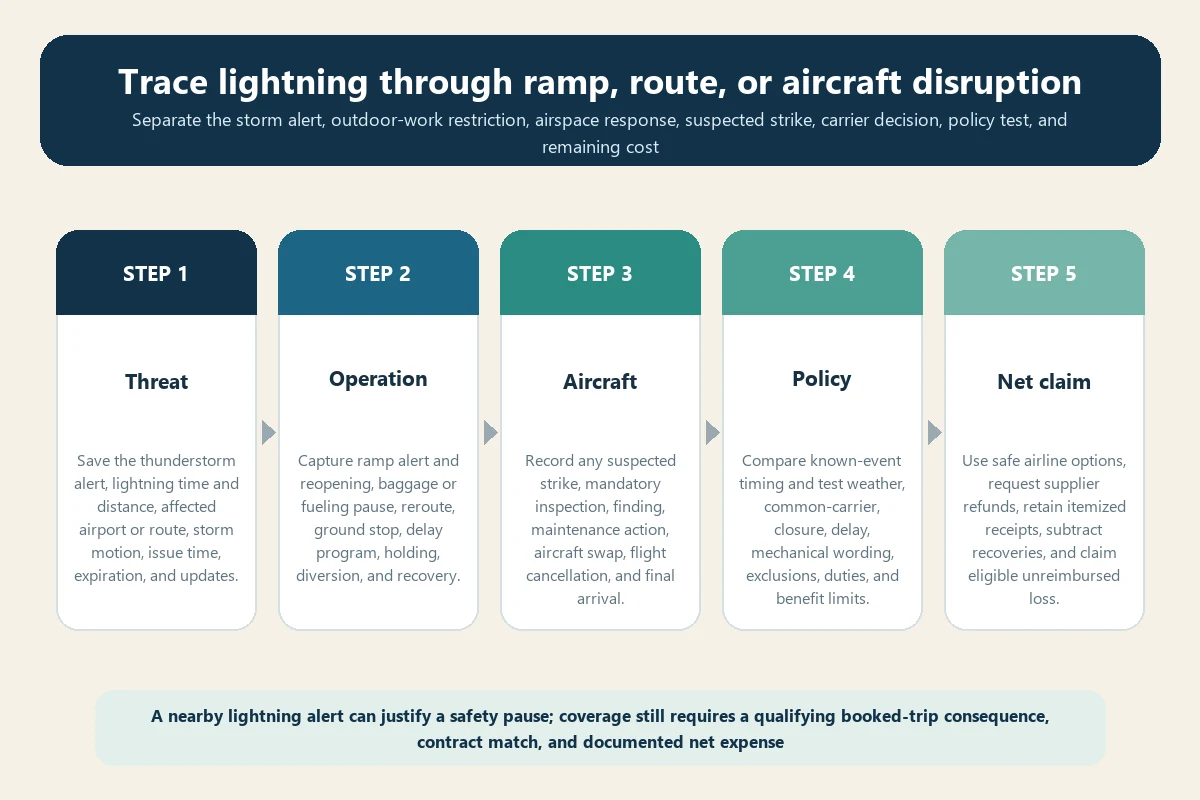
- Threat: forecast, watch or warning, lightning time and distance, airport or route, and updates.
- Ramp: alert level, work stopped, closure time, reopening, backlog, and affected service.
- Airspace: reroute, flow restriction, ground program, holding, diversion, and recovery.
- Aircraft: suspected strike, inspection, finding, maintenance, swap, and final disposition.
- Contract and money: policy timing, threshold, supplier recovery, receipts, and net loss.
Use only the paths that occurred. A claim does not need every category, but it should not substitute one for another. Write a short chronology linking each record to the booked flight and expense.
Calculate only net loss
Create a ledger listing supplier, original charge, service date, currency, refund eligibility, refund requested, refund received, voucher, card credit, replacement purchase, and amount claimed. Separate airfare, lodging, meals, transport, and unused prepaid activities.
Update the insurer if a pending supplier refund later posts. The guide to supplier refunds and insurance recovery explains how to avoid duplicate reimbursement.
Common lightning claim mistakes
- Submitting a lightning screenshot without airport, distance, or timestamp.
- Calling a ramp shutdown a complete airport closure.
- Treating every thunderstorm reroute as a direct lightning strike.
- Claiming aircraft damage when only an inspection occurred.
- Ignoring a later crew, maintenance, or network cause.
- Buying coverage after the storm became known.
- Using trip cancellation for a delay below the required threshold.
- Claiming expenses already refunded, credited, or provided.
File and follow the claim
Notify the insurer within the deadline. Submit the policy, purchase proof, chronology, itinerary, weather and lightning records, ramp or FAA evidence, carrier explanation, inspection or maintenance record if available, supplier correspondence, itemized receipts, and net-loss ledger.
If more evidence is requested, answer the precise question. If coverage is denied, request the cited clause and factual basis, then compare them with the timed operational record. The claim filing guide can organize the package.
Bottom line
Lightning can support travel insurance benefits when it creates the qualifying trip consequence described by the policy. The strongest file identifies whether the disruption occurred on the ramp, in the airspace, or through an aircraft inspection, proves the booked-flight outcome, applies timing and thresholds, uses airline remedies, and claims documented net loss.
Wind shear needs runway-specific alert, flight-maneuver, and final carrier evidence. Use this wind shear flight cancellation travel insurance guide to distinguish an alert from a go-around, hold, diversion, or cancellation, preserve remedies, test thresholds, and claim net loss.
Tornado disruption needs separate warning, shelter, operational, damage, and flight evidence. Use this tornado flight cancellation travel insurance guide to distinguish a watch from a shutdown or physical loss, preserve remedies, test timing and thresholds, and claim net loss.
