
Travel insurance damaged baggage claim decisions depend on who controlled the bag, when damage was reported, whether it can be repaired, how the policy values it, what the airline pays, and who keeps the damaged property. A cracked suitcase, broken camera, and damaged wheelchair do not follow one identical rule.
This U.S. guide explains airport reporting, condition evidence, carrier liability, repair versus replacement, depreciation, salvage, and coordination with travel insurance. It is educational, not legal or insurance advice.
Inspect baggage before leaving the airport
Check the shell, frame, seams, zipper, lock, handles, wheels, straps, contents, and signs of opening. Photograph the bag on the carousel or in the baggage area with the tag visible.
Hidden damage may appear later, but a contemporaneous airport record creates the clearest custody timeline.
Report the damage to the airline immediately
Locate the operating carrier’s baggage desk, not only the ticket seller. Obtain a property irregularity or damage report, claim number, contact details, submission instructions, and copy of everything signed.
The U.S. Department of Transportation’s damaged-baggage guidance tells passengers to file with the airline as soon as possible and explains repair or reimbursement responsibility when damage occurs under airline control.
Preserve baggage tags and the full itinerary
Keep boarding passes, bag-tag stubs, receipts, rebooking records, interline details, and the report. Identify every operating carrier and where the bag changed custody.
Domestic rules can differ from international treaty rules, including on a domestic segment connected to an international itinerary.
Resolve codeshare and interline responsibility
Record the marketing carrier, operating carrier, ticket issuer, baggage-checking carrier, final delivering carrier, and every transfer. Ask which entity accepts the damage report and whether another carrier must inspect or decide it.
Do not let a handoff consume the deadline. Submit timely written notice to each plausibly responsible carrier when responsibility is unresolved, preserve acknowledgments, and request a single lead contact. Keep the through-check tag and ticket coupon sequence because they connect the damaged bag to the full carriage.
Photograph damage systematically
Take wide views of every side and close-ups with scale. Photograph broken components, contents, internal packaging, moisture, residue, punctures, crush points, and serial numbers.
Do not stage damage. Preserve original files and metadata, then create annotated copies for the claim.
Prove pre-trip condition
Use recent photographs, purchase records, repair history, prior-trip images, product registration, and witness observations. Identify scratches or defects that existed before check-in.
An honest baseline helps distinguish new damage from ordinary wear.
Separate suitcase damage from contents damage
Create a row for the bag and a separate row for each damaged item. Record owner, description, age, original price, condition, damage, repairability, value, evidence, exclusion, and claimed amount.
A carrier or insurer may treat fragile contents differently from damage to wheels, handles, straps, or the case itself.
Identify the likely custodian
Damage can occur during airline handling, security screening, ground transport, hotel storage, cruise transfer, tour handling, or theft. Record the last undamaged observation and first damaged observation.
Do not assume the airline caused damage solely because the bag traveled by air.
Use airline recovery before secondary insurance
Many travel policies require the traveler to pursue a carrier or other responsible party first. Submit the airline claim within its deadline and preserve the acknowledgment, inspection, repair offer, payment, voucher, or denial.
The baggage-delay and lost-luggage guide explains related carrier-first documentation, but damaged property requires its own repair evidence.
Understand domestic airline liability
14 C.F.R. §254.4 restricts how low a covered carrier may limit liability for provable direct or consequential damages from lost, damaged, or delayed baggage in domestic transportation.
The regulatory ceiling is not an automatic award. Prove actual loss and check the current amount, route, carrier status, contract, and exclusions.
Check international baggage rules separately
DOT explains that the Montreal Convention governs baggage liability on many international itineraries and uses a per-passenger Special Drawing Rights limit. The current amount and dollar conversion can change.
Determine whether the treaty applies, which carrier is responsible, and what written notice deadline governs damage. Do not borrow a domestic limit for an international claim.
Do not accept outdated liability figures
DOT’s current baggage page lists updated domestic and international figures and explains periodic adjustments. Preserve the version reviewed on the claim date.
A search snippet, old ticket wallet, or archived blog may display a superseded limit.
Evaluate improper packing and pre-existing damage
Preserve how the item was packed, protective materials, manufacturer instructions, check-in warnings, special handling tags, and external damage. Ask the carrier to identify its factual basis for a packing defense.
Weak packaging and rough handling can be disputed competing causes; document both.
Obtain a repairability assessment
Ask a qualified repairer or manufacturer whether repair is safe, functional, cosmetic, economical, and supported by parts. Obtain a written estimate with labor, parts, taxes, shipping, warranty, and turnaround.
Do not repair before the carrier or insurer completes any required inspection unless urgent mitigation is necessary and documented.
Compare repair cost with replacement value
Identify the policy’s valuation measure: repair cost, actual cash value, depreciated value, replacement cost, market value, or another standard. Match a replacement by function and specifications, not a convenient premium upgrade.
Record why repair is unavailable or unreasonable if replacement is requested.
Document depreciation transparently
Record purchase date, original price, age, condition, useful life, prior repairs, comparable used value, and the depreciation schedule applied. Request the insurer’s calculation.
A claim limit caps payment; it does not prove the item’s actual value.
Apply per-item and category limits
Check aggregate baggage, per-item, electronics, jewelry, camera, sports equipment, professional equipment, and high-value sublimits. Identify deductibles and whether they apply per item, occurrence, claim, or trip.
Use the lost-luggage coverage guide to compare common category restrictions while keeping damage-specific proof separate.
Handle security-screening damage separately
If evidence points to TSA screening, preserve inspection notices, lock condition, photographs, airport, checkpoint or bag route, and airline response. TSA provides an official claims process for alleged property loss or damage during screening.
Filing with TSA does not automatically preserve airline or insurance deadlines. Calendar each process independently.
Protect assistive-device claims
A wheelchair, walker, prosthetic, hearing device, CPAP, or another disability-related device may receive different treatment from ordinary baggage. Preserve make, model, serial number, original price, custom configuration, repair urgency, loaner cost, and functional impact.
DOT’s assistive-device damage guide explains that domestic airline liability is not governed by ordinary baggage caps in the same way.
Mitigate without destroying evidence
Prevent water intrusion, isolate broken batteries, secure sharp edges, back up data, and obtain necessary temporary equipment. Photograph the condition before and after reasonable mitigation.
Keep removed parts and invoices. Emergency safety measures should be proportionate and documented.
Confirm salvage and ownership before surrender
A payer may request the damaged item after a total-loss payment or account for salvage value. Ask who owns it after payment, who pays shipping, what happens to personal data, and whether surrender is a condition.
Do not discard, sell, donate, or surrender the item until inspection and ownership requirements are confirmed in writing.
Protect personal data on electronics
Before surrendering a phone, laptop, camera, drive, or smart device, ask whether evidence can be preserved while accounts, encryption keys, payment credentials, and personal data are securely removed.
Document the approved process. Destructive wiping can affect proof; unprotected surrender can expose sensitive data.
Reconcile every recovery source
Track airline payment, repair, replacement, TSA outcome, travel insurer, credit-card benefit, homeowners or renters insurance, warranty, retailer remedy, chargeback, voucher, salvage, and refund.
The subrogation and recovery guide helps reconcile later payments without duplicate recovery.
Distinguish cash, voucher, repair, and replacement
Compare face value, restrictions, expiration, taxes, shipping, warranty, deductible, depreciation, and ownership consequences. A larger voucher is not necessarily equal to cash.
Obtain the settlement terms and release before accepting.
Submit one itemized insurance claim
Include the issued policy, itinerary, baggage tags, airport report, photographs, pre-trip evidence, purchase proof, repair assessment, airline outcome, item matrix, other recoveries, and requested amount.
Use the travel-insurance claim-filing guide to index the submission and preserve delivery proof.
Calendar notice and proof deadlines
Airline, treaty, TSA, card, and insurance deadlines can differ. Give prompt notice even when repair estimates or carrier decisions remain pending.
The notice and proof-of-loss guide explains how to document outstanding evidence without silently missing a deadline.
Create a damaged-property matrix
Use columns for item, owner, custodian, pre-trip condition, damage, report, repairability, repair cost, replacement, depreciation, policy limit, carrier outcome, other recovery, salvage, current location, and final disposition.
Keep ordinary baggage and assistive devices in separate sections.
Questions for each payer
- Which contract, policy, regulation, or treaty governs this route and item?
- Must the property be inspected before repair or disposal?
- How are repairability, replacement, and depreciation calculated?
- Which exclusions, sublimits, deductibles, and deadlines apply?
- Who owns and stores the item after a total-loss payment?
- How will other payments, salvage, vouchers, and recoveries be credited?
Practical takeaway
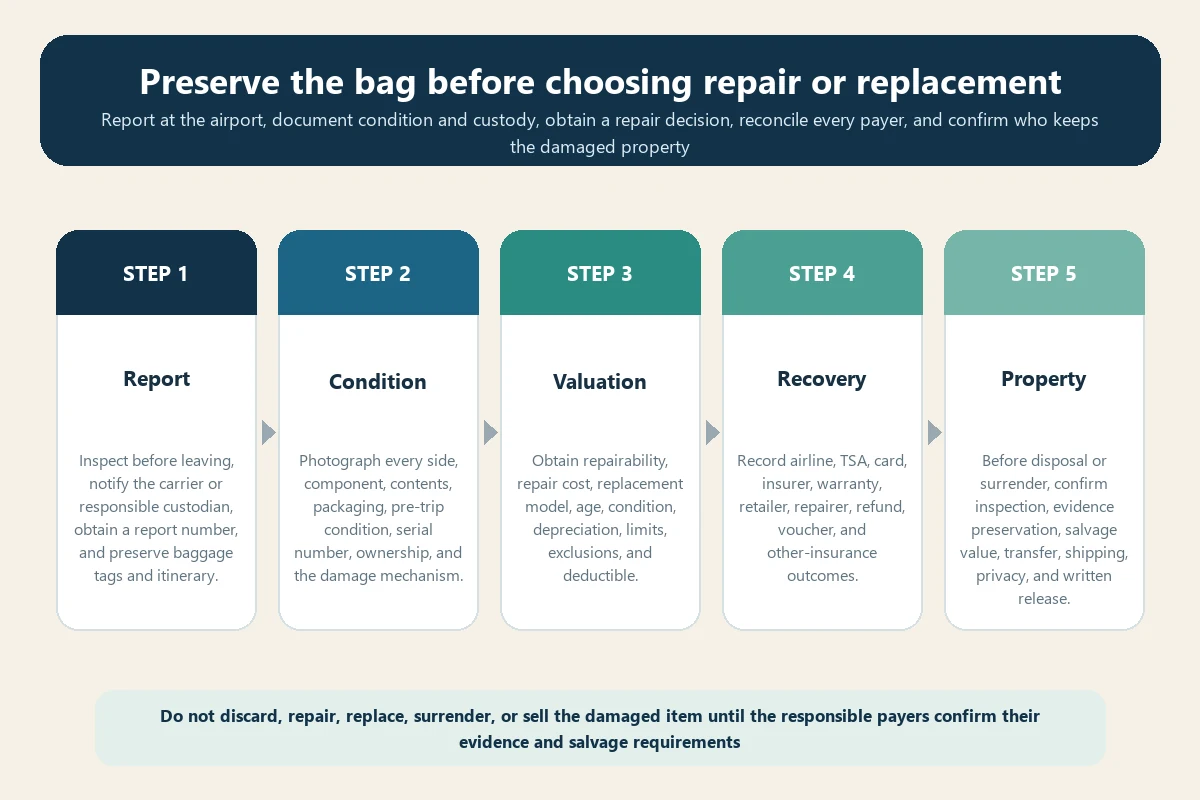
For a travel insurance damaged baggage claim, inspect and report before leaving the airport, preserve the custody and condition record, pursue the responsible carrier, and obtain a repair-versus-replacement assessment tied to the policy’s valuation standard.
Then reconcile every payer and confirm salvage, ownership, data, and disposal in writing. Do not surrender the evidence—or seek duplicate payment—before the complete recovery picture is documented.
An airline bankruptcy filing, flight cancellation, and insured financial default are different events. Use this travel insurance airline bankruptcy coverage guide to identify the correct supplier, policy trigger, refund route, and remaining insured loss.
A flight diversion is not automatically a cancellation or an insured loss. Use this travel insurance flight diversion coverage guide to document the alternate-airport timeline, airline response, policy trigger, missed connection, expenses, and net loss.
