
Travel insurance airline bankruptcy coverage is not activated merely because an airline files a court petition or appears in alarming news. The policy may require a defined “financial default,” a complete cessation of operations, an eligible travel supplier, timely insurance purchase, and an actual nonrefundable loss.
This U.S. guide separates insurance from airline refunds, credit-card disputes, and bankruptcy claims. It is educational, not legal or insurance advice. Read the certificate and current court notices for the named company involved.
Start with the exact policy wording
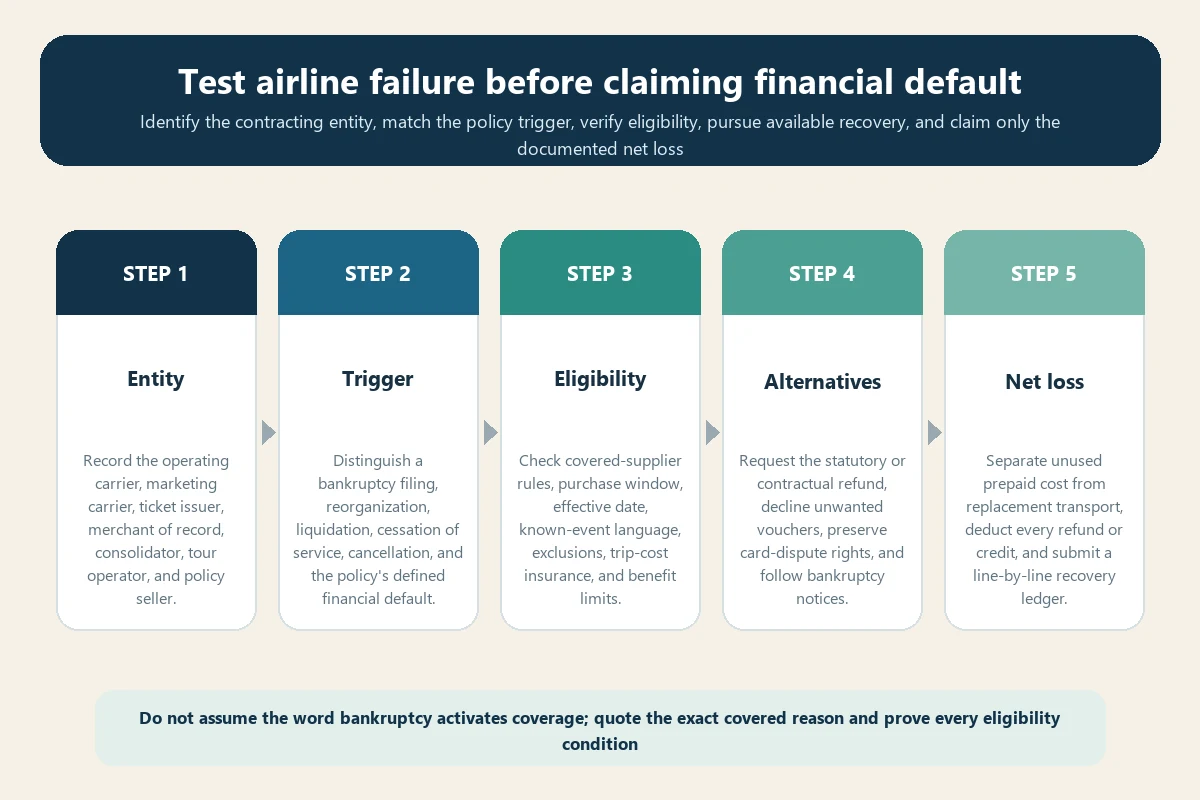
Search the certificate, declarations, and endorsements for financial default, insolvency, bankruptcy, cessation of operations, supplier failure, common carrier, travel supplier, covered reason, and exclusions. These phrases are not interchangeable.
A policy may cover financial default only under trip cancellation, only under trip interruption, or not at all. Another may define the event but exclude the company that sold the policy. Build the claim from the contract, not a marketing summary.
Bankruptcy filing does not always mean airline collapse
The U.S. Courts explains that Chapter 11 generally permits reorganization; a debtor commonly remains in possession and may continue operating while proposing a plan. Therefore, a Chapter 11 headline alone does not prove that flights stopped or that a policy definition was met.
Chapter 7 generally concerns liquidation. Even then, the relevant contractual date may be the filing date, an order, a service suspension, or the date operations cease. Record each date instead of selecting the most favorable one.
Identify every company in the transaction
An itinerary can name several entities: the marketing airline, operating airline, ticket issuer, codeshare partner, travel agency, consolidator, tour operator, package organizer, and card merchant. The company in court may differ from the company holding the traveler’s money.
Save the e-ticket receipt, 13-digit ticket number, confirmation, card statement descriptor, agency invoice, fare rules, package terms, and operating-carrier details. Match the policy’s definition of travel supplier to the legal entity whose failure caused the loss.
Test the covered-supplier requirement
Some plans use a list of covered suppliers. Others define eligibility by location, licensing, years in business, or whether the supplier was in financial default when insurance was purchased. A parent company, franchise, affiliate, regional operator, and brand may not be treated as one insured supplier.
Ask the administrator in writing which entity it evaluates, whether that entity qualifies, and which policy provision controls. Do not accept an unexplained statement that “airline bankruptcy is covered.”
Check the purchase window after the first trip payment
Financial-default protection can be time-sensitive. The policy may require purchase within a stated number of days after the initial trip deposit and coverage of the full eligible nonrefundable trip cost. Later additions may require prompt updates.
Prepare a dated ledger of the first deposit, every later payment, the insurance purchase, premium changes, and the first public warning about the airline. Our guide to when to buy travel insurance explains why the first-payment date matters.
Apply known-event and foreseeability language carefully
Insurance generally protects against uncertain future events, subject to its wording. If insolvency, route suspension, missed payroll, regulator action, or a public shutdown announcement existed before purchase, the insurer may examine whether the loss was known or foreseeable.
Preserve the purchase timestamp and the sources available at that moment. Do not backdate knowledge, and do not rely on a later article to describe what was reasonably knowable earlier.
Separate cancellation from interruption
Before departure, a covered default may produce a trip-cancellation claim for eligible unused, prepaid, nonrefundable arrangements. After departure, trip interruption may address unused arrangements and necessary additional transportation, but its covered reasons and limits can differ.
Keep replacement airfare in a separate row from the original unused ticket. The trip interruption guide explains why the two amounts should not be combined.
Request the airline or ticket-agent refund first
The U.S. Department of Transportation states that a consumer is entitled to a refund when an airline cancels a flight and the consumer declines the alternatives. Its airline refund guidance also explains automatic-refund timing and treatment of vouchers or credits.
Send a written refund request to the entity that took payment. Save the cancellation notice, response, refund status, and whether an offered voucher was accepted. A theoretical refund and a refund actually received should be labeled separately.
Preserve credit-card dispute rights
Contact the card issuer promptly if paid services will not be delivered. Ask which federal or contractual dispute path applies, where written notice must go, and the deadline measured from the statement containing the charge. Do not wait for an insurance decision if that would consume a card deadline.
A provisional credit is not necessarily final. Track the dispute number, temporary credit, merchant response, final decision, and any reversal. Report the result to the insurer.
Escalate the correct problem to the correct organization
A DOT aviation complaint can document an unresolved airline or ticket-agent refund issue, but it does not decide a private insurance claim or distribute a bankruptcy estate. A state insurance department may accept complaints about an insurer or administrator, but it does not replace the policy appeal or a court deadline.
Record each complaint number, submission date, response, and requested remedy. Keep regulatory complaints separate from the insurer’s proof-of-loss package, the card issuer’s dispute, and the bankruptcy docket so one process is not mistaken for another.
Follow the bankruptcy case separately
A traveler may be an unsecured creditor for an unpaid refund or undelivered service. The U.S. Courts’ bankruptcy process overview explains that distributions depend on the case and claim process. Court notices, schedules, bar dates, and the debtor’s claims agent control—not social-media instructions.
Determine whether the traveler is correctly scheduled and whether a proof of claim is required. If it is, use the court-designated process; the judiciary publishes Official Form B 410. Filing does not guarantee recovery, and legal advice may be appropriate.
Do not recover the same dollar twice
Insurance, an airline refund, agency refund, card chargeback, bankruptcy distribution, voucher, and another policy can concern the same expense. Most reimbursement claims turn on the remaining eligible loss.
Use the reconciliation method in our supplier refunds and subrogation guide. Disclose pending recovery as pending, then update the insurer when it becomes final.
Build a net-loss ledger
Create one row per charge. Include traveler, supplier legal name, service, travel date, payment date, amount, currency, merchant, refundable amount, voucher, chargeback, bankruptcy recovery, insurance requested, and balance. Attach a source document to every figure.
For a $900 ticket with a final $500 card recovery, the gross charge remains $900 but the remaining ticket loss is $400 before other policy terms. If a replacement flight costs $1,100, do not automatically claim $1,500; original-ticket loss and extra transportation require separate benefit analysis.
Handle packages, consolidators, and tour operators
A package invoice can hide who holds each payment. Obtain an allocation for airfare, lodging, transfers, fees, and commissions. Ask whether the organizer must replace the airline service or refund it under the package contract.
If the tour operator remains able to perform with a substitute carrier, the airline’s bankruptcy may not create a loss. Conversely, default of an intermediary may not satisfy a provision limited to a common carrier. Follow the money and the performance duty.
Handle award tickets and travel credits
For award travel, separate cash taxes and fees from miles. Document who owns the loyalty account, whether miles were redeposited, redeposit fees, program terms, and whether the policy recognizes points as insured trip cost.
A voucher has an issuer, face value, restrictions, expiration, and market usefulness. Do not call it cash, but do not omit it. Explain whether it replaces the canceled service and whether accepting it affected refund rights.
Document the causal chain
The claim should connect the defined event to the cancellation or interruption and then to each dollar. Include the court filing or official company notice, cessation evidence if required, original itinerary, cancellation, unavailable service, mitigation attempts, replacement bookings, refund responses, and recovery ledger.
Use the structured workflow in our travel insurance claim guide. Label evidence rather than sending an unindexed mailbox export.
Ask for a provision-specific decision
If the claim is denied, request the exact definition, covered-reason provision, exclusion, eligibility condition, relied-on facts, calculation, and appeal method. Determine whether the dispute concerns the event, supplier, timing, insured cost, other recovery, or proof.
Contract interpretation and deadlines may depend on governing law and forum. Our guides to choice-of-law clauses and suit-limitation clauses explain why appeal activity should not be assumed to stop every deadline.
Airline bankruptcy claim checklist
- Certificate, declarations, endorsements, and purchase confirmation
- Exact financial-default or supplier-failure provision
- Initial deposit and insurance-purchase timeline
- Legal names of carrier, seller, issuer, and merchant
- Ticket, invoice, itinerary, fare rules, and cancellation notice
- Official filing, operations, and claims-agent notices
- Refund requests, voucher choices, and card-dispute record
- Replacement transportation and mitigation evidence
- Bankruptcy claim status and any distribution
- Line-by-line net-loss reconciliation
Bottom line
Travel insurance airline bankruptcy coverage depends on the exact supplier, defined trigger, purchase timing, exclusions, and remaining loss—not the headline alone. Identify every contracting entity, preserve refund and dispute rights, follow official court notices, and submit a transparent ledger that prevents duplicate recovery.
A flight diversion is not automatically a cancellation or an insured loss. Use this travel insurance flight diversion coverage guide to document the alternate-airport timeline, airline response, policy trigger, missed connection, expenses, and net loss.
A government shutdown, an FAA action, an airline cancellation, and an insured covered reason are distinct facts. Use this travel insurance government shutdown flight cancellation guide to preserve refund rights, test policy wording, document expenses, and calculate net loss.
A jet-fuel shortage needs a supplier-first and timing-specific analysis. Use this travel insurance fuel shortage coverage guide to preserve airline refunds, identify the underlying event and known-date cutoff, test policy wording, and calculate net loss.
