
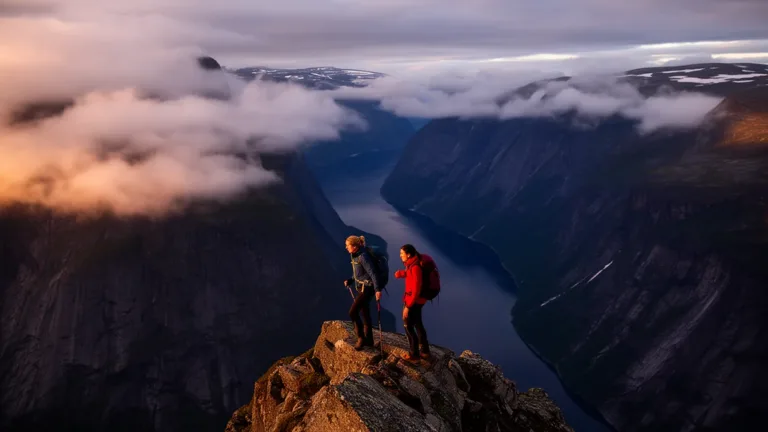
Travel insurance for Norway is not required at the border for US passport holders, who enter visa-free for short stays, but Americans cannot use the European Health Insurance Card there and are billed as private patients. Norway is not in the EU but is inside the Schengen Area and the European Economic Area. What shapes a Norwegian claim is distance: the country is long, thinly populated in the north and cut by fjords, so cost depends on how far a rescue has to reach and move you.
Key facts
- Norway is in the Schengen Area and the EEA but not the EU; US passport holders enter visa-free for short stays.
- Schengen visa nationals need at least EUR 30,000 of medical cover valid across Schengen; US citizens are not asked at the border.
- Americans cannot use the European Health Insurance Card in Norway and are billed as private patients.
- Search and rescue and medical evacuation are separate benefits with separate limits; evacuation cover does not pay for a search.
- Svalbard is outside Schengen and has limited medical facilities; confirm your policy names it and covers search and rescue.
- CDC advises considering travel health and medical evacuation insurance for what regular insurance will not cover.
For a US traveler neither point is the one that matters most. What shapes a Norwegian claim is distance. The country is long, thinly populated in its northern half and cut through by fjords and mountains, and the cost of an incident there is driven by how far someone has to travel to reach you and how far you then have to be moved.
Schengen, the EEA, and where a US traveler stands
Because Norway is in Schengen, the Schengen insurance requirement applies to visa nationals: at least EUR 30,000 of medical cover, valid across the Schengen area, covering emergency treatment and repatriation. US passport holders travel visa-free for short stays and are not asked to produce a policy at the border.
Because Norway is in the EEA, visitors from EU and EEA countries can use the European Health Insurance Card to access state care on resident terms. A US resident cannot hold that card. The effect is the familiar one across Europe: much of the reassuring advice online is written for people with an entitlement Americans do not have.
Norway’s public system also charges patient contributions to its own residents for many services, so “covered” in a Norwegian context does not mean free even for locals. A visitor without an EHIC is outside the arrangement entirely and is billed as a private patient.
Search and rescue is not the same benefit as medical evacuation
These two are the most confused items in any policy sold for an outdoors trip, and in Norway the distinction does real work.
Search and rescue refers to finding and reaching a person who is lost, overdue or stranded, and moving them to safety. Emergency medical evacuation refers to transporting a patient who has already been reached to a facility that can treat them, or onward to their home country. They are separately defined, separately capped, and frequently sold separately. A policy with a generous medical evacuation limit may say nothing at all about the cost of a search.
Who bears the cost of a rescue varies by country and by the organization carrying it out, and it is not safe to generalise from one European country to another. The question your policy can answer, and the one to settle before departure, is narrower: does this policy pay search and rescue costs, up to what limit, and does it pay them for the activity I am actually going to do. Our guide to medical evacuation limits explains how the evacuation side is normally structured and why the limit is so often separate from the medical maximum.
What this means: Read the two benefits as separate lines with separate limits, because that is how they are written. A policy that covers evacuation is not automatically a policy that covers the cost of finding you.
Activity definitions decide more claims than limits do
Norway sells its landscape, and the activities travelers book there are exactly the ones policies scrutinise. Glacier walking, via ferrata, ski touring and anything off marked pistes, kayaking on open water, climbing, and winter driving on mountain routes all appear in exclusion lists or in the tier of activities that requires an upgrade.
The pattern across insurers is roughly consistent even though the wording is not. Hiking on marked trails at moderate altitude is typically included as standard. Guided glacier travel and via ferrata often need an add-on. Anything involving ropes, off-piste terrain or a permanent snowfield is usually the point at which a standard policy stops.
| Activity | How policies typically treat it | What to check |
|---|---|---|
| Marked-trail hiking | Usually included as standard | Any altitude ceiling in the wording |
| Glacier walking, via ferrata | Often requires an adventure upgrade | Whether a licensed guide is a condition |
| Off-piste or backcountry skiing | Commonly excluded without an upgrade | Whether avalanche terrain is named |
| Sea kayaking, open water | Varies widely by insurer | Distance from shore, supervision |
| Snowmobiling, winter driving | Frequently excluded or limited | License and operator conditions |
Where an upgrade requires a licensed guide, that condition is usually strict: doing the same route unguided can void the cover you paid extra for. Our guide to adventure and winter sports exclusions goes through the wording patterns in more detail, and the same logic applies in the Alps, as our guide to Switzerland sets out.
Svalbard is a separate decision
Svalbard is Norwegian territory but is not treated as part of the mainland for these purposes, and it is not inside the Schengen area in the way the mainland is. It sits far north, with limited medical facilities, polar bear risk outside the settlements, and weather that can stop air movement for days.
The Governor of Svalbard operates a permit and notification regime for travel outside the main settlement area, and insurance covering search and rescue costs is part of what organized expeditions are expected to hold. If Svalbard is on your itinerary, treat it as a separate insurance question from the rest of Norway, confirm in writing that your policy names it, and confirm that it covers search and rescue rather than only medical treatment. A policy that covers “Norway” does not necessarily answer that question.
Flights, ferries and baggage: the ordinary Norway claims
Dramatic scenarios attract attention, but most Norwegian claims are mundane: a delayed flight into a tight itinerary, a cancelled ferry, a lost bag with cold-weather clothing in it, a fall on wet rock. Norway’s internal transport depends on regional flights, ferries and long road links, and weather interrupts all three.
Baggage matters more than usual here because replacing technical clothing at short notice is expensive and, outside the cities, sometimes impossible. Check the per-item limit rather than only the total, since a single jacket or camera can exceed a per-item cap while the overall limit looks generous. Reading the wording before you travel is the whole exercise, and our guide to reading a policy sets out where the load-bearing definitions live.
Frequently asked questions
Is Norway in the Schengen Area?
Yes. Norway is part of the Schengen Area and the European Economic Area despite not being an EU member. Schengen entry rules, including the insurance requirement that applies to visa nationals, therefore apply to Norway, while EU-specific arrangements do not.
Does my policy cover mountain rescue in Norway?
Only if it says so. Search and rescue is a separate benefit from emergency medical evacuation, with its own limit or its own absence. Check that the benefit exists, check the limit, and check that the activity you plan is not excluded, because an excluded activity removes the cover regardless of the limit.
Do I need extra cover for Svalbard?
Treat it separately. Svalbard is remote, has limited medical capacity and operates its own permit and notification regime for travel beyond the settlements, with search and rescue cover expected of organized expeditions. Confirm your policy names Svalbard specifically and that it covers search and rescue costs.
Can Americans use an EHIC in Norway?
No. The card is issued to people covered by a statutory health system in an EU or EEA country, normally through residence. A US resident is outside all of those systems and is billed as a private patient in Norway.
Mountain rescue and medical evacuation can use different contracts and limits. Use the mountain rescue insurance audit to test the planned activity, route, altitude, field rescue, medical handoff, sports rider, authorization, and claim record.
Sources and further reading
- Norway – Traveler view | Travelers' Health | CDC — Recommendation to review your health plan and consider travel health and medical evacuation insurance for what regular insurance will not cover (key fact 6, evacuation section).
- Health cover for temporary stays — Non-EU nationals cannot use an EHIC in Norway (Schengen/EEA section, FAQ 'Can Americans use an EHIC in Norway?'), and the EHIC does not cover rescue or repatriation, which needs separate insurance (search and rescue section).
- Regulation (EC) No 810/2009 establishing a Community Code on Visas (Visa Code) — Article 15: Schengen visa applicants need travel medical insurance of at least EUR 30,000 covering repatriation for medical reasons, urgent medical attention, emergency hospital treatment or death, valid throughout the Member States (Schengen section, key fact 2).
