
Medical evacuation insurance mountain rescue coverage is not one yes-or-no benefit. A mountain incident can trigger an overdue-person search, technical field extraction, transport to a trailhead or clinic, an ambulance to a hospital, and a later medical evacuation. The planned activity must also be eligible before a limit becomes useful.
Contact local rescue authorities and obtain appropriate care first. This guide is educational, not medical, insurance, mountaineering, aviation, or legal advice. Rescue organizations control operations and safety; insurers control contract decisions. No policy can guarantee that a team or aircraft will reach a patient.
Key takeaways
- Audit the trip and activity before comparing rescue limits.
- Search, technical extraction, ambulance, and medevac can be different benefits.
- Local authorities—not insurers—dispatch public rescue resources.
- Altitude, route, guide, permits, and sports riders can affect eligibility.
- Document the exact point where rescue hands the patient to medical care.
Reviewed August 16, 2026. Copy the certificate definitions and exclusions. “Hiking,” “trekking,” “climbing,” “mountaineering,” “off-piste,” and “expedition” are not interchangeable contract labels.
Start with four coverage layers
A useful audit has four layers: eligibility for the trip and activity; search and field rescue; medical transport after the rescue handoff; and treatment, interruption, companion, equipment, or return expenses afterward. A gap in one layer is not repaired by a large number in another.
The helicopter rescue guide maps aircraft roles. This article starts earlier, with the contract definition of the mountain trip.
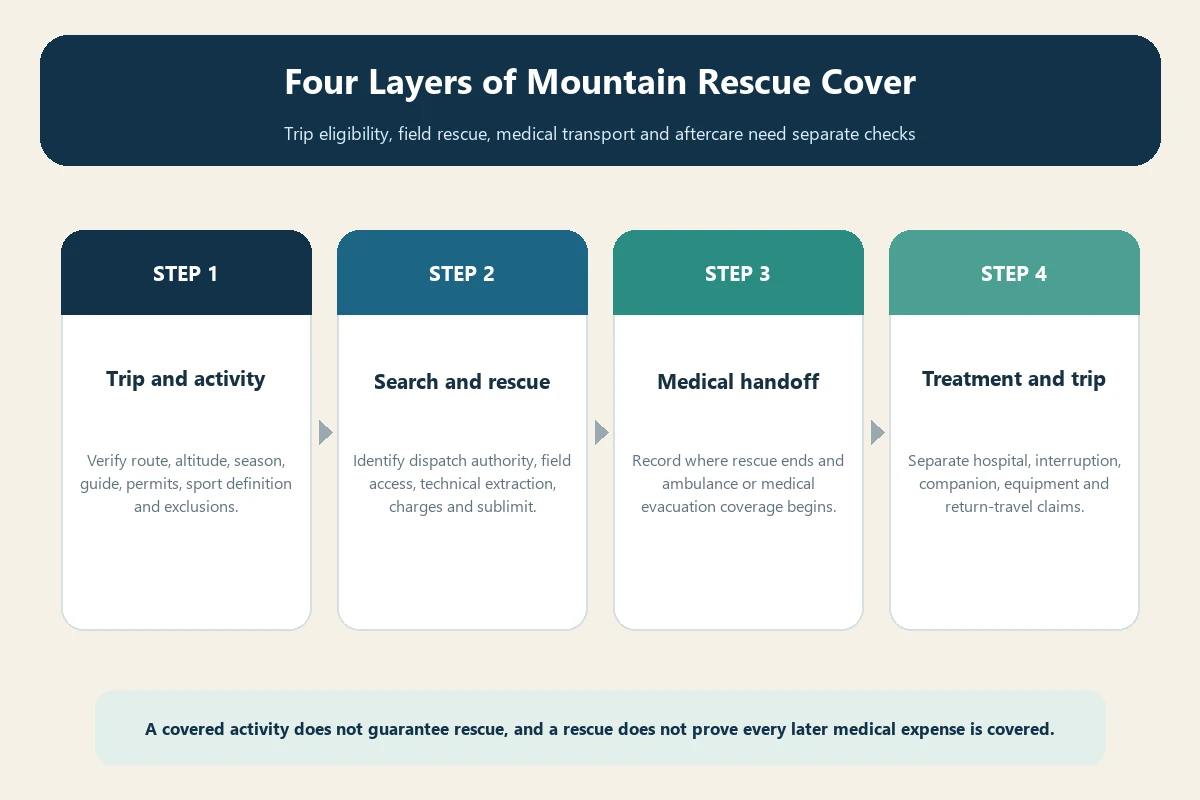
Layer 1: identify the actual activity
Write the route name, highest planned altitude, terrain, season, dates, expected snow or glacier travel, equipment, guide status, permits, and whether ropes, crampons, skis, bikes, paragliders, or motor vehicles are used. Marketing names such as “adventure hike” are not enough.
Then match those facts to the policy’s activity table. A plan might cover ordinary hiking while excluding mountaineering, technical climbing, off-piste skiing, racing, professional participation, or travel above a stated altitude.
A sports option might change only selected clauses
An adventure-sports option can remove one exclusion, raise an altitude, or add a rescue benefit. It does not necessarily change pre-existing-condition rules, alcohol exclusions, notification duties, territorial limits, ordinary medical expenses, or the evacuation destination.
Ask for the endorsement and read it with the base policy. Do not rely on a checkout-box label saying “adventure included.”
A rescue membership is not the same contract
A club or membership can provide coordination, field rescue, transport services, or a financial benefit under its own rules. It may not insure hospital treatment, cancellation, baggage, liability, or every activity. Some services act only when their medical or security team approves the case.
Compare membership and insurance side by side: eligible traveler, territory, trip duration, activity and altitude, rescue trigger, transport destination, dispatch control, advance payment, exclusions, maximum, and appeal process. Do not add their displayed amounts until the coordination and other-insurance clauses are understood.
Guide, permit, and route rules matter
Some forms require an accredited guide, authorized operator, marked route, open resort boundary, lawful permit, or compliance with local restrictions. Others exclude deliberate exposure to danger or participation after an official closure.
Save the itinerary, operator terms, guide credentials, permits, route conditions, and official closure notices. The Norway rescue guide shows how destination rescue practice and activity wording must be checked separately.
Layer 2: search begins before a medical diagnosis
An overdue traveler may be missing, stranded, uninjured, or unable to communicate. A search can use ground teams, dogs, drones, aircraft, snow vehicles, or other resources before responders know whether medical evacuation will be needed.
Ask whether the policy covers search, rescue, both, or only transportation after an illness or injury is confirmed. Record the trigger for search, dispatching authority, last known point, route plan, communications, and mission number.
Technical rescue solves an access problem
A patient might need litter carry, rope lowering, avalanche response, crevasse extraction, river crossing, snow vehicle, or helicopter hoist. Those techniques move the person to a place that responders or medical transport can reach.
The rescue endpoint might be a trailhead, road, clinic, helipad, or local hospital. Technical rescue is not automatically the same as an equipped interfacility air ambulance.
What the CDC says about adventure insurance
The CDC Yellow Book adventure chapter says having insurance does not guarantee rescue. It warns that travelers may need advance payment, that medical-control approval and maximums can apply, and that wilderness rescue or sports such as mountaineering and skiing may be excluded.
Use those warnings to build questions. Do not treat them as proof that a particular policy excludes or covers the planned route.
Public, volunteer, and private rescue are not the same payer
A national park, local government, military, police, volunteer mountain team, ski patrol, tour operator, or private helicopter company may respond. Jurisdiction, dispatch, billing, and reimbursement differ.
The National Park Service visitor-protection aviation page describes NPS search-and-rescue missions using aircraft and other resources with partner agencies. That operational capability is not a promise of availability or a market-wide rule about traveler charges.
Do not call a private aircraft before identifying dispatch authority
A guide or traveler might know a helicopter operator, but local law or rescue command can control the mission. A self-arranged aircraft can be unsafe, duplicate a public response, lack required medical configuration, or fall outside policy authorization.
If communication is possible, contact local emergency authority and the insurer’s assistance team. If immediate action is necessary, preserve why prior contact was impossible and who made the safety decision.
An SOS device is a communication tool, not a benefit
A satellite messenger or beacon can transmit distress and location information. It does not decide whether the activity is covered, who pays the response, what team is available, or where a patient will be transported.
Register the device, keep the subscription active, test it as permitted, share the route plan, and know the emergency procedure. Save message logs and coordinates after an incident, but never delay a safety call while searching for an insurer’s preferred channel.
Weather can close every aviation option
Cloud, wind, icing, darkness, terrain, visibility, landing-zone condition, avalanche hazard, aircraft range, crew duty, and competing missions can prevent flight. Ground rescue may be slower but safer.
The CDC injury chapter explains that sudden weather changes and inadequate remote trauma response can hamper rescue and delay care. A policy cannot override that operational risk.
Layer 3: mark the medical handoff
Write down the time and place where the rescue team transfers care to an ambulance, clinic, emergency department, or aeromedical crew. Record the patient condition, receiving clinician, mode, operator, and whether a new case or invoice begins.
The travel-medical ambulance guide helps separate local ground or air ambulance charges from a broader evacuation benefit.
A later evacuation needs its own medical case
After stabilization, a local hospital may lack surgery, intensive care, imaging, blood products, or another specialty. A medically equipped transport to an adequate facility can then be considered.
That decision can require the treating record, unavailable capability, patient fitness, receiving physician and bed, destination rule, transport mode, vendor, and insurer approval. Rescue dispatch alone does not establish these elements.
Search-and-rescue sublimits can be separate
A plan may show one maximum for emergency evacuation and a smaller maximum for search and rescue. Escort, equipment, repatriation, or related-event costs might also share a bucket.
A state-specific Travel Guard policy form illustrates separate displayed limits for evacuation and search and rescue. Treat the structure as a prompt to inspect the issued form, not its figures as a recommendation.
Use the evacuation limit worksheet to test per-person, occurrence, related-cause, shared-cost, and aggregate language.
Layer 4: treatment and trip costs continue after rescue
Hospital care, medication, companion lodging, damaged equipment, unused tour services, replacement transportation, and return travel might use medical-expense, baggage, interruption, delay, or family-transport benefits. They should not be submitted as one rescue invoice.
Request supplier refunds and identify other insurance. Coverage generally prevents duplicate recovery for the same expense.
Build a mountain incident evidence file
- Route plan, coordinates, altitude, activity, guide, permits, and equipment
- Last contact, emergency trigger, and rescue case number
- Weather, closure, and operational decisions
- Search log, extraction method, and rescue endpoint
- Patient handoff and local medical record
- Assistance contacts and exact written authorization
- Transport mission record, receiving hospital, and invoices
- Proof of payment, other-insurance response, and refunds
The pre-authorization timeline can be added to the file when a later medical transfer is considered.
Witness and guide records can resolve a claim dispute
Ask the guide or rescue leader to record the planned route, actual location, activity underway, weather, patient condition, emergency trigger, communications, extraction technique, and reason an alternate route or mode was chosen. Preserve any official mission or incident report.
Those records can distinguish a sudden covered injury from an excluded activity allegation, or a safety-driven reroute from a traveler preference. They should describe facts, not promise insurance coverage.
Questions to ask before the trip
- What exact activity and altitude does the policy cover?
- Is a guide, permit, marked route, or sports option required?
- Are search and technical rescue defined separately?
- What is the rescue maximum and what expenses share it?
- Who must dispatch or approve a private operator?
- Where does rescue end and ambulance coverage begin?
- Does later interfacility evacuation use another benefit?
- What emergency-notice exception applies when communication fails?
Bottom line
Medical evacuation insurance mountain rescue planning requires four audits: the trip and activity, the search and technical rescue, the medical handoff and later transport, and the treatment or trip expenses afterward. Match the actual route to definitions, altitude, guide and permit conditions, rescue sublimits, dispatch rules, authorization, and evidence. Rescue comes first; coverage analysis must never delay a safety call or imply that resources are guaranteed.
Search, field rescue, medical evacuation, hospital transfer, and home-country transport are not one service. Use the medical evacuation membership vs rescue membership guide to test the exact trigger, starting location, first destination, provider control, geographic scope, and self-arranged-cost rules.
