
The Netherlands is an EU member and part of the Schengen Area, and its healthcare is consistently well rated. None of that means a visiting American is covered. Dutch residents are required to hold a national basic health insurance policy, and that requirement, along with the cover it buys, attaches to residence rather than to presence in the country.
What makes the Netherlands distinctive for a visitor is not the cost so much as the route. The system is built around a gatekeeper, and going around it is both harder and more expensive than in countries where you can simply present at a hospital.
The GP is the front door, not the emergency room
Dutch care is organized around the huisarts, the general practitioner. For anything that is not an emergency, the huisarts is where you start, and a referral from one is normally what opens the door to a specialist or a hospital outpatient clinic. Turning up at a hospital and asking to see a specialist is not the expected path and generally will not work.
Visitors can be seen by a GP practice as a passing patient. Outside office hours, care runs through a huisartsenpost, an out-of-hours GP center, which is usually attached to or near a hospital and which you telephone before attending rather than walking into. For a genuine emergency the number is 112, the European emergency number, which works across the EU.
This structure has a direct effect on claims. Travel medical policies reimburse medically necessary treatment, and an insurer assessing a bill will look at whether the route taken was appropriate. Presenting at an emergency department for something a GP would have handled is the scenario where a traveler most often ends up arguing about a bill afterwards.
What this means: In the Netherlands, knowing which door to use is part of managing the cost. A phone call to a huisartsenpost is the correct first step for most out-of-hours problems, and it is also the step that keeps a claim straightforward.
Why Dutch basic insurance does not help you
The Dutch basisverzekering is a statutory insurance that residents must buy from a private insurer, with the benefit package set by the government. Because entitlement runs through residence and registration, a tourist is outside it entirely, in the same way a visitor to the United States is outside an employer plan.
Visitors from EU and EEA countries bridge the gap with the European Health Insurance Card, which gives them state-provided care on the same terms as a Dutch resident. A US resident cannot hold that card, so the bridge does not exist and the bill arrives in full. We set out why in our guide to the EHIC and US citizens.
Nor does a US domestic health plan reliably fill it. Many plans cover emergencies abroad on a reimbursement basis at best, some cover nothing outside their network, and Original Medicare generally does not cover care outside the United States at all. Our guide to where US plans stop working covers what typically survives the border and what does not.
Schengen rules and what they actually require of you
The Netherlands is in the Schengen Area, so the Schengen insurance rule applies to travelers who need a visa: minimum medical cover of EUR 30,000, valid across the Schengen area, including emergency treatment and repatriation. US passport holders are visa-exempt for short stays and are therefore not asked to show a policy.
Treat the figure as a floor rather than a target. It is what a group of European governments considers the minimum defensible cover for a short visit, and a serious hospital admission with an air transfer home can pass it. Our guide to the Schengen insurance requirement explains how the rule is written and what “valid across the Schengen area” means in practice.
| Situation | Where to go | Who pays |
|---|---|---|
| Non-urgent illness, office hours | Huisarts (GP practice) | You, then claim from your insurer |
| Non-urgent illness, evening or weekend | Huisartsenpost, telephone first | You, then claim |
| Serious or life-threatening emergency | 112, or hospital emergency department | You or your insurer, billed after treatment |
| Specialist or hospital outpatient care | Normally by GP referral | You or your insurer |
Bicycles, and the cover most travelers forget
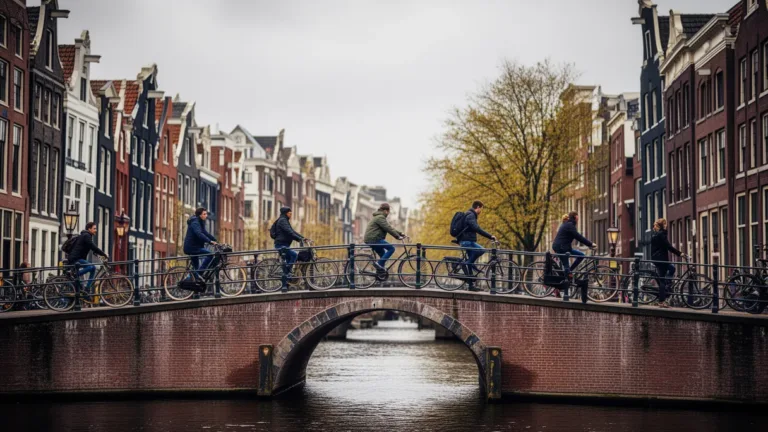
Cycling is ordinary transport in the Netherlands rather than a sport, and visitors ride in traffic conditions they have not practised. Rented city bikes, unfamiliar priority rules, tram tracks and separated cycle lanes with their own signals produce a steady flow of minor injuries among tourists.
Two distinct kinds of cover are relevant, and travelers routinely conflate them. Emergency medical cover pays for treating your own injury. Personal liability cover responds if you injure someone else or damage their property, which in a country this dense is a real scenario. Liability is a common inclusion in policies sold to Europeans and a common omission in policies sold to Americans, so check whether yours includes it rather than assuming.
Cycling on public roads is normally treated as ordinary travel rather than a hazardous activity, so it does not usually trigger the sports exclusions that catch skiing or climbing. Anything more organized, such as a racing event, may be treated differently, and the definition is in the policy wording.
Practical steps that make a claim work
Call your insurer’s assistance line early rather than after the fact, particularly for anything that might involve admission. Assistance lines can confirm cover, arrange direct billing with a hospital where the insurer has a relationship, and record the case, which matters later. Our guide to the assistance line and the claims department explains why those are two different functions.
Keep every document. Dutch providers issue clear itemized invoices, and an itemized bill with a diagnosis is what a claims assessor needs. Pay attention to filing deadlines too, since many policies require notification within a defined window after treatment, and a late claim can fail on the deadline alone rather than on the merits.
Frequently asked questions
Can I just walk into a Dutch hospital as a tourist?
For a genuine emergency, yes, and you should. For anything else the system expects you to go through a GP first, and a hospital will usually redirect you. Calling a huisartsenpost out of hours, or a GP practice during office hours, is both the faster route and the cheaper one.
Does the Netherlands require proof of travel insurance to enter?
Only for travelers who need a Schengen visa, who must show minimum medical cover of EUR 30,000 valid across the Schengen area. US passport holders traveling visa-free for a short stay are not required to present a policy, though the same medical exposure applies to them.
Will my US health plan pay a Dutch hospital directly?
Rarely. Most US plans that offer any overseas benefit do so by reimbursing you afterwards, which means paying the hospital yourself first. A dedicated travel medical policy with an assistance line is more likely to arrange payment directly with the provider, particularly for an admission.
Do I need liability cover for cycling in the Netherlands?
It is worth checking whether your policy includes personal liability, because injuring another cyclist or pedestrian is a realistic scenario in Dutch traffic and medical cover does not respond to it. Liability is commonly included in European policies and commonly absent from US ones.
