
Travel insurance for seniors on a river cruise should be built around the route obligations, not the ship alone. Low or high water, lock closures, a medical event, or a missed embarkation can convert part of a cruise into buses, hotels, a different vessel, or an extended stay. The financial result depends on what the cruise contract supplies, what the insurer defines as a covered loss, and what remains the traveler’s responsibility.
This guide creates a route-obligation matrix for a U.S. senior. It does not rank insurers or river-cruise operators and does not promise that water-level disruption is covered. Read the passenger contract, booking terms, and issued insurance certificate together.
Key takeaways
- Separate an operator’s itinerary substitution from an insurer’s covered event.
- Map every vessel, coach, hotel, flight, excursion, and border in chronological order.
- Assign each possible expense to the operator, insurer, health plan, credit card, or traveler.
- Test medical access and mobility when the route changes from ship to land.
- Save revised itineraries, refunds, credits, and itemized extra costs.
Reviewed August 16, 2026. “Covered reason,” “trip delay,” “interruption,” “common carrier,” “supplier,” and “uninhabitable” are contract-specific terms.
Why a river cruise needs a different insurance audit
An ocean cruise often centers on shipboard care and remote evacuation. A river cruise can create a different chain: frequent ports, daily walking tours, low bridges, locks, coach substitutions, vessel swaps, and hotel stays along a multi-country route. A navigational change can alter mobility, medical access, luggage handling, and independent air arrangements without canceling the entire trip.
European River Information Services include water-level and navigation information because river conditions affect inland transport. That operational reality does not itself trigger an insurance benefit. The certificate must connect the event to a covered cause, waiting period, eligible expense, and documented loss.
Build the booked-route baseline
Save the itinerary and terms in effect when the deposit is paid. Create one row for each day: vessel, embarkation point, port, included excursion, optional excursion, ground transfer, hotel, flight or rail segment, border, and prepaid nonrefundable amount. Note which pieces were sold by the cruise operator and which were booked independently.
Add the passenger’s age, mobility requirements, medication or refrigeration needs, current health coverage, and any companion or caregiver. If a coach substitution would be difficult, document accessible-transport needs with the operator before purchase.
Read the operator contract before buying insurance
A passenger ticket contract can give the operator broad rights to alter the route. As one current example, AmaWaterways’ U.S. terms say high or low water, weather, lock malfunction, docking difficulty, and other causes may lead to a delayed or changed sailing, omitted ports, another vessel, coach transport, or temporary disembarkation. That is one operator’s form, not a rule for every cruise.
Highlight what the operator promises after a change: substitute transport, lodging, a new vessel, refund, credit, or no compensation. Insurance generally addresses an eligible remaining loss; it should not be expected to pay an amount already refunded, credited, or supplied by the operator.
The cruise insurance clause guide helps compare the booking contract with cancellation, interruption, delay, and missed-connection wording.
Distinguish four water-level outcomes
| Operational outcome | What the traveler still receives | Insurance question |
|---|---|---|
| Minor schedule change | Same ship and core itinerary | Is there any financial loss? |
| Coach substitution | Transport and many visits by land | Does inconvenience alone trigger a benefit? |
| Ship swap or hotel segment | Alternative vessel or accommodation | Which prepaid component was not supplied? |
| Cancellation or early termination | Refund, credit, or partial service under operator terms | What eligible nonrefundable balance remains? |
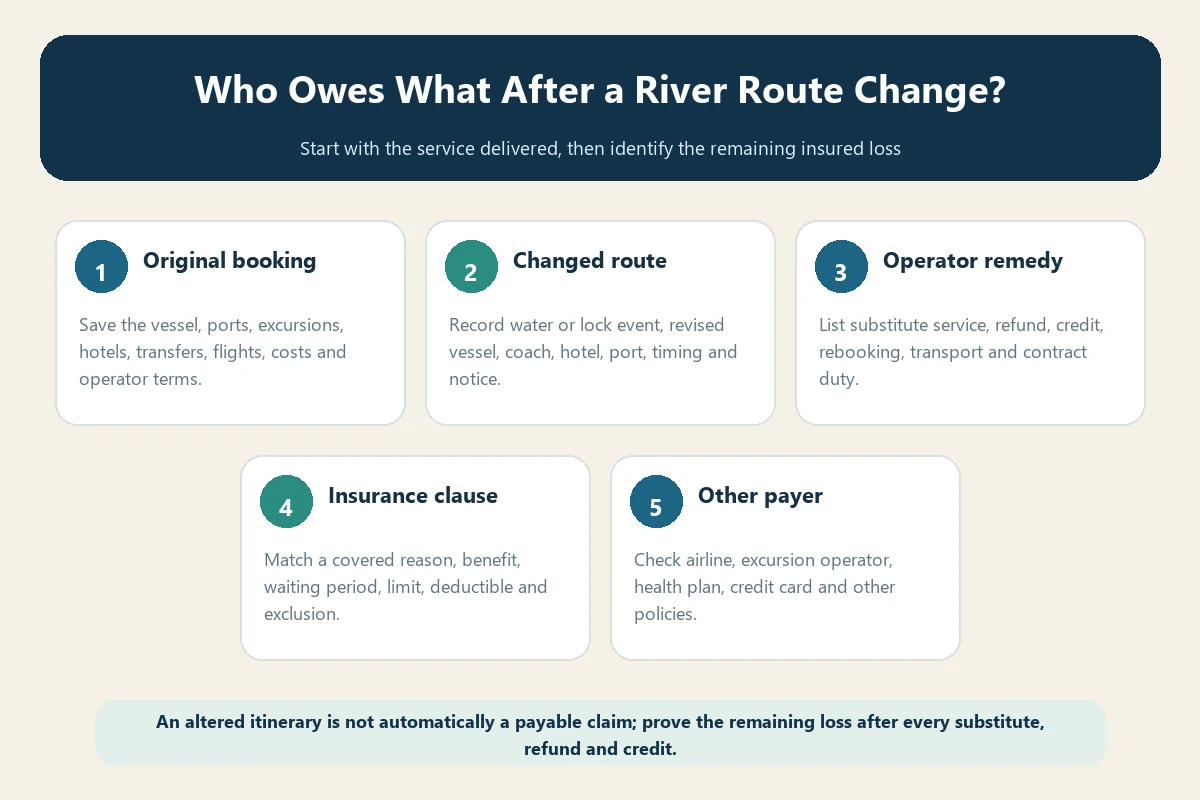
Do not file every low-water change as trip cancellation. First calculate the service delivered, supplier remedy, and actual extra expense. Then identify the insurance benefit whose definition fits the event. A route change may be disappointing but not a covered financial loss.
Create the route-obligation matrix
For each disruption, add five columns:
- Operator duty: substitute service, refund, credit, transport, hotel, or none under the booking contract.
- Insurance trigger: the exact covered reason and benefit, if any.
- Other payer: airline, excursion operator, health plan, credit card, or another policy.
- Traveler balance: the amount not supplied or reimbursed elsewhere.
- Evidence: notice, revised itinerary, invoice, refund statement, receipt, and policy clause.
This prevents double counting and makes a claim reviewable. If the traveler receives a future cruise credit, ask the insurer how credits are valued before assuming the original payment is still nonrefundable.
Test independent flights and missed embarkation
A river cruise may begin in one city and end in another. If independently booked air arrives late, the traveler may need rail, hotel, or a long ground transfer to catch the moving vessel. Check the missed-connection definition, required delay cause, minimum delay, common-carrier requirement, and eligible catch-up expenses.
Save scheduled and actual arrival times, airline notices, baggage reports, receipts, and the cruise operator’s instructions. If air was packaged by the operator, its assistance duties can differ from cruise-only terms. Do not assume a credit-card delay benefit and travel policy will pay the same expense twice.
Plan for mobility when ship days become coach days
A coach replacement can add steps, longer seated periods, hotel changes, and manual luggage movement. Ask the operator whether accessible coaches, lift equipment, wheelchairs, walking alternatives, and accessible hotel rooms can be provided on a changed route. Record the answer.
Travel insurance may cover an eligible medical event but does not guarantee accessibility or compensate every itinerary inconvenience. The State Department’s older-traveler guidance recommends checking accommodations in advance for mobility needs. The route matrix should contain an accessibility fallback for each major segment.
Map medical care along the river, not at sea
List the countries and overnight locations. For each, identify how to reach appropriate care, what payment may be required, and how the insurer’s assistance team would coordinate a transfer. A river vessel can be close to shore yet still far from a facility able to manage a complex condition.
Medicare usually does not pay for care abroad, subject to limited exceptions. Confirm any Medigap, Medicare Advantage, employer, or retiree benefit and the order of payment. Review the Medicare in Europe guide for a document checklist, then verify the exact plan.
If the cruise operates outside Europe, repeat the analysis for those countries. “River cruise” is a trip style, not an insurance territory.
Check evacuation and interruption as separate decisions
A medical transfer may move the passenger to the nearest appropriate facility while the cruise continues. Trip interruption may address unused prepaid cost and return travel if a covered reason applies. A companion benefit may have separate limits. Do not combine these into one evacuation number.
The international hospital-transfer guide explains receiving-facility acceptance and case management. The travel-companion evacuation guide separates patient transport from companion expenses.
Audit pre-existing conditions and purchase timing
River cruises can require large staged payments well before departure. Record the initial deposit, policy purchase, later trip-cost additions, final payment, and any medical changes. If the policy offers a pre-existing-condition waiver, verify its deadline, insured-cost rule, medical-fitness requirement, age eligibility, and state form.
Use the pre-existing-condition look-back guide. A doctor’s clearance or operator fitness form does not replace the insurer’s waiver conditions.
Price prepaid tours and optional extensions correctly
Separate included excursions, prepaid optional tours, independently booked activities, pre-cruise hotels, post-cruise extensions, and air. Identify who owes a refund if each is missed. An operator-provided substitute tour can reduce or eliminate the financial loss even if the traveler preferred the original.
Update the declared trip cost when the policy requires it. Save cancellation schedules for every supplier. A single package total is not enough for an itemized interruption claim.
Prepare evidence for low water or route disruption
- Original itinerary, passenger contract, booking terms, and invoices
- Written notice explaining the route change and effective date
- Revised daily program, ports, vessel, coach, hotels, and excursions
- Operator refund, credit, substitute-service, and compensation statement
- Airline or rail notices for affected independent transport
- Receipts for eligible meals, lodging, transfers, calls, and rebooking
- Medical or accessibility records if the change creates a covered health issue
- Insurance certificate, declarations, assistance log, and claim correspondence
Ask for facts, not blame: what changed, why, what was supplied, what was canceled, and what the traveler paid. Water-level data can support the operational background, but the financial evidence proves the loss.
Questions to ask before final payment
- What may the operator substitute when water or lock conditions disrupt the route?
- Which refunds or credits are available after a shortened or altered cruise?
- Does the policy list low water, weather, mechanical failure, or supplier default as a covered reason?
- Is itinerary change alone covered, or must there be a defined delay or cancellation?
- How does a future cruise credit affect a claim?
- Are independent flights and catch-up transport eligible after a missed embarkation?
- Can accessible transport and hotels be maintained after a ship-to-coach change?
- How are foreign medical care, evacuation, interruption, and companion costs separated?
- Are all countries, extensions, and optional excursions inside the territory and trip cost?
- What evidence is required for each benefit?
FAQ about travel insurance for senior river cruises
Do seniors need special insurance for a river cruise?
There is no universal special policy requirement. The useful comparison combines trip-cost protection, foreign medical and evacuation needs, age and pre-existing-condition rules, route substitutions, independent air, and the operator contract.
Does travel insurance cover low water on a river cruise?
Not automatically. Coverage depends on the listed cause, benefit definition, waiting period, actual financial loss, supplier remedy, and exclusions. A coach substitution or revised itinerary may not create a payable loss.
Will insurance pay if the cruise changes ships?
Only if the change produces an eligible loss under a covered benefit. First document what substitute service and refund or credit the operator provided.
What if a senior cannot manage a replacement coach itinerary?
Discuss accessibility contingencies with the operator before travel and obtain medical advice where appropriate. Insurance coverage depends on a defined covered reason; reduced convenience alone is not necessarily insured.
Bottom line
Travel insurance for seniors on a river cruise is most useful when it protects the remaining financial and medical gaps after the passenger contract does its work. Build the booked-route baseline, model water and lock disruptions, assign each expense to the responsible party, and preserve an itemized evidence trail. The right question is not “is low water covered?” but “what service disappeared, what loss remains, which clause responds, and who can prove it?”
