

Travel insurance over 75 is widely searched as though age 75 were one market cutoff. It is not. Age is an input used alongside residence, destination, trip dates, product type, trip cost, medical history, and state form. One plan may accept a 76-year-old with lower medical options; another may offer trip protection but not medical-only coverage; a third may be designed for visitors entering the United States rather than U.S. residents leaving it.
This guide provides a controlled comparison method for a U.S. traveler age 75 or older. It does not rank insurers or declare a universal minimum. It is educational, not insurance, medical, legal, financial, or Medicare advice. Verify every quote against the issued certificate.
Key takeaways
- Hold the traveler and itinerary constant when comparing plans.
- Label trip protection, travel medical, visitor medical, and membership products correctly.
- Confirm which date determines the traveler’s age band.
- Compare exact-age medical and evacuation limits, not advertised “up to” amounts.
- Resolve pre-existing-condition rules and purchase windows before judging price.
Reviewed August 16, 2026. Eligibility, age, pre-existing condition, waiver, medically necessary, period of coverage, and maximum limit are contract-specific terms.
Begin with a locked traveler profile
Create one input sheet before requesting quotes: full date of birth, state and country of residence, citizenship if requested, destination countries, departure and return dates, initial trip deposit, total prepaid nonrefundable cost, activities, cruise or tour, current health coverage, and desired benefits. Use the same answers everywhere.
The travel insurance age-limits guide lists the separate enrollment, renewal, duration, price, and benefit rules that can use age. At 75, the first question is not “who is cheapest?” It is “which exact contract did this input sheet produce?”
Label the product class before comparing it
| Product | Main purpose | Critical over-75 check |
|---|---|---|
| Comprehensive trip protection | Cancellation, interruption, delay, baggage, medical, and evacuation | State form, waiver timing, medical amount |
| Outbound travel medical | Temporary medical and emergency transport outside the U.S. | Residence, Medicare-related eligibility, age tier |
| Inbound visitor medical | Medical cover for a non-U.S. resident visiting the U.S. | Home country, U.S. network, age maximum |
| Annual multi-trip | Several trips during one policy year | Per-trip day limit and renewal age |
| Assistance membership | Defined transport or coordination service | Eligibility and service rules, not insurance benefits |
A Google result for “over 75” may answer a British resident, an inbound parent visiting family in America, or a U.S. Medicare enrollee traveling abroad. Those are not interchangeable markets. Record residence, destination, and product class in the first three columns of the comparison.
Confirm whether age is measured at purchase or departure
A traveler can be 74 at booking, 75 at purchase, and 76 before the trip ends. Ask which date controls eligibility, premium, medical maximum, and renewal. Save the completed quote inputs and written answer. If two plans use different measurement dates, note that beside the rate rather than assuming a pricing error.
The over-70 age-band guide explains why a birthday can move the available options in steps. A quote generated with an approximate age is not reliable evidence for the issued plan.
Compare only the benefits available at the exact age
Copy the medical maximum, emergency evacuation, non-emergency transport, return to residence, return of remains, deductible, coinsurance, hospital or ambulance sublimits, and out-of-pocket structure. Mark whether each amount is per injury, illness, trip, period of coverage, or lifetime.
IMG’s current GlobeHopper Senior page provides one U.S.-resident outbound medical example. It presents higher selectable medical maximums for ages 65–79 than for ages 80 and older, plus separate evacuation and pre-existing-condition-related amounts. This is product-specific, but it demonstrates why the traveler’s actual age tier matters.
Use the contract, not the summary
The corresponding sample contract adds eligibility, period, pre-certification, exclusions, claims, and definition details not captured by a headline. It states a 5-day-to-12-month period for that product and plan-specific medical tiers. A different state, issue date, or product can use another form.
Save the form number and revision date. When the policy arrives, compare its declaration and endorsements with the sample. Use the free-look or review period stated in the issued contract to resolve a mismatch.
Separate trip protection from medical-only coverage
A medical-only plan can protect emergency treatment and transport without reimbursing the prepaid trip if the traveler cancels. Comprehensive trip protection can include cancellation and interruption but offer a lower medical maximum. A useful comparison records both the known trip-cost risk and the open-ended medical risk.
Seven Corners’ current Basic/Choice page is one trip-protection example that states U.S.-resident eligibility up to age 99 and describes trip and emergency benefits subject to its plan document. It does not prove that every over-75 traveler should buy that product, that it is available in every state, or that its medical amount fits every destination.
Audit Medicare and other U.S. coverage
Medicare’s official foreign-travel page says Medicare usually does not cover health care outside the United States, with limited exceptions. Some Medigap policies may cover foreign emergency care. Medicare Advantage, employer, retiree, military, and private plans have their own networks and rules.
Ask each current plan about destination, emergency and routine care, ambulance, medical evacuation, direct payment, claim forms, deadlines, and coordination. Then decide whether the travel plan is primary or secondary. Do not write “Medicare does not travel” in the workbook without recording the traveler’s actual coverage and the official exceptions.
Resolve pre-existing conditions before the quote clock expires
Trip-protection products may waive a pre-existing-condition exclusion when purchase timing and other conditions are met. Travel medical products may exclude prior conditions, cover only a defined sudden recurrence or acute onset, or provide a limited age-banded benefit. Those mechanisms are not equivalent.
Use the senior pre-existing-condition checklist to copy the definition, look-back, stability or medically-able-to-travel rule, waiver window, full-trip-cost requirement, age threshold, maximum, and evacuation treatment. Do not disclose sensitive health details to a comparison site beyond what it legitimately requests.
Do not overlook the waiver purchase date
For plans offering a waiver, the clock can start with the first trip payment or deposit, not the policy quote. Record every cruise, tour, flight, lodging, and card-reward payment. Ask whether adding trip costs later requires updating the insured amount and by what deadline.
The waiver eligibility guide separates purchase timing, full trip cost, medical ability, and covered persons. If the deadline has passed, compare the actual unwaived terms rather than assuming a late purchase restores the option.
Test trip duration and extension
Count calendar days using the certificate’s method. An annual plan can cover a full year but limit each trip to 30, 45, 60, or another number of days. A single-trip medical plan can allow a longer continuous period but exclude routine care or require an extension before expiry.
Record departure, return, time zones, cruises that cross midnight, side trips, home visits, and any planned extension. Ask whether coverage ends on return to the country of residence and whether a claim-related continuation provision applies only to treatment, not to every benefit.
Compare evacuation by route, not by a generic target
Medical evacuation needs depend on local care, islands or mountains, scheduled-airline access, ground transfers, receiving facilities, patient stability, and distance. A large advertised number can still be constrained by medical necessity, destination control, approval, exclusions, and included sublimits.
The evacuation limit worksheet maps those dependencies. At age 75, do not assume the highest tier shown for younger travelers is selectable. Copy the available amount from the exact quote and certificate.
Check payment mechanics, not only reimbursement
Ask whether the company can arrange direct payment to an overseas hospital, whether a guarantee is discretionary, which network exists, how precertification works, and what the traveler may need to pay upfront. Record the assistance number and secure claim channel.
A primary benefit can still require records and authorization. A secondary benefit can require an EOB or denial from another plan. Compare cash exposure, deductible, coinsurance, exchange rates, and claim timing alongside the premium.
Price the residual risk
After eliminating ineligible and inadequate plans, estimate what remains uninsured: medical amounts above the age-tier maximum, an evacuation shortfall, excluded prior-condition loss, routine care, medications, a longer trip, cancellation beyond the insured cost, or costs the traveler must advance. A cheap premium can be expensive if one of those gaps is material.
Do not raise the insured trip cost or select optional benefits merely to make plans look comparable. Quote the same exposure, then note where a plan cannot match it.
Use this comparison workbook
- Traveler, date of birth, age dates, state, residence, and destination
- Product class, plan name, form, revision, underwriter, and administrator
- Trip deposit, total nonrefundable cost, purchase window, and travel dates
- Exact-age medical, evacuation, return, and other material maximums
- Deductible, coinsurance, sublimits, primary or secondary status, and direct payment
- Pre-existing-condition definition, waiver or limited benefit, timing, and age rule
- Per-trip days, policy period, extension, return-home effect, and renewal
- Premium, taxes, optional benefits, free-look deadline, and residual risk
The State Department’s age 65+ guidance recommends insurance for emergency medical, dental, and evacuation services and advises travelers to carry health information, medications, and emergency contacts. Use that preparation guidance after the contract comparison; it does not select a plan or set a benefit amount.
The practical conclusion
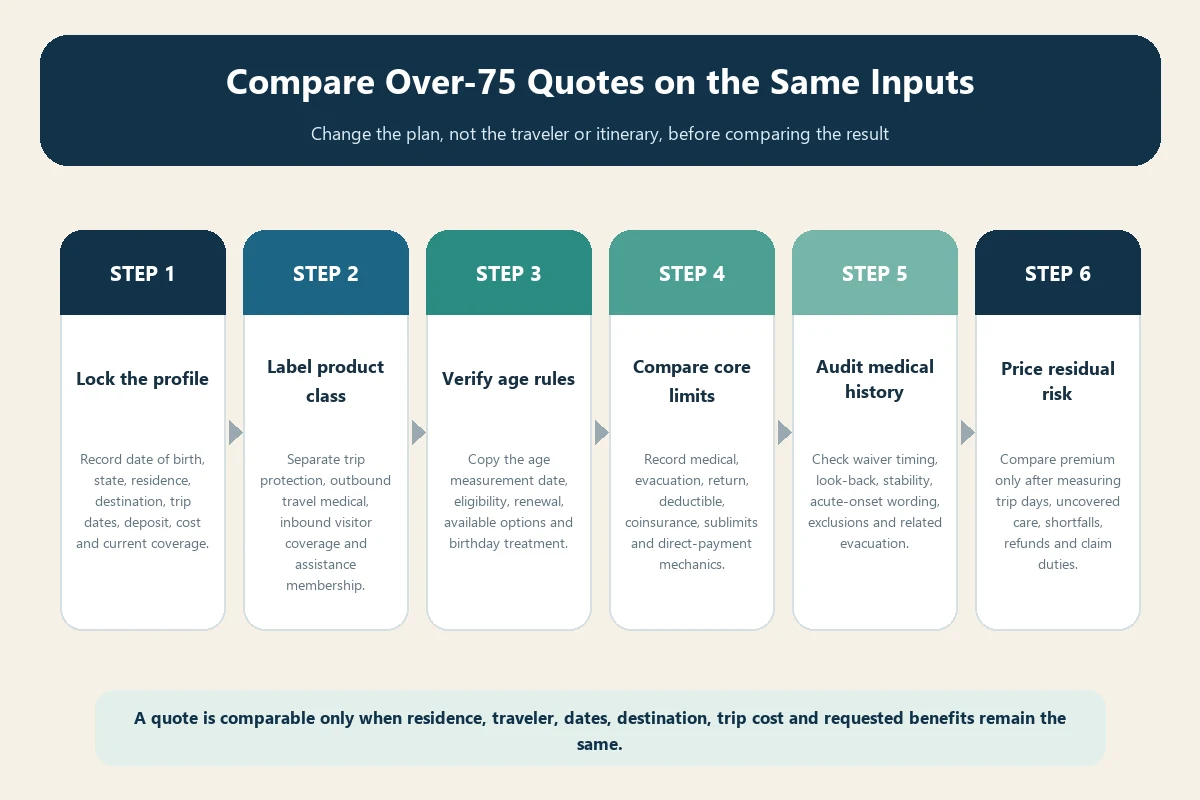
Travel insurance over 75 should be compared as a controlled experiment. Keep the person, itinerary, state, residence, destination, trip cost, and desired benefits unchanged. Then label the product, verify the age date, copy the exact available limits, audit medical-history terms, count trip days, and measure cash and residual risk.
The strongest plan is not the one most often named in search results. It is the eligible issued contract whose age-75-plus terms fit the actual trip and whose exclusions and payment process the traveler can follow.
