
Travel insurance tarmac delay coverage depends on more than the number of hours an aircraft remains on the ground. A traveler must separate U.S. passenger rights during the onboard wait from the policy benefit that may reimburse the resulting delay, missed connection, or interruption.
This guide explains how U.S. travelers can document both clocks, protect airline remedies, and claim only the remaining eligible loss. It is educational, not legal or insurance advice.
What counts as a tarmac delay?
The U.S. Department of Transportation defines a tarmac delay as a period when an aircraft on the ground is awaiting takeoff or has just landed and passengers do not have an opportunity to get off. It can occur before departure or after arrival.
A gate delay before boarding is not a tarmac delay. An aircraft parked at a gate may still qualify if passengers cannot deplane. Record the physical situation and opportunity to leave, not only the flight-status label.
DOT rights and insurance coverage are different
DOT’s Tarmac Delays guide sets protections for covered carriers during qualifying delays at U.S. airports. Travel insurance is a contract whose benefit, waiting period, covered reasons, expenses, limits, and exclusions appear in the policy.
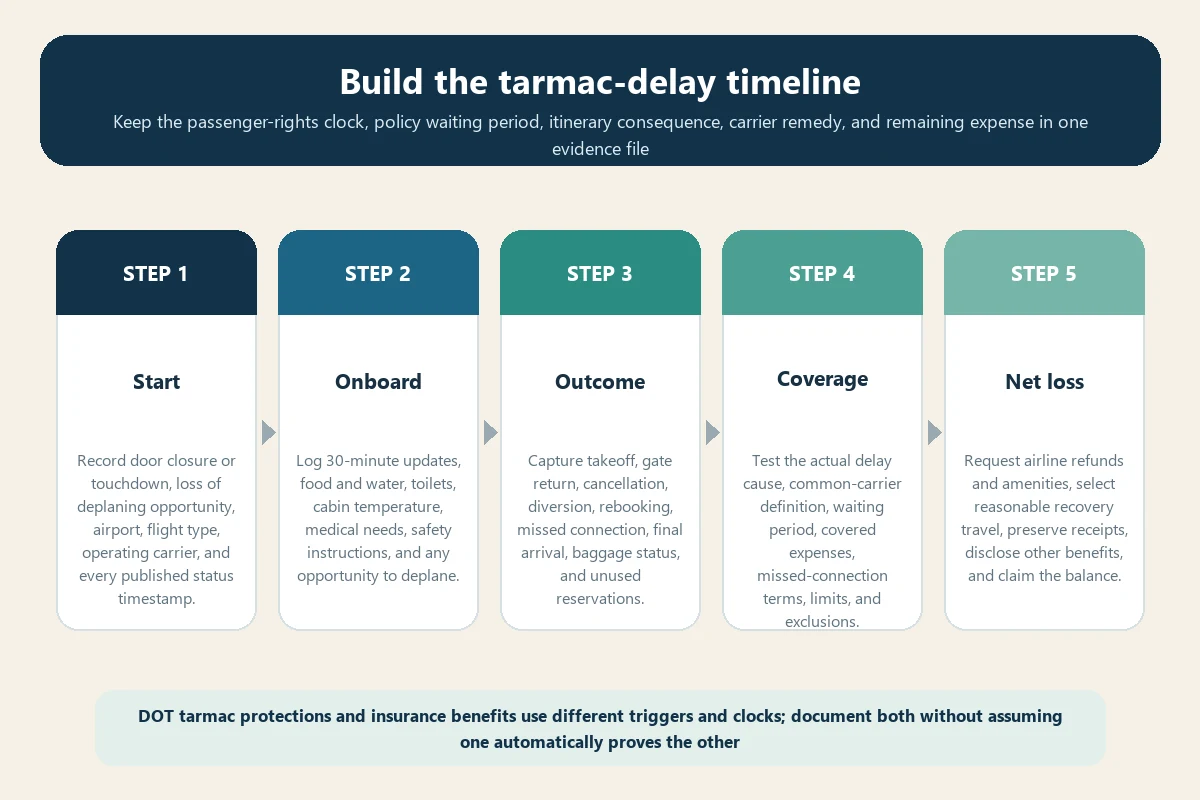
An airline can comply with its tarmac plan while the traveler still has an eligible trip-delay expense. A rule violation does not automatically make every expense insured. Build two analyses and reconcile them at the end.
Know the domestic and international limits
For covered flights at U.S. airports, DOT says airlines generally must begin moving a departing aircraft to a safe deplaning location before three hours for domestic flights and four hours for international flights. Arriving passengers generally must receive a safe opportunity to get off before those respective limits.
Safety, security, and air-traffic-control exceptions can apply. The rule covers qualifying events at U.S. airports; a foreign-airport delay may be governed by another country’s law. Record airport, route, operating carrier, aircraft, and whether the flight is domestic or international.
Food and water have a separate clock
DOT says airlines must provide a snack and drinking water no later than two hours after the tarmac delay begins, unless the pilot determines service would be unsafe or insecure. A full meal is not necessarily required.
Record when service occurred, what was supplied, and any safety announcement. Do not buy onboard goods solely to manufacture an insurance expense. If the aircraft later returns to the terminal, itemize reasonable purchases made after deplaning.
Track updates, toilets, temperature, and medical needs
When a tarmac delay exceeds 30 minutes, DOT requires a status notification; airlines may provide later updates as appropriate. Covered carriers must also provide working toilets, comfortable cabin temperature, and adequate medical attention when needed.
Write down announcements with timestamps. Preserve messages and photographs without obstructing the crew. Report urgent health or disability needs immediately and follow safety instructions. Medical documentation matters more than a retrospective description.
When does the tarmac clock begin?
The practical evidence file should capture door closure, pushback, first loss of an opportunity to deplane, touchdown, gate arrival, door opening, and any interim gate return. The legal measurement can depend on the particular operation and rule.
Ask the operating carrier for its tarmac-delay record. Compare that record with app history, photographs, messages, calls, location data, and witness notes. Keep time zones consistent.
The insurance clock may start differently
A policy may measure delay from scheduled departure, actual common-carrier delay, a specified covered event, or the time a minimum waiting period is satisfied. Another benefit may use scheduled versus actual arrival. Do not automatically use the DOT tarmac start time.
Quote the policy definition and create a second timeline. Our delay, interruption, and cancellation comparison helps select the correct benefit before calculating the claim.
Identify the cause behind the ground wait
Weather, air-traffic-control restrictions, congestion, mechanical failure, crew limits, security, airport closure, fueling, gate unavailability, or an earlier disruption can produce a tarmac delay. Policies frequently cover only named causes.
Request a carrier delay statement and preserve contemporaneous flight-status notices. “Tarmac delay” describes the condition; it may not be the covered reason. If the aircraft lands somewhere else, use our flight-diversion coverage guide to document the diversion separately.
Deplaning is a consequential choice
If an airline offers a safe opportunity to leave during a tarmac delay and the traveler exits, DOT warns that the airline may not be required to let that passenger reboard. The flight could depart without the traveler, and checked baggage may remain onboard.
Before exiting, ask whether reboarding is guaranteed, how notice will be given, what happens to baggage, and which rebooking options exist. Follow instructions in an emergency. For a voluntary nonemergency exit, document the information available and why the choice was reasonable because insurance mitigation and causation may be disputed.
A gate return is not automatically a cancellation
An aircraft may return to a gate, allow passengers off, and later depart under the same flight number. It may also unload, cancel, change aircraft, or rebook passengers. Preserve every status change and the final operation.
If the airline significantly changes the itinerary, compare its refund and rebooking options using our flight-change coverage guide. Choosing a refund or alternative flight changes the remaining insured loss.
Measure the final arrival delay
A two-hour tarmac wait does not always produce a two-hour destination delay. The aircraft may recover time, return to the gate, miss a slot, divert, cancel, or break a protected connection.
Record the original scheduled arrival, each revised itinerary, and actual arrival at the ticketed destination. Use our flight-delay coverage guide to test the policy waiting period and eligible expenses against the final evidence.
Handle a missed connection separately
If the tarmac delay makes an onward flight impossible, obtain written confirmation of the misconnection and the carrier’s rebooking response. Identify whether all segments were on one protected ticket or separate reservations.
A missed-connection benefit may require a particular delay length, cause, transportation type, or onward cruise or tour. Do not assume trip delay and missed connection reimburse the same expense twice.
Claim only reasonable additional expenses
Depending on the policy, eligible costs may include meals, lodging after a gate return, local transport, communications, and reasonable replacement travel. Waiting onboard usually creates few purchasable expenses, so the financial loss often arises afterward.
Keep itemized receipts and proof of payment. Luxury accommodation, alcohol, entertainment, upgrades, speculative bookings, and expenses above per-day or total limits may be excluded. Contact the insurer’s assistance service before a major replacement purchase when practical.
Seek the airline remedy first
Ask the airline about rebooking, refunds, meal or hotel commitments, ground transport, and reimbursements under its customer-service plan. The DOT’s Flight Delays resource links the federal rules and guidance governing delays and tarmac events.
Passenger-rights protections do not necessarily create automatic cash compensation for inconvenience. Preserve what the carrier actually provides and any written denial. Supplier remedies reduce or reshape the insurance loss.
Avoid double recovery
List airline refunds, vouchers, meals, hotel, replacement transport, credit-card protection, and other insurance payments. Match each recovery to the expense it addresses. Then submit the eligible balance under the applicable policy provision.
Follow our supplier-refund and subrogation guide when several parties may pay. Disclose a voucher even if its value or usability is disputed and request the insurer’s written coordination calculation.
Build a complete evidence packet
Include the itinerary, ticket receipt, boarding pass, flight-status history, operating carrier, airport, domestic or international classification, scheduled times, door and touchdown events, announcements, food and water, deplaning opportunity, gate return, rebooking, actual arrival, and receipts.
Add carrier correspondence, its tarmac contingency plan, delay statement, weather or airport notice when relevant, baggage record, insurer communications, refunds, vouchers, and benefits from other sources. A minute-by-minute table makes competing clocks easier to audit.
File a precise claim
State the covered cause, policy section, waiting-period calculation, itinerary consequence, mitigation, expenses, and recoveries. Avoid saying only “we sat on the runway for hours.” The insurer needs the event and financial chain.
Use our travel-insurance claim guide to meet notice and proof deadlines. If the airline may have violated a federal protection, DOT offers an aviation consumer complaint process; that complaint does not pause the insurance deadline.
Tarmac-delay checklist
- Record when passengers first lost the opportunity to deplane.
- Identify the operating carrier, airport, and domestic or international flight.
- Log updates, food and water, toilets, temperature, and medical response.
- Preserve the documented operational cause.
- Ask what happens if a safe deplaning opportunity is accepted.
- Track gate return, takeoff, cancellation, rebooking, and actual arrival.
- Test the policy’s independent trigger and waiting period.
- Request airline remedies and keep itemized receipts.
- Disclose every refund, voucher, amenity, and other benefit.
- Submit the documented net loss before all deadlines.
Bottom line
Travel insurance tarmac delay coverage requires two disciplined timelines. Protect DOT passenger rights during the onboard wait, then prove how the documented cause and itinerary consequence satisfy the policy.
When travelers preserve announcements, final arrival, carrier remedies, reasonable expenses, and recoveries, they can present a clearer claim for the loss that actually remains.
An ATC restriction needs a cause-and-timing record beyond the airline’s short delay code. Use this travel insurance air traffic control delay coverage guide to identify the traffic-management event, test policy wording, preserve FAA evidence, and calculate net loss.
