
Travel insurance air traffic control delay coverage is not automatic whenever an airline app displays “ATC,” “flow control,” or “airspace restriction.” The policy may name air traffic control as a covered reason, cover only the underlying weather or equipment failure, or omit the event entirely.
This U.S. guide explains how to decode the operational event, preserve official evidence, test the correct benefit, and calculate the remaining loss. It is educational, not legal, aviation, or insurance advice.
Quick check: the flight delay credit card checker compares the time rule, payout cap and claim deadlines card by card.
What is an air traffic control delay?
Air traffic managers regulate aircraft flow when expected demand exceeds available runway, airport, route, or airspace capacity. A flight may wait at its origin, receive a controlled departure time, reroute, hold in the air, divert, or cancel.
“ATC delay” identifies an operational layer, not necessarily the root cause. Weather, congestion, runway work, equipment failure, staffing, security, an airport closure, a launch, wildfire, or military activity may sit underneath the restriction.
Ground stop and ground delay program are different
A ground stop generally holds affected departures on the ground for a limited period. A ground delay program meters flights toward a constrained destination by assigning arrival capacity and controlled departure times.
The FAA’s official Ground Delay Program guidance explains that the program manages demand and capacity by assigning arrival slots and calculated departure times. Record the exact initiative rather than using the terms interchangeably.
Use FAA status as contemporaneous evidence
The FAA’s National Airspace System Status reports active and forecast airport events such as ground stops, ground delay programs, departure delays, closures, and deicing. Save the event detail while the disruption is active because the page changes continuously.
Capture airport code, event type, start and end, average delay, scope, reason, advisory number, and update time. An FAA network notice supports the operational chronology but does not by itself prove that a specific passenger’s flight was included or that a policy covers it.
Get the carrier’s flight-specific reason
Ask the operating airline for written confirmation of the delay cause, length, and affected flight. Preserve app messages, emails, gate displays, announcements, boarding passes, rebooking records, and the original itinerary.
If the carrier says only “ATC,” ask whether the restriction arose from weather, volume, staffing, equipment, runway capacity, security, or another cause. Do not pressure an agent to choose a more favorable code; request the factual record.
Policy wording controls the answer
Some policies expressly list air traffic control restrictions, airport closure, or common-carrier delay. Others name only severe weather, carrier equipment failure, strike, accident, or a short set of events. A broad-sounding trip-delay heading does not override the covered-reason list.
Read definitions, benefit triggers, exclusions, and endorsements together. Quote the applicable words in the claim. If ATC is not named, determine whether the verified underlying event independently satisfies another listed cause without relabeling the facts.
Weather-driven ATC restrictions require two proofs
Thunderstorms, low visibility, wind, snow, or runway contamination can reduce capacity and trigger traffic-management initiatives. Preserve both the FAA event and the weather evidence applicable to the airport or route.
The insurer may still require the common carrier’s statement connecting that condition to the flight. Use our weather-delay coverage guide to document timing, location, official warning, and causal link.
Congestion and volume may receive different treatment
High traffic volume can produce metering even in clear weather. A policy that covers inclement weather or carrier mechanical failure may not cover ordinary congestion. Another form may expressly cover an FAA or ATC mandate.
Save the FAA reason code and airline explanation. Avoid assuming that a delay outside the airline’s control is automatically within the insurance contract; “not the carrier’s fault” and “covered reason” are different tests.
Staffing and government action need precise classification
A controller shortage, facility evacuation, federal shutdown, or government directive can affect traffic capacity, but policies differ on government regulation, governmental action, labor issues, and known events. Identify the agency action and operational consequence separately.
Our government-shutdown flight guide explains why the public event is not enough. The claim needs the specific facility or route restriction, flight consequence, policy trigger, and net loss.
Equipment outages may not be airline mechanical failures
An FAA radar, communications, automation, or navigation outage is different from a mechanical failure of the passenger’s aircraft. A policy may define “common carrier” and “equipment failure” narrowly.
Obtain the official outage notice and carrier statement, then compare the definition word for word. Do not submit an ATC system failure as an aircraft breakdown unless the evidence actually supports that description.
Airspace closures and route restrictions vary widely
Wildfires, volcanic ash, security events, military activity, rocket launches, temporary flight restrictions, conflict, and government orders can close or constrain airspace. Each cause may interact with different policy exclusions and known-event rules.
Record geographic scope, effective times, issuing authority, planned reroute, and why the flight could not operate. A carrier may reroute and arrive late rather than cancel, so measure the actual itinerary consequence.
The waiting period is an independent gate
Even when ATC or its underlying cause is covered, trip-delay benefits commonly require a minimum consecutive delay or an overnight stay. The clock may run from scheduled departure, actual interruption, or scheduled arrival depending on the form.
Record scheduled, estimated, and actual departure and arrival times. Use our flight-delay coverage guide to test the waiting period, additional-expense rules, and limits.
Ground delay is not the same as tarmac delay
A passenger can wait inside the terminal while the aircraft is held by a ground stop or program. A tarmac delay begins when passengers are onboard an aircraft on the ground without an opportunity to deplane under the applicable definition.
If passengers are trapped onboard, preserve that separate timeline using our tarmac-delay coverage guide. DOT onboard protections and insurance waiting periods use different clocks.
Measure missed connections and final arrival
An origin hold may cause no meaningful destination delay if the flight recovers time. It can also break an onward connection, force an overnight stay, or strand the traveler before a cruise or tour.
Preserve the protected itinerary, minimum connection, gate arrival, onward departure, carrier rebooking, and actual final arrival. Our missed-connection insurance guide explains the separate benefit tests and catch-up costs.
Check airline remedies before spending
Ask the carrier about rebooking, standby, partner-airline options, meal vouchers, hotel, ground transport, refunds, and travel credits. DOT’s Airline Customer Service Dashboard describes voluntary commitments for significant disruptions within an airline’s control.
An ATC restriction is commonly treated as outside carrier control, so dashboard amenities may not apply. Still check the ticket contract and carrier response. If the airline cancels or significantly changes the itinerary and the traveler rejects alternatives, federal refund rules may create a separate remedy.
Choose reasonable mitigation
Before buying a replacement ticket, ask whether the restriction affects every airline at the airport, only a destination, or a specific route. A costly ticket on another carrier may face the same ground stop.
Save availability and price screenshots at the purchase time. Contact the insurer’s assistance service when practical, use confirmed rather than speculative transport, and explain why the selected route was reasonable.
Document additional expenses
Potential eligible expenses include reasonable meals, hotel, local transport, communications, and sometimes replacement transportation or unused prepaid arrangements. The policy controls categories, daily caps, total limits, and whether benefits are excess.
Keep itemized receipts and proof of payment. Separate costs the traveler would have incurred anyway. Alcohol, entertainment, upgrades, luxury lodging, and unsupported cash purchases may be rejected.
Calculate net loss without double recovery
List airline refunds, vouchers, amenities, replacement travel, credit-card benefits, and payments from another policy. Match each recovery to the cost it addresses, then claim the eligible balance.
Follow our supplier-refund and subrogation guide when several sources may pay. Disclose disputed or restricted vouchers and request a written coordination calculation.
Build the claim packet
Include the original and revised itineraries, ticket receipt, boarding passes, operating carrier, FAA advisory or status capture, carrier cause statement, scheduled and actual times, cancellation or rebooking notice, final arrival, missed arrangements, receipts, refunds, vouchers, and assistance communications.
Create one chronology from the first restriction through destination arrival. Mark time zone and source for every timestamp. File using our travel-insurance claim guide and meet notice and proof deadlines even if airline issues remain unresolved.
ATC-delay checklist
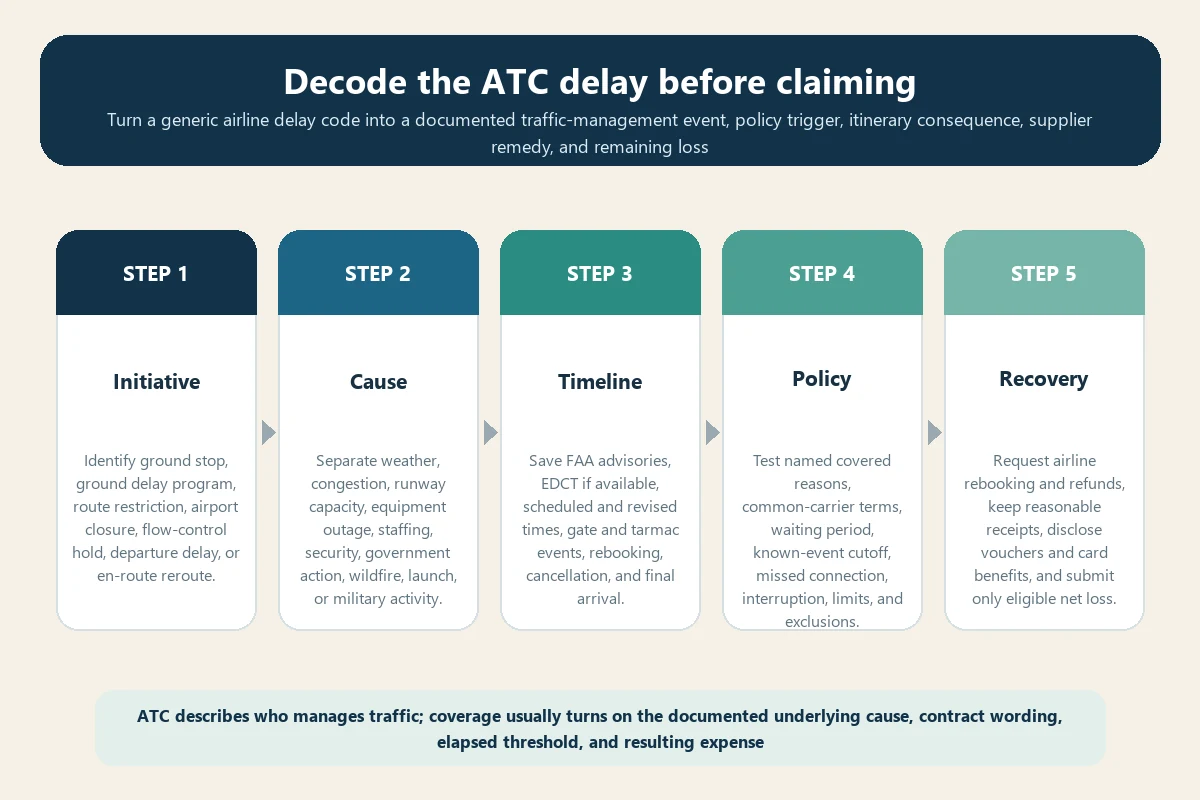
- Identify the exact traffic-management initiative.
- Determine the documented underlying cause.
- Save the FAA event detail while it is live.
- Obtain the airline’s flight-specific written reason.
- Preserve scheduled, revised, and actual times.
- Test the policy’s named reason and waiting period.
- Separate terminal, tarmac, connection, and arrival delays.
- Request rebooking, refunds, and applicable amenities first.
- Keep reasonable, itemized additional-expense receipts.
- Disclose recoveries and submit only the documented net loss.
Bottom line
Travel insurance air traffic control delay coverage starts by decoding the generic ATC label. Identify the initiative, prove the underlying cause, preserve the FAA and carrier timelines, and then test the exact policy provision and waiting period.
That evidence-first sequence distinguishes an operational restriction from an insured loss and produces a clearer claim for the eligible expense that remains.
A missing or timed-out crew is an airline staffing event, not an ATC restriction. Use this travel insurance flight crew shortage coverage guide to identify the crew problem, preserve controllable-delay remedies, test policy wording, and calculate net loss.
Closed or restricted airspace needs its own order, scope, cause, and reroute analysis. Use this travel insurance airspace closure coverage guide to preserve airline refunds, verify the aviation restriction, test exclusions and timing, and calculate net loss.
An airport closure requires facility-specific evidence and a separate recovery sequence. Use this travel insurance airport closure coverage guide to verify the closure, compare carrier alternatives, preserve refund rights, test policy wording, and document net loss.
A blackout needs system-specific evidence even when it does not close the entire airport. Use this airport power outage travel insurance guide to locate the failure, verify its cause, preserve airline remedies, test policy wording, and document net loss.
Dust storms create a visibility-specific weather and airport evidence chain. Use this dust storm flight cancellation travel insurance guide to preserve NWS warnings and FAA traffic actions, use airline remedies, test policy timing, and claim net loss.
Wind shear needs runway-specific alert, flight-maneuver, and final carrier evidence. Use this wind shear flight cancellation travel insurance guide to distinguish an alert from a go-around, hold, diversion, or cancellation, preserve remedies, test thresholds, and claim net loss.
