

Travel insurance for French Polynesia from USA trips should match the exact archipelago, domestic flights, ferries, cruises and water activities—not treat Tahiti, Bora Bora and a remote atoll as one medical location. The practical question is how the traveler reaches appropriate care and how each supplier responds when an island link fails.
Key takeaways
- Map every island and carrier; medical capability is concentrated on the major islands.
- Ask how an emergency moves from an outer island to Tahiti and when a further evacuation is authorized.
- Verify diving, recompression, boat rescue and medical evacuation as separate policy terms.
- Treat a cruise, domestic flight, ferry and hotel as separate contracts and evidence sources.
- Save official weather information with the supplier action and actual refund.
Planning information reviewed August 16, 2026. Entry rules, medical capacity, weather guidance, carrier schedules and policy terms can change. Recheck official sources, suppliers and the issued certificate for the travel dates.
Build the archipelago itinerary
List Tahiti, Moorea, Bora Bora, Raiatea, Taha’a, Huahine, Rangiroa, Fakarava, the Marquesas, Austral Islands and every other stop. Add the international flight, domestic air pass or individual ticket, ferry, resort boat, cruise, transfer and prepaid excursion.
Record the operator, departure point, schedule, baggage rule, last service and refund terms for each handoff. Give the full island chain to the insurer. “Tahiti vacation” is not enough when the traveler will be several transport stages from Papeete.
Map care from an outer island to Tahiti
U.S. Department of State French Polynesia travel guidance says care is generally good on major islands but limited in less populated areas. Serious cases are often referred to Tahiti, and an emergency may require air movement to Papeete.
For every remote stay, identify the local dispensary or clinic, airfield or harbor, practical transport to Tahiti and a higher-capability facility. This is a planning chain, not a promise that a specific flight or bed will be available.
Test the evacuation destination wording
Ask who determines medical necessity, selects the receiving facility and authorizes transport. One certificate may pay movement to the nearest suitable facility, while another offers a later transfer under additional conditions. Neither phrase automatically means return to a U.S. hospital.
The evacuation-limit guide turns the headline amount into questions about approval, aircraft, medical escort and receiving capacity. Ask how the policy handles movement from an outer island to Papeete and a possible later international transfer.
Prepare for provider payment
State guidance reminds travelers that U.S. Medicare and Medicaid do not apply overseas and that many overseas providers accept cash payment rather than U.S. insurance. Ask assistance whether it can contact an appropriate facility and issue a payment guarantee.
Keep secure backup payment capacity without assuming reimbursement. Request diagnosis, itemized charges in Pacific francs, payment proof, prescription and discharge instructions. The health insurance abroad guide structures the separate call to the traveler’s U.S. plan.
Audit diving and recompression planning
Give the insurer the diver’s certification, planned depth, gas, operator, boat and atoll. Ask whether the policy covers an initial boat response, medical treatment, recompression, inter-island movement and international evacuation. Verify the operator’s oxygen, communications and emergency plan.
A chamber shown on a directory is not proof of current operation or immediate access. Ask assistance how it confirms suitable treatment when an event occurs. The activity-exclusions guide helps compare depth, equipment and guide clauses.
Separate a cruise from the island stays
Record the cruise line, ship, embarkation, ports, tender operations, cabin cost, excursions and return-to-ship times. Ask how the certificate defines a cruise, shipboard medical care, missed embarkation, missed port and evacuation from a vessel.
The cruise policy clauses guide identifies the wording to compare. A cruise line’s guest service, onboard bill and the traveler’s insurance are separate layers. Preserve the ship’s medical record and itemized account.
Test every domestic flight and ferry
Ask whether the actual domestic airline, scheduled ferry, resort launch or charter meets the policy’s carrier definition. Save passenger names, schedules, tickets, baggage rules and the onward international connection. Note whether separate tickets provide any through-protection.
If a carrier cancels, request the operational reason and next available service. Save the hotel or cruise response and every refund. The delay, interruption and cancellation guide helps classify added nights, unused stays and replacement transport.
Use official weather information by island group
Météo-France Polynésie française publishes current forecasts and cyclone information. The territory spans a large area, so save the named island group, bulletin time, expected period and hazard rather than a screenshot without location.
Then connect the bulletin to an airline, ferry, cruise, resort or excursion decision. A tropical system may affect one archipelago differently from another. Coverage depends on certificate wording and the resulting loss, not the existence of a wet or cyclone season.
Distinguish warning, closure and voluntary change
Create a timeline beginning with the first trip payment and policy purchase. Add the official bulletin, carrier notice, lodging response, replacement decision and refund. This shows whether the event was already known and which supplier controlled each loss.
The weather-delay guide explains why poor conditions alone may not activate a benefit. A traveler’s sensible choice to add buffer time can reduce risk even when it is not reimbursable.
Review health guidance for the real islands
The CDC publishes current French Polynesia traveler health guidance. Review vaccines, mosquito exposure, food and water, heat, medicines and water activities with a clinician. Include every island group and the traveler’s medical history.
Ask the certificate about unexpected illness, pre-existing conditions, preventive care and medicine replacement. Carry necessary lawful prescriptions in original packaging with supporting records. Remote access can make ordinary continuity planning more important.
Compare one realistic island scenario
Use identical travelers, dates and prepaid amounts for every quote. Include Tahiti, an outer atoll, domestic flights, a resort boat, diving, a cruise segment, severe weather, urgent local care and possible referral to Papeete.
- Which carriers qualify for delay or missed-connection benefits?
- What dive depth, equipment and operator rules apply?
- Who authorizes movement to Tahiti?
- When could a further evacuation be considered?
- How is provider payment arranged?
- Which airline, cruise or resort refunds reduce the loss?
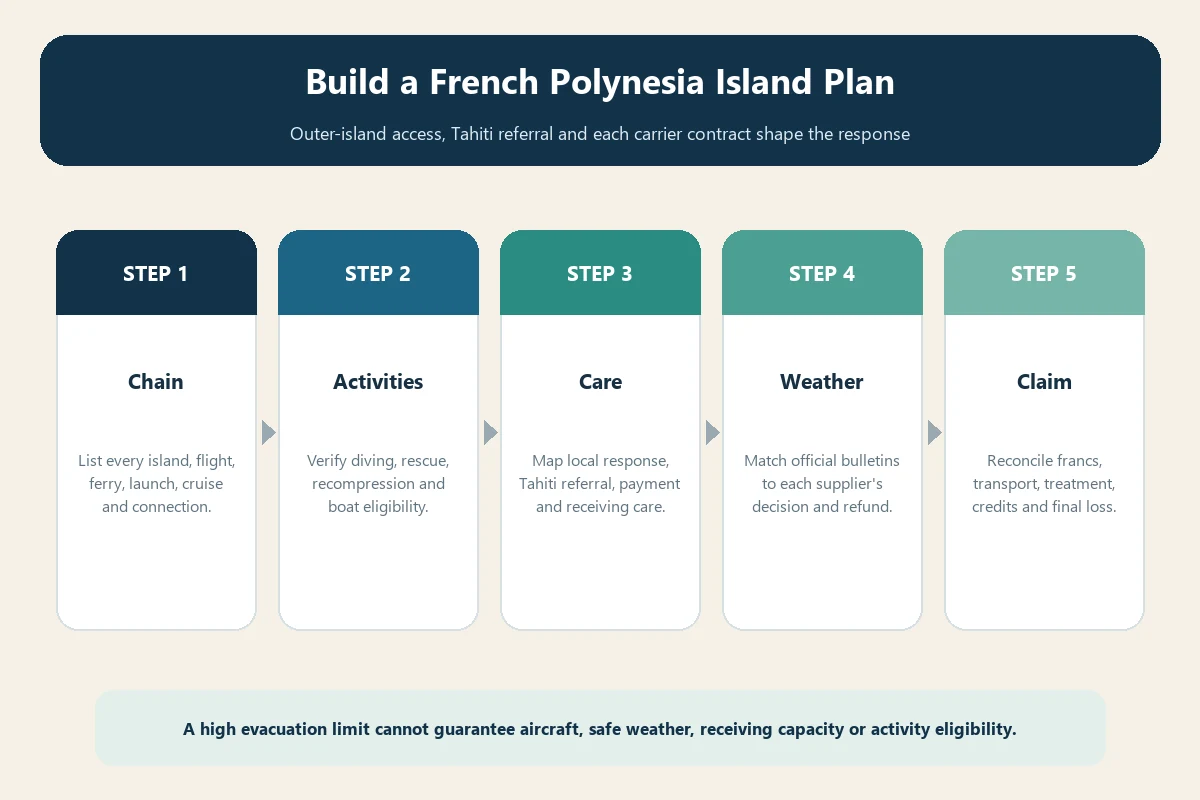
Read the full certificate. A large evacuation number cannot guarantee aircraft, weather, receiving care or activity eligibility.
Use assistance as an operating log
Store the policy, assistance contact, lodging coordinates, carrier numbers and emergency number 15 offline. In a serious event, obtain necessary local help and notify the insurer as soon as practical. Record names, times, case numbers and instructions.
The assistance versus claims guide explains why coordination is not final coverage approval. Ask for written confirmation before a costly nonemergency movement whenever circumstances allow.
Build an archipelago claim ledger
Label every document by island, traveler, supplier, local time, Pacific franc amount and policy section. Keep medical, airline, ferry, cruise, hotel and activity records in separate folders even when one event connects them.
Add supplier returns, credits, card benefits and health-plan payments beside the related cost. The claim documentation guide shows how to calculate the final unreimbursed amount and record the actual currency conversion.
Rehearse a broken carrier chain
Work backward from the international departure. Identify the last reasonable domestic flight or ferry, the next service and a safe Tahiti buffer. If the connection fails, contact the operating carrier before buying a replacement and save the alternative it offered.
Record why a new ticket or added night was necessary. A tight self-built itinerary can create losses that no supplier accepts. Insurance eligibility still depends on the named carrier, covered reason and waiting period.
Create an offline island response card
List the traveler’s passport name, allergies, medicines, policy, assistance line, resort coordinates, dive operator, ship and next practical medical point. Give a companion and home contact the same information and a missed-check-in rule.
A response card does not guarantee rescue, but it reduces delay caused by missing route or medical facts. Pair it with weather compliance, licensed operators, connection margins and a realistic plan for losing mobile service.
Audit language, currency and separate tickets
Keep French and English copies of critical medical or carrier messages when available. Preserve the original document, and translate only what the insurer requests. Record the Pacific franc amount, card settlement and actual conversion instead of applying one later online rate to every transaction.
For separate domestic and international tickets, ask each airline what protection it provides when the earlier flight fails. Record minimum check-in, baggage collection and the last reasonable island departure. A missed long-haul flight may depend on the policy’s carrier definition and connection provision rather than the traveler’s expectation of a through journey.
Keep baggage-delay records by carrier and island, because a bag transferred by several operators may have different tracing numbers, delivery promises and reimbursement responsibilities.
Price a Tahiti buffer night against the potential replacement fare and cruise or hotel loss. The buffer may be a personal planning cost, but it can protect a self-built itinerary that no carrier treats as one contract. Save the final schedule and all ticket conditions with the policy file.
Bottom line
A strong French Polynesia plan follows the traveler across every island and carrier. Map local care through Tahiti, verify diving and cruise wording, preserve official weather and supplier evidence, and reconcile every refund before claiming the remaining loss.