
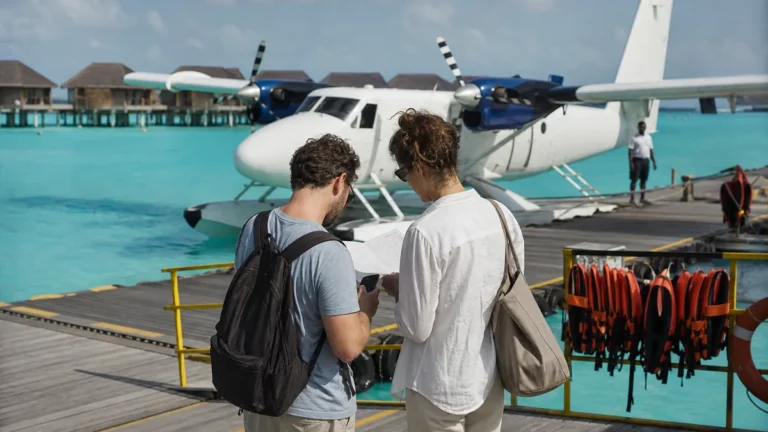
Travel insurance for Maldives trips should cover the part of the journey that starts after you land at Velana International Airport: the seaplane or speedboat transfer, the resort island, local medical response and inter-island evacuation to suitable care. Medicare usually does not pay for health care outside the U.S., and the CDC notes that travelers will likely pay out of pocket for care abroad, so medical and evacuation benefits matter more than headline limits. This guide follows each link in that island chain and shows what to ask before you pay the balance.
Key facts
- Ambulance service is generally unreliable outside Malé and Hulhumalé, so the resort's transport plan is part of your coverage.
- Medicare usually does not cover health care outside the U.S.; get your domestic plan's answer in writing before you go.
- The CDC advises considering medical evacuation insurance, which covers transport from a remote area to a suitable hospital; evacuation may end at the nearest suitable facility, not home.
- Delay benefits may require a common carrier; confirm whether the resort seaplane or speedboat fits the policy definition.
- Disclose scuba, freediving and motorized water activities by name; a beach vacation label can leave dives excluded.
- Weather alone does not prove a covered loss; pair the official bulletin with the carrier or resort action that changed the trip.
Key takeaways
- Put every international flight, resort transfer and island stay on one dated route sheet.
- Ask who coordinates movement from the resort to Malé or another suitable facility.
- Verify scuba, freediving and motorized water activities against the issued certificate.
- Separate weather, carrier, resort and traveler decisions when documenting a disruption.
- Compare plans with one realistic island scenario, not headline limits alone.
Planning information reviewed August 16, 2026. Entry rules, health guidance, transfer schedules, medical capacity and policy language can change. Recheck official sources, each supplier and the issued certificate before departure.
Build the trip after Velana International Airport
Write down the U.S. departure, every connection, arrival at Velana International Airport, the domestic terminal or boat point, resort transfer and room check-in. Add the return sequence. Record separate ticket numbers, baggage rules, transfer cutoff times and the last connection of the day.
A package sold as one vacation may contain several legal contracts. Ask the resort which company operates the seaplane or speedboat, who controls rebooking and what happens after an international delay. Save the answer with the invoice rather than relying on a chat message visible only in an app.
Check current U.S. guidance before buying
The U.S. Department of State publishes current Maldives travel guidance, including safety, entry and medical information. Review the page when paying the first deposit, when coverage is purchased and again before travel. Save the version or date reviewed.
Do not assume a policy responds merely because official advice changes. Ask how the certificate defines a travel advisory, foreseeable event, destination and covered cancellation reason. A warning, a supplier cancellation and a traveler’s personal decision can produce different claim outcomes.
Map an island-to-care pathway
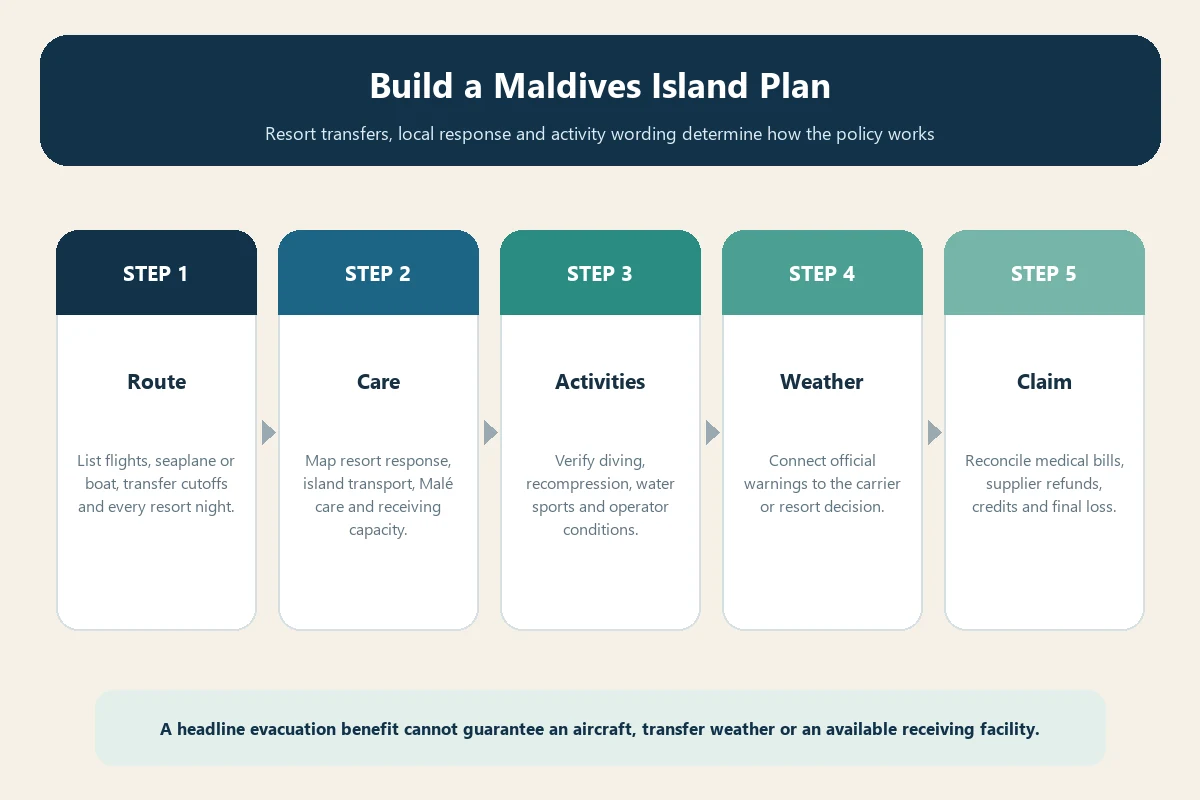
State guidance says ambulance service is generally unreliable outside Malé and Hulhumalé. It also notes that some inter-island sea or air ambulance service exists but does not serve the whole country. That makes the resort’s first-response and transport plan a practical insurance question.
Ask the resort where a minor injury is treated, how a serious patient reaches the departure dock or airfield, and which facility would normally receive the traveler. Then ask the insurer who must authorize each movement. The remote medical evacuation guide helps turn that route into a call checklist.
Ask where evacuation actually ends
“Medical evacuation” may mean transport to the nearest suitable facility, not automatic return to the United States. Ask who chooses the receiving facility, what medical necessity means, whether inter-island transport is included and when a later international move could be considered.
Read the authorization, medical escort, aircraft, companion and repatriation provisions together. The evacuation limit guide explains why a large benefit number is only one part of operational coverage. Weather, aircraft availability and receiving capacity remain real constraints.
Prepare for medical payment on the islands
State guidance says medical care is not free and reminds travelers that U.S. Medicare and Medicaid do not cover bills abroad. Ask the traveler’s domestic health plan what, if anything, it covers outside the United States. Get the response in writing.
Ask the travel insurer whether its assistance team can contact a provider or arrange a payment guarantee. Keep a secure backup payment method without assuming reimbursement. Collect the diagnosis, itemized charge, proof of payment, prescription, discharge note and any referral. The U.S. health insurance abroad guide structures that separate verification.
Disclose scuba and water activities precisely
List certification level, planned depth, breathing gas, liveaboard segments, night dives, freediving, jet skiing, parasailing and any other activity. Ask whether each one is included, excluded or subject to a guide, equipment, depth or licensing condition. Do not describe the trip only as a beach vacation.
Ask the dive operator about oxygen, communications, recall procedures and its written emergency plan. Coverage for initial rescue, medical treatment, recompression and later evacuation may sit in different clauses. Use the activity exclusion guide to compare the exact wording.
Treat chamber access as a logistics question
A chamber named in an online list is not proof that it is operating, staffed or reachable when needed. Ask the operator how it obtains current information and ask the insurer how assistance identifies an appropriate facility during an incident.
Save the dive log, operator report, boat record and treating clinician’s notes after any event. Contact assistance as soon as reasonably possible, but do not delay urgent local care to complete paperwork. Document why each transport step was medically necessary.
Cover transfer delays, weather and health risks
Some delay benefits require a common carrier or impose a waiting period. Ask whether the scheduled seaplane, domestic flight, resort speedboat or private launch fits the policy definition. Confirm whether a transfer included in the hotel package is treated differently from a separately ticketed service.
If a connection fails, request the operational reason, cancellation notice, next available transfer and resort response. The delay, interruption and cancellation guide helps separate extra nights, replacement transport and unused accommodation instead of placing everything under one label.
Build a weather evidence timeline
Weather alone does not prove a covered loss. Save the official bulletin, named island or atoll, issue time and affected period. Pair it with the airline, seaplane, boat or resort action that actually changed the itinerary. Add all refunds and alternatives offered.
The Maldives Meteorological Service provides official forecasts and warnings. Recheck them close to travel. The weather delay guide explains why a closure or carrier cancellation is stronger evidence than a screenshot of rain.
Review health risks for the traveler, not the brochure
The CDC maintains current Maldives traveler health guidance. Review recommended vaccines, mosquito exposure, food and water precautions, heat, medicines and water safety with a qualified clinician. Start early enough to act on medical advice.
Ask the policy how it handles unexpected illness, pre-existing conditions, preventive care and medicine replacement. Carry lawful prescription medicine in original packaging with supporting documentation. Pack sufficient supply plus a reasonable delay margin after confirming local rules.
Calculate trip cost, compare quotes and prepare the claim
Create a ledger for international airfare, resort, domestic air or boat transfer, prepaid activities, liveaboard, taxes and nonrefundable fees. Label refundable and nonrefundable amounts. Do not insure the same expense twice or include costs the supplier has already promised to return.
Update the declared amount after adding a room, transfer or excursion if the certificate requires it. Keep the first deposit date and purchase date. Eligibility for some time-sensitive provisions may depend on these records and the policy’s rules.
Compare one realistic resort scenario
Use the same travelers, dates, medical history and prepaid amounts for every quote. Test an inbound flight delay that misses the last resort transfer, two added nights near Malé, an unused resort night, a dive injury and possible movement to suitable care.
- Does the transfer operator satisfy the carrier definition?
- What waiting period applies to the inbound delay?
- Which unused resort cost is nonrefundable?
- Is the planned dive activity eligible?
- Who authorizes inter-island medical transport?
- Which supplier refunds must be deducted?
Record answers with the policy section. A salesperson’s summary does not replace the certificate, schedule of benefits and exclusions.
Understand assistance versus reimbursement
The assistance team may locate a provider, open a case and coordinate transport. The claims team later decides whether the loss satisfies the contract. Ask for a case number and written instructions. Note every caller, time and decision in local time and the insurer’s time zone.
The assistance versus claims guide shows how to preserve this operating record. Before arranging a costly nonemergency movement, request authorization whenever circumstances allow.
Reconcile the resort and carrier refunds
Ask each supplier for a written cancellation or change notice, the reason, unused amount, refund, credit and alternative. A resort package can hide which company controlled the failed transfer. Break the invoice into lodging, transport and activity components.
Claim only the remaining eligible loss after refunds, card benefits and other payments. The travel insurance claim guide provides a clean document order. Preserve original currency amounts and the actual card conversion.
Create an offline island response card
Store the passport name, allergies, medicines, policy number, assistance contact, resort coordinates, transfer operator, planned dives and nearest practical response point. Give a companion and a home contact the same information. Include a missed-check-in rule for independent excursions.
Download the policy and key reservations before leaving the United States. Mobile service and battery power can fail. A printed one-page route and medical summary can help a resort or assistance coordinator understand the situation quickly.
Use connection margins as prevention
Compare the last island transfer with the scheduled international arrival and allow for immigration, baggage and terminal movement. On the return, price a Malé-area buffer against the risk of missing a long-haul flight. A voluntary buffer may not be reimbursable, but it can protect a self-built itinerary.
Ask whether international and domestic tickets offer through-protection. If not, record each carrier’s rule. Insurance should support a reasonable plan; it does not convert separate contracts into one guaranteed journey.
Bottom line
The strongest Maldives plan connects the insurance certificate to the actual island chain. Verify resort transport, local medical response, evacuation authorization, water activities and weather evidence before paying the balance. During a disruption, preserve supplier decisions and subtract every recovery from the final documented loss.
Sources and further reading
- Maldives – Traveler view | Travelers' Health | CDC — CDC Maldives guidance: be up to date on routine vaccines, dengue is a year-round risk, and the advice to consider buying medical evacuation insurance.
- Travel Insurance | Travelers' Health | CDC — If you need medical care in another country you will likely need to pay out of pocket; medical evacuation insurance covers emergency transportation from a remote area to a high-quality hospital.
- Travel outside the U.S. | Medicare — Medicare usually doesn't cover health care while traveling outside the U.S., with some exceptions; Medigap policies may cover emergency care abroad.