
An anonymous travel insurance complaint may be available for a suspected-fraud tip in some states, but an individual consumer complaint seeking review of a claim usually requires identity, policy, claim, contact, and authorization information. The regulator needs to distinguish the insured, obtain records, send the complaint to the company, and communicate an outcome.
Anonymous, confidential, and nonpublic are different concepts. Providing your name to an agency does not necessarily make it public, while submitting anonymously does not guarantee that the facts cannot identify you. This guide is general information, not legal advice.
Define what you want the regulator to do
Decide whether you want the department to review your denied or delayed claim, explain policy handling, obtain a company response, investigate a licensed entity, record a market-conduct concern, or receive a suspected-fraud tip.
Individual assistance usually requires a case that can be tied to a policyholder and claim. A tip can alert investigators without creating a consumer-service relationship or personal remedy.
Distinguish a consumer complaint from a fraud report
A consumer complaint generally asks the insurance department to review conduct involving a specific insurer, producer, policy, claim, or transaction. A fraud report alleges intentional deception or another potentially criminal or administrative violation.
Do not label a coverage disagreement “fraud” merely to use an anonymous channel. State only facts and evidence that support the suspected conduct.
Read the regulator’s identity requirements
Review the consumer complaint form, fraud-report page, privacy statement, public-record notice, authorization, and required fields. Some portals require an account and verified contact details; paper forms may still require a signature.
The Utah Insurance Department consumer complaint form expressly says anonymous complaints are not accepted and may become public records. That is Utah’s stated process, not a nationwide rule.
Understand why identification can be necessary
The department may need to verify the policyholder, match the correct contract, obtain private records, distinguish similarly named consumers, ask follow-up questions, protect another person’s data, and send the complaint to the insurer for response.
A name-free narrative may not establish that the filer has authority to receive claim information. The state travel insurance complaint guide explains the identity, jurisdiction, insurer, chronology, evidence, and requested-review fields normally needed.
Know what an anonymous fraud channel can do
An anonymous tip can provide names of suspected entities, dates, transactions, documents, advertisements, payment instructions, licensing concerns, or patterns. Investigators decide whether the information falls within their authority and warrants action.
The Ohio Department of Insurance online fraud complaint form provides a checkbox for a reporter who wishes to remain anonymous. North Carolina consumer fraud materials also state that information may be reported anonymously. Those examples concern fraud reporting, not a promise of personal claim resolution.
The official Ohio insurance fraud complaint form separates the reporter’s contact information from an explicit anonymous-report option. The Pennsylvania Attorney General insurance fraud referral likewise asks whether a private citizen wishes to remain anonymous. Neither page should be substituted for the state insurance department’s ordinary consumer complaint process.
Compare the outputs before choosing a route
An identified consumer complaint can produce a case number, requests for evidence, a company response, analyst communication, and an explanation of the regulator’s review. An anonymous fraud report may instead enter an investigative intake process that does not provide the reporter with status, a company response, or an individualized claim decision.
Write down the desired output carefully before submitting anything. If the goal is payment or correction of a personal claim, continue the insurer’s appeal and ask the consumer-services unit what identity and authorization it requires. If the goal is to alert investigators to suspected criminal or licensing conduct, use the fraud channel the responsible authority identifies.
Know what anonymity can prevent
Investigators may be unable to verify source reliability, request missing documents, clarify ambiguous dates, authenticate messages, obtain consent, or report the outcome. The insurer may not be able to identify which transaction to review without facts that indirectly reveal the claimant.
An anonymous report may therefore contribute to oversight without producing a payment, corrected claim decision, explanation, or status update for the traveler.
Do not confuse anonymity with confidentiality
An identified complaint can be protected from general public disclosure under some state laws while still being shared with the insurer and authorized agencies. An anonymous complaint can sometimes be identifiable from the narrative or exhibits.
Use the complaint public-record privacy guide to compare disclosure, insurer sharing, redaction, and confidentiality notices.
Review public-record rules before choosing
Indiana’s insurance complaint page says a consumer complaint becomes a public record and is sent to the company. Illinois, by contrast, describes insurance complaints as confidential records released only to the originating policyholder, insured, or enrollee.
These state examples show why “identified” and “public” are not synonyms. Check the exact jurisdiction rather than assuming anonymity is the only privacy protection.
Consider whether the facts identify you anyway
A unique trip, exact loss date, claim amount, medical event, adjuster conversation, policy number, payment reference, or attached email can reveal the person even without a name.
Do not promise anonymity to another traveler when the evidence is inherently identifying. Ask the receiving agency what it can protect and what may be disclosed.
Minimize unnecessary personal data
Use required fields and relevant evidence. Remove passwords, one-time codes, complete card numbers, unrelated bank transactions, unrelated medical history, and third-party identifiers when the regulator permits.
Keep complete originals securely. Redaction should reduce unnecessary exposure, not conceal decisive facts or alter evidence.
Use an authorized representative when appropriate
If the concern is health, disability, language, technology, fear of direct contact, or administrative burden, a properly appointed representative may provide a better route than anonymity. The consumer remains identified to the agency while another person handles communications.
The authorized representative guide explains the form, scope, information access, signatures, legal capacity, and revocation process.
Ask about confidential contact options
Before abandoning a consumer complaint, ask whether the department can use a secure portal, protected messages, a safe mailing address, limited telephone contact, language assistance, accessibility support, or a designated representative.
Do not create a false identity or misleading address. Explain the safety or privacy concern and request the agency’s accepted procedure.
Separate whistleblower or employee concerns
An employee, contractor, vendor, or producer may have information about systemic conduct but also employment, licensing, confidentiality, retaliation, or legal obligations. Consumer complaint forms may not be the correct channel.
Consult the department’s market-conduct, fraud, licensing, or whistleblower instructions and obtain qualified legal advice before sending proprietary or privileged material.
Build an evidence-first fraud tip
If an anonymous route is allowed, provide objective facts: who, what, when, where, transaction method, licensed entity, exact representation, payment path, corroborating record, and why the conduct appears suspicious.
Avoid speculation about motive. Identify which facts you personally observed and which came from another source.
Do not expose another person’s records
An anonymous filer still lacks automatic authority to disclose a spouse’s, companion’s, employee’s, patient’s, or customer’s complete health and financial file. Limit the submission to lawfully possessed, relevant information.
Use a representative or legal-capacity process when seeking action for someone else. Do not treat anonymity as a substitute for consent.
Understand that anonymous reports may receive no updates
Without verified contact information, the agency may be unable to acknowledge receipt, request clarification, or provide a disposition. Some fraud investigations are also confidential even when contact details exist.
If you filed an identified consumer complaint and simply received no acknowledgment, use the no state response guide instead of converting it into an anonymous duplicate.
Avoid duplicate submissions
Do not file the same matter as an identified complaint, anonymous fraud report, and multiple state cases without disclosure. Different routes may be justified, but each should identify the related case numbers where permitted and explain its distinct purpose.
If the wrong department received the filing, use the wrong-state complaint guide to correct jurisdiction rather than hiding identity in a second submission.
Protect claim and legal deadlines
An anonymous fraud tip generally does not replace an insurer appeal, proof-of-loss requirement, contractual limitation period, lawsuit filing, arbitration demand, chargeback, or supplier refund request.
Continue every applicable deadline independently. Seek qualified legal advice promptly when retaliation, criminal conduct, employment rights, safety, or a substantial financial dispute is involved.
Keep a private reporting log
Retain the official instructions, submitted narrative, exhibits, confirmation or tracking reference, date, channel, agency, related consumer cases, and every follow-up. Store sensitive evidence with access controls.
The log should distinguish anonymous tips, identified complaints, insurer appeals, law-enforcement reports, and private legal action.
Bottom line
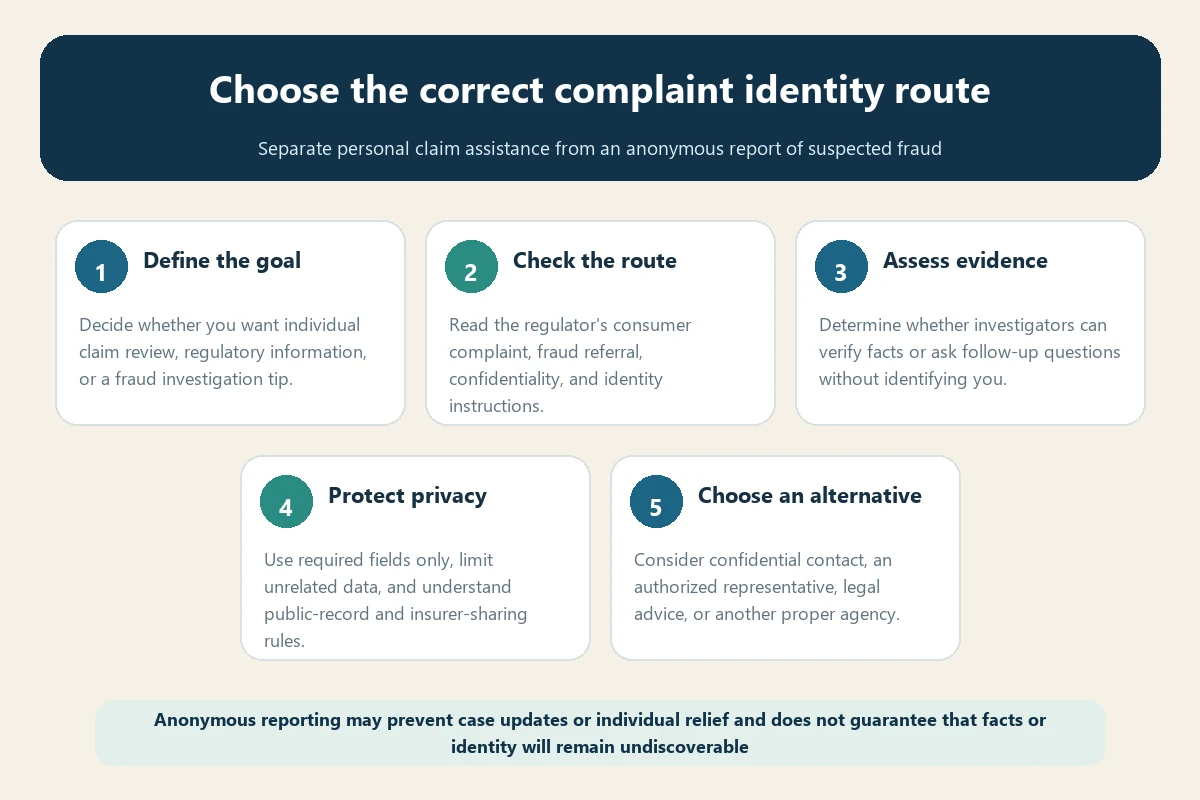
An anonymous travel insurance complaint may be possible as a fraud tip in some jurisdictions, but a consumer complaint seeking review of a personal claim usually requires identification and authorization. Define the goal, read the regulator’s exact route, understand privacy and public-record limits, minimize unrelated data, and consider an authorized representative or secure contact method when anonymity would prevent meaningful assistance.
