
If a travel insurance complaint reaches the wrong state department, preserve the first filing, identify where the policy was issued or delivered, confirm the purchaser’s residence and licensed insurer, and ask the agencies whether the matter can be referred or must be refiled. Do not assume the trip destination or insurer headquarters determines jurisdiction.
State insurance authority depends on the contract, transaction, regulated entity, alleged conduct, and applicable law. A wrong-state notice is not a decision on coverage, but delay can affect other deadlines. This guide provides general information, not legal advice.
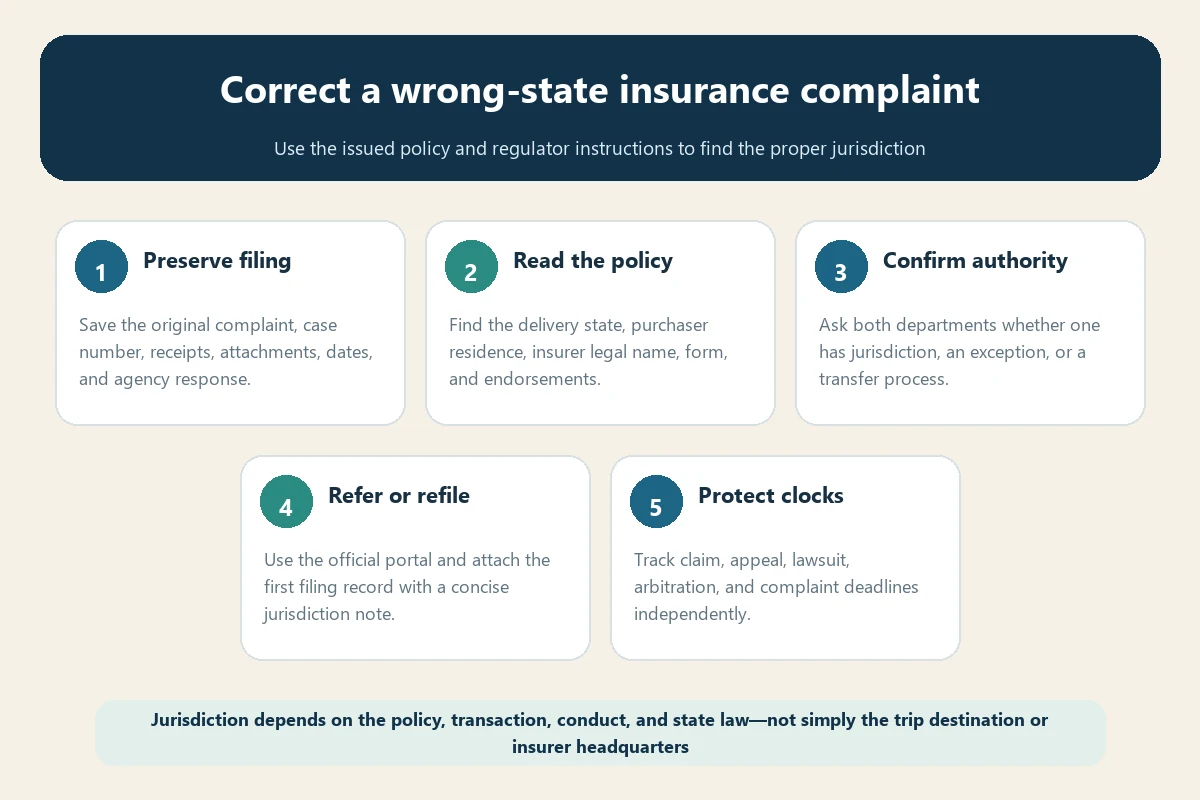
Save the original complaint record
Keep the complaint, exhibits, portal receipt, case number, submission date, acknowledgment, agency response, and every message about jurisdiction. Export online records before access expires and retain original files unchanged.
Create a short transfer index listing each document and date. The travel insurance claim status guide can track both regulator contacts and separate insurer deadlines.
Read the agency notice literally
Determine whether the department says it lacks jurisdiction, needs more information, regulates the insurer but not the disputed conduct, or recommends another agency. A request for the declarations page is not the same as a final refusal.
Record the exact reason and any named destination agency. Ask whether the department will transfer the record, close it, or require you to submit a new complaint yourself.
Start with the issued policy
Locate the declarations, certificate, schedule, application, purchase confirmation, delivery email, state endorsement, form number, and notices. Record the purchaser’s address at purchase and the legal name of the underwriting insurer.
The seller’s brand, administrator, assistance provider, and booking platform may differ from the insurer. Jurisdiction analysis should name every involved entity and its role.
Find where the policy was issued or delivered
Many departments point consumers to the state where the contract was issued, purchased, or delivered. The Iowa Insurance Division complaint instructions state that Iowa generally cannot accept a complaint about a policy issued or purchased in another state, even when the insurer is based in Iowa.
Do not infer the issuance state from a mailing address alone. Use the policy, purchase record, endorsement, and regulator confirmation.
Do not use insurer headquarters as the only test
An insurer can be domiciled in one state, sell a policy to a resident of another, use a third-state administrator, and cover travel worldwide. Corporate headquarters may help identify the company but does not automatically select the consumer complaint forum.
Ask the proposed regulator whether the insurer is licensed there and whether the policy or alleged conduct falls within its authority.
Do not use the trip destination as the only test
A loss in Florida, Mexico, France, or on a cruise does not automatically place the insurance contract under that destination’s state or national regulator. The destination may control another issue, such as a supplier refund, medical provider bill, accident report, or local consumer complaint.
Separate insurance conduct from airline, hotel, travel-agent, healthcare, and payment disputes. Different agencies may handle different actors from the same trip.
Check purchaser residence and group-policy details
Individual travel insurance often records the primary policyholder’s residence. Group or blanket coverage can involve a certificateholder, employer, association, card issuer, or travel supplier. The relevant jurisdiction may depend on how the coverage was structured and delivered.
Collect the master-policy information available to you, certificate, sponsor identity, residence record, and any state-specific notice. Ask the department which document determines its analysis.
Recognize that exceptions can exist
A rule about out-of-state policies may have exceptions for resident consumers, sales conduct, unfair trade practices, or another statutory connection. The Maryland Insurance Administration jurisdiction page says Maryland law generally does not apply to policies issued elsewhere, but notes that some complaints may still fall within its authority, including certain alleged unfair trade practices involving a Maryland resident.
That is a Maryland example, not a nationwide rule. Ask the agency to evaluate the actual facts rather than arguing from another state’s website.
Use the NAIC department directory
The NAIC state insurance department directory provides official department contacts and complaint links. Navigate from the listed government site rather than a paid complaint intermediary.
Verify the portal domain, privacy notice, accepted files, signature requirements, and confirmation method before uploading policy, medical, identity, or financial records.
Ask the first department for a referral
Send a concise message with the case number: ask whether the department can refer or transfer the complaint, what record will move, whether you must file separately, and whether the original submission date will be communicated.
Do not assume transfer occurred until the receiving department confirms a new case number. Keep proof of every instruction and follow-up.
Contact the proposed receiving department
Before refiling, describe the policy issuance facts and the first department’s response. Ask whether the proposed department accepts the matter and what documents establish jurisdiction.
The Indiana Department of Insurance complaint page, for example, says Indiana law generally does not apply to policies issued in other states and directs consumers to the regulator in the issuing state. Use each department’s own guidance for the specific case.
Prepare a clean refiling packet
Include the new complaint form, declarations or certificate, purchase and delivery evidence, insurer legal name, claim and appeal decisions, concise chronology, disputed conduct, key exhibits, the first department’s jurisdiction notice, and the outcome requested.
Do not simply forward a long email chain. Explain in one paragraph why the receiving department appears to have authority and identify the prior case number.
Include a short comparison table if more than one state is plausible: policy delivery state, purchaser residence, sale location, insurer license, alleged conduct, and each regulator’s written guidance. This makes the jurisdiction question reviewable without asking an analyst to reconstruct it from scattered documents.
Keep the complaint issue focused
State what the insurer or producer did, when it occurred, which policy term or regulated duty is relevant, what evidence supports the concern, and what review you request. Avoid turning a jurisdiction correction into a new collection of unrelated disputes.
The state travel insurance complaint guide provides a complete structure for the factual narrative and exhibit index.
Preserve the insurer response and rebuttal
If the first department already obtained an insurer response, include it when permitted. Identify which points remain unresolved and whether the response addresses the correct policy and evidence.
Use the travel insurance complaint response guide to separate factual errors, policy interpretation, evidence gaps, calculations, and handling concerns.
If the first agency already closed the file, compare its stated finding with the complaint closure review guide. A jurisdiction closure and a no-violation closure are different outcomes and should not be described as the same decision.
Do not duplicate complaints without disclosure
Submitting the same matter to multiple agencies without identifying the related cases can create confusion, repeated document requests, and inconsistent records. Tell each department about prior and pending submissions.
If different agencies oversee different actors, create separate narratives and clearly define each requested review. Preserve a master chronology connecting them.
Protect sensitive information during transfer
Use authorized secure portals. Redact unrelated account numbers, passwords, full payment-card data, and third-party records when permitted. Do not email identity documents merely because an unofficial message requests them.
Record the files, page counts, channel, recipient, and delivery confirmation. Keep originals in a read-only archive.
Track every deadline independently
A jurisdiction dispute or agency referral may not pause the insurer’s internal appeal period, contractual limitation clause, statute of limitation, arbitration deadline, chargeback window, supplier refund deadline, or tax requirement.
Continue any timely insurer reconsideration that remains available. The denied travel insurance claim appeal guide helps keep the contract review moving while the departments resolve which regulator can examine the public-law complaint.
If a deadline is near or the amount is substantial, consult a qualified attorney promptly. Do not wait for two departments to resolve authority before obtaining advice.
Ask counsel whether notice to one agency preserves anything in another forum; do not assume that it does. Record the answer, the source of every deadline, and the next required act in a dedicated deadline chart.
Review the final jurisdiction outcome
Record whether the first complaint was transferred, referred, closed, or retained; whether the receiving department opened a case; and which issues each agency agreed to review. Save both case numbers and assigned contacts.
If neither department accepts the matter, request written explanations. Compare the stated reasons with the policy delivery evidence and obtain legal advice about the correct forum.
Keep the final audit file
Retain the policy, purchase record, jurisdiction evidence, complaints, exhibits, portal receipts, agency notices, referrals, insurer responses, rebuttals, closure letters, and a final deadline chart.
A complete file should let a new reviewer understand why the first department was selected, why authority was questioned, how the correct regulator was identified, what was refiled, and what rights remain.
Bottom line
When a travel insurance complaint goes to the wrong state department, preserve the first filing, identify the policy’s issuance and delivery facts, verify the licensed insurer, ask whether referral is available, refile through the official regulator when necessary, and track all other deadlines separately. Jurisdiction should come from the record and agency guidance—not from the destination, brand name, or headquarters alone.