
To withdraw a travel insurance complaint, contact the state insurance department through the existing case, identify the complaint number, state exactly what you want withdrawn or closed, and request written confirmation of the final status. Do not assume that telling the insurer the dispute is resolved will close the regulator’s file.
Withdrawal, closure, deletion, correction, and settlement are different actions. A department may close consumer assistance while retaining the complaint record, the insurer’s response, and the disposition data. It may also continue a separate regulatory review when the facts suggest a possible violation. Procedures vary by state, so use this guide as general information rather than legal advice.
Decide whether withdrawal is really the right request
First identify what changed. Perhaps the insurer paid the claim, the complaint was duplicated, the wrong department received it, an important fact was mistaken, or you prefer to pursue an internal appeal. The correct request may be to update, correct, transfer, or mark the matter resolved—not necessarily to withdraw it.
The National Association of Insurance Commissioners recognizes “Complaint Withdrawn” as a disposition for closed complaints. Its current consumer guidance also explains that state procedures vary and that a department ordinarily forwards an accepted complaint to the insurer for a response. These points matter: withdrawal is a recognized outcome, but the complaint may already have generated agency and company records.
Reasons travelers ask to close a complaint
- The insurer paid, reconsidered, or supplied the missing explanation.
- The same issue was submitted twice.
- The complaint named the wrong insurer, administrator, or state.
- The traveler needs to correct a material factual error.
- A settlement, appeal, arbitration, or lawsuit now controls the dispute.
- The filer lacked authority and an insured or authorized representative will proceed.
- The requested help falls outside the department’s jurisdiction.
If the only problem is an incorrect fact or missing document, an update is usually more accurate than withdrawing the entire case. Virginia’s insurance complaint portal, for example, directs consumers to add a comment or upload a document to the existing complaint. Pennsylvania similarly tells portal users to add a comment to an open complaint so the assigned investigator is notified. Follow your own department’s instructions.
Contact the existing case—not a new complaint
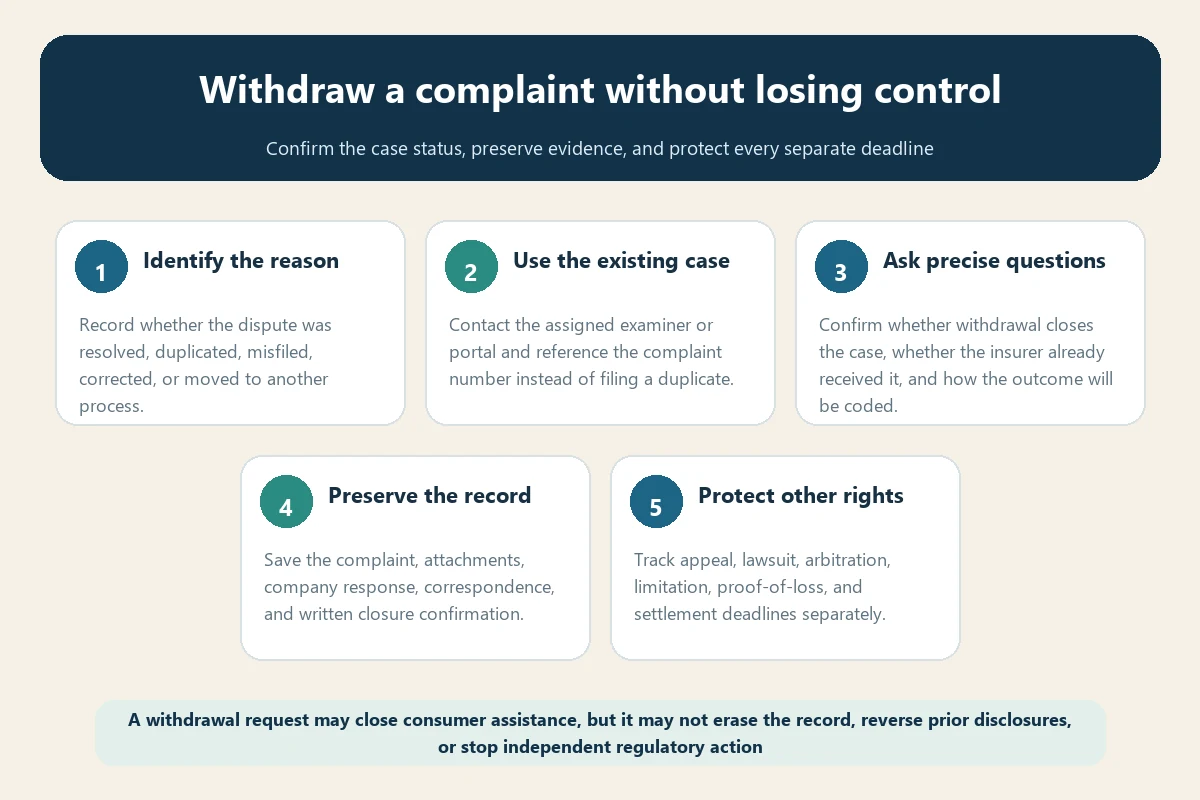
Use the regulator’s portal, the assigned examiner’s email, or the consumer hotline listed in the acknowledgment. Include the complaint or confirmation number, policyholder name, insurer name, policy or claim identifier where permitted, and reliable contact information. Avoid submitting a second complaint merely to request closure.
The Virginia State Corporation Commission complaint instructions explain how consumers can add comments and documents inside an existing numbered matter. The Pennsylvania Insurance Department portal FAQ likewise emphasizes the existing complaint ID. These are useful examples, not universal procedures.
Write a precise withdrawal request
A short factual request is usually stronger than a vague message such as “cancel everything.” State the reason without unnecessary personal detail. If the dispute was resolved, describe what was resolved and the effective date. If the complaint contains an error, identify the exact statement and provide the correction rather than asking that an inaccurate record simply disappear.
Re: Complaint [number]. I request that the department close my consumer complaint concerning [insurer and claim]. The reason is [brief factual reason]. Please confirm in writing the final disposition, whether the complaint was already sent to the company, whether any response remains part of the file, and whether the department requires another form or action from me. This request does not waive any policy, appeal, or legal right except as expressly stated in a separate signed agreement.
Do not use that final sentence as a substitute for legal review. An agency message cannot undo a release, settlement, court filing, contractual election, or expired deadline. If a lawyer represents you, a suit is pending, or a settlement contains withdrawal terms, follow counsel’s advice.
Ask what “withdrawn” means in that department
Before relying on the closure, request answers to these questions:
- Will the matter be coded withdrawn, resolved, closed, duplicate, no action requested, or something else?
- Has the complaint already been transmitted to the insurer or another agency?
- Must the insurer still send a response?
- Will the department issue a closure letter?
- Can the consumer request reopening if the insurer’s promised action fails?
- Will attachments and correspondence be retained under records rules?
- Can the department continue a market-conduct, licensing, or enforcement review?
The NAIC’s closed complaint disposition report describes disposition reporting based on data submitted by state insurance departments. A historical NAIC disposition table includes both “Complaint Withdrawn” and “No Action Requested/Required,” showing why the exact recorded outcome should be confirmed rather than guessed.
Withdrawal usually is not deletion
Once filed, the complaint may become an agency record governed by state retention, confidentiality, and public-record rules. It may also have been shared with the insurer so the company could investigate and respond. Asking to withdraw does not necessarily retrieve copies, delete email, remove audit logs, or prevent authorized statistical use.
Review the department’s privacy notice and the authorization you signed. The travel insurance complaint privacy guide explains how insurer sharing, redaction, medical information, and public-record rules can differ. Ask the regulator—not the insurer—to explain the status of the regulator’s file.
Preserve a complete copy before closure
Download or save the original complaint, every attachment, the submission confirmation, the case number, comments, agency emails, the insurer’s response, and the final closure notice. Record the date, method, recipient, and exact wording of the withdrawal request.
If the portal may become inaccessible after closure, save the material before sending the request. Keep unredacted originals in a secure location and use redacted working copies when possible. A later appeal may depend on proving what the insurer said, what evidence was submitted, and when each event occurred.
Do not sacrifice a claim appeal or legal deadline
A state consumer complaint generally does not replace the policy’s internal appeal, proof-of-loss requirement, contractual limitation, statutory limitation, arbitration deadline, court deadline, or deadline imposed by another agency. Filing, updating, or withdrawing the complaint may have no tolling effect.
Maintain a separate deadline calendar. If the company’s payment is conditional, confirm that funds cleared and that every promised correction occurred before asking for closure. If the complaint was closed without finding a violation, the closed-no-violation complaint guide explains how to evaluate the closure without treating it as a court judgment.
Handle settlements and releases carefully
An insurer may ask the consumer to withdraw the complaint as part of a settlement. Read the entire agreement. Determine whether it releases only this claim or broader claims, requires confidentiality, characterizes the payment, affects subrogation, or restricts future statements. A regulator closure request and a private release are separate documents with different consequences.
Do not tell the department that every issue is resolved if only part of the claim was paid. Instead, identify what remains disputed. Do not accept wording that is false or misleading. Seek qualified legal advice when the value, release scope, pending litigation, or limitation period makes the decision consequential.
Correct mistakes transparently
If you discover a wrong date, amount, identity, quotation, or allegation, notify the examiner promptly. Label the correction, explain why it is needed, and attach supporting evidence. Never withdraw merely to conceal a knowingly false submission. A transparent correction protects credibility and gives the regulator a usable record.
If jurisdiction was the problem, consult the wrong state insurance department guide before closing the first matter. Ask whether the department will transfer the complaint, refer you to the proper agency, or require a new filing. Preserve proof of the original filing because it may help explain timing, even when it does not preserve a separate deadline.
Confirm closure in writing
Do not treat silence as acceptance. Look for a portal status change, examiner email, or formal closure letter. The confirmation should identify the complaint, closure date, and disposition. If the wording is unclear, ask whether any response is still due and whether further consumer action is expected.
If the department does not respond, follow its status-check process and keep the case number in every message. The no state response guide provides a measured follow-up sequence. The Massachusetts Division of Insurance, for example, tells consumers who already filed to use its hotline or email for an update rather than starting over.
What to do after the complaint is withdrawn
- Verify that the portal and closure notice show the expected disposition.
- Confirm that any insurer payment, correction, or promised document was completed.
- Update the separate appeal and legal deadline calendar.
- Store the complete complaint record securely.
- Ask promptly about reopening if the resolution fails.
Also review the insurer’s written response before closing. The complaint response review guide helps compare the company’s position with the policy, chronology, documents, and requested remedy.
Frequently asked questions
Can I withdraw after the complaint was sent to the insurer?
You can ask, but the department may retain the file and the insurer may already possess the material. Ask whether a response is still required and how the case will be coded.
Will withdrawal erase the complaint?
Not necessarily. Closure and deletion are different. Records retention, confidentiality, public-record law, and agency systems determine what remains.
Can the regulator continue investigating?
Potentially. A department may have independent authority to examine suspected violations or broader conduct even if the consumer no longer seeks assistance. Ask the assigned examiner about the specific case.
Can I reopen a withdrawn complaint?
That depends on the department and the reason for closure. Ask before withdrawal what evidence, time limit, or new circumstances would be required. A new complaint may not revive an expired policy or legal deadline.
Should I withdraw as soon as the insurer promises payment?
Usually it is prudent to verify the payment and all promised corrections first. If timing is sensitive, tell the examiner that a resolution is pending and ask how to update the open case.
A careful withdrawal creates a clear ending without destroying your evidence or confusing separate rights. Use the existing complaint number, make the request precise, obtain written confirmation, preserve the full record, and treat every appeal or legal deadline as independent until a qualified source confirms otherwise.
