
Travel insurance arbitration agency theory disputes arise when a platform, insurer, producer, administrator, assistance company, supplier, purchaser, or traveler tries to invoke an arbitration clause through an alleged principal-agent relationship.
Agency is not established by a brand relationship or contract label alone. This U.S. consumer guide explains how to audit the entities, authority, control, manifestations, conduct, agreements, claims, and defenses. It is not legal advice.
Identify the requested enforcement direction
Start by recording who seeks arbitration and who resists. State whether a claimed agent invokes the principal’s agreement, a principal invokes an agent’s agreement, or one party argues that another person’s acceptance binds it.
The direction and governing state law shape the analysis. Do not assume that authority to perform one travel task includes authority to create or enforce arbitration rights.
Build an entity-level relationship map
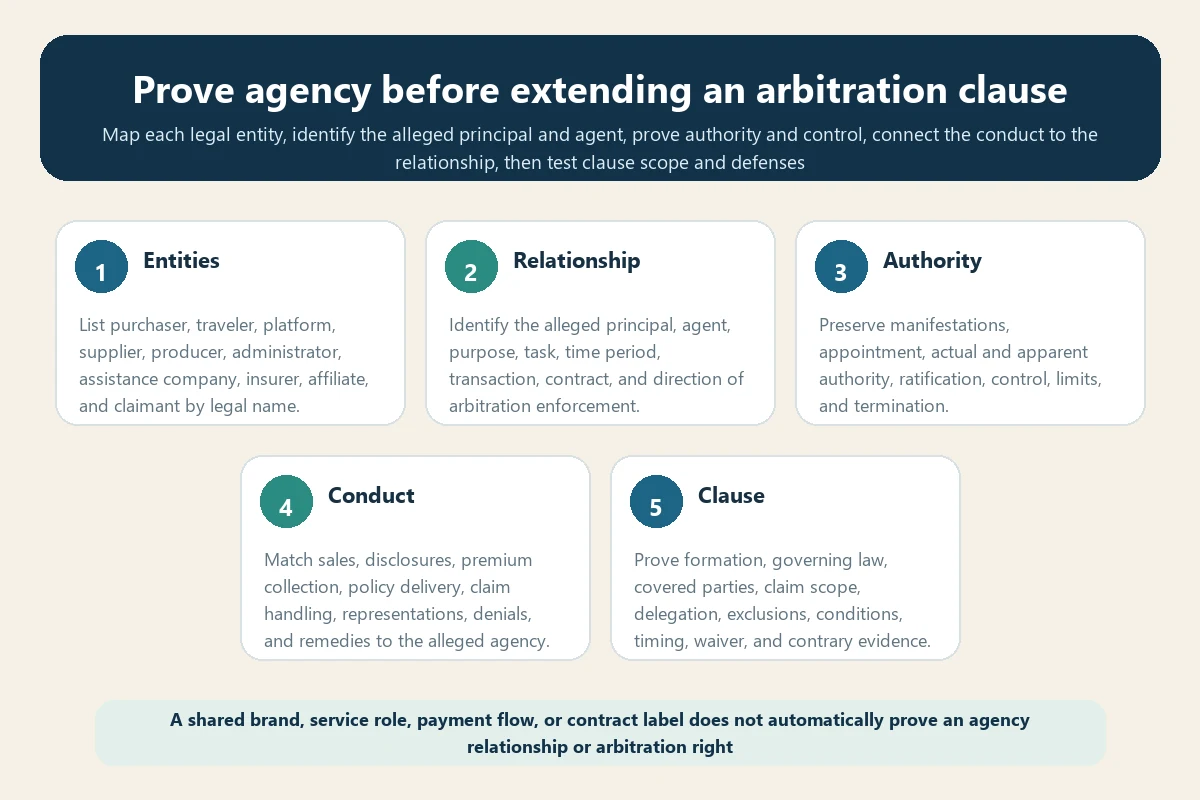
List the purchaser, traveler, account holder, platform, travel supplier, insurance producer, insurer, claims administrator, assistance company, payment processor, affiliate, and claimant. Record each legal name and role.
Draw separate lines for ownership, contract, referral, distribution, payment, claim handling, and alleged agency. These relationships are not interchangeable.
Inventory every contract
Preserve platform terms, booking rules, supplier conditions, policy, certificate, producer agreement, administration agreement, assistance agreement, checkout screen, confirmation, amendments, and incorporated arbitration rules.
For each document, record its parties, effective date, version, purpose, governing law, authority language, arbitration clause, and exclusions. A single purchase may involve several contracts.
Prove formation of the asserted agreement
Reconstruct the notice, hyperlink, assent action, purchaser identity, timestamp, screen design, confirmation, and terms version. Agency doctrine does not replace evidence that an arbitration agreement was formed.
The clickwrap agreement guide provides a transaction-level method for preserving online acceptance evidence.
Use federal arbitration law accurately
Section 4 of the Federal Arbitration Act describes petitions to compel arbitration under a written agreement and directs a court to address a genuine dispute over making the agreement.
The FAA does not create a universal federal agency test for travel insurance. State contract and agency law ordinarily supplies the relationship rules relevant to nonsignatory enforcement.
Read Arthur Andersen as a framework
In Arthur Andersen LLP v. Carlisle, the U.S. Supreme Court explained that traditional state-law principles may permit enforcement of arbitration agreements by or against nonsignatories.
The decision recognizes ordinary contract and agency principles; it does not prove agency in a particular travel transaction. The applicable state elements and record still control.
Determine the governing state law
Identify contractual choice-of-law provisions, forum rules, transaction contacts, and controlling state appellate authority. Record the elements for actual authority, apparent authority, ratification, and any nonsignatory arbitration rule.
Do not mix standards from different states. Terminology may be similar while the required manifestations, reliance, control, or burden differs.
Name the alleged principal and agent
Agency is relational. A conclusion that a company was “an agent” is incomplete unless it identifies the principal, authorized task, time period, transaction, and conduct within the relationship.
Create one row for each proposed principal-agent pair. A producer might act for an insurer for one function and for a traveler or platform for another, depending on governing law and facts.
Test actual authority
Look for the principal’s manifestations to the alleged agent: written appointment, operating instructions, approved activities, authority limits, training, systems access, compensation structure, and termination terms.
Ask whether authority to quote, collect a premium, deliver documents, or administer a claim included authority concerning dispute resolution. Do not infer broader power without evidence.
Test apparent authority separately
Apparent authority generally focuses on manifestations traceable to the alleged principal and the third party’s response under governing law. Statements by the supposed agent alone may be insufficient.
Preserve webpages, emails, co-branding, checkout disclosures, policy documents, phone scripts, and account screens. Record who created each representation and when the traveler saw it.
Evaluate ratification with a chronology
If ratification is asserted, identify the unauthorized act, when the principal learned material facts, what benefit it accepted, what conduct allegedly affirmed the act, and whether the principal had a meaningful choice.
Later claim handling or payment retention should not be labeled ratification without applying the state’s complete test and the arbitration-specific facts.
Distinguish control from coordination
Record who controlled pricing, product design, disclosures, underwriting, premium collection, policy issuance, claim standards, personnel, scripts, communications, refunds, and complaint resolution.
Commercial coordination, software integration, quality standards, or contractual oversight can exist without the control required for agency. Describe evidence instead of relying on labels.
Analyze current platform language cautiously
Travelocity’s current official terms distinguish platform services, travel providers, payment roles, booking on behalf of others, traveler-support agents, and travel insurance products.
These provisions illustrate why the precise role and contract matter. Current terms do not prove the wording, notice, assent, or entity relationship for an earlier booking.
Separate purchaser authority from company agency
A purchaser may book for companions, but authority to buy travel does not automatically establish authority to waive another traveler’s court rights. Identify consent, relationship, communications, benefit, and applicable law.
For a deceased claimant or representative, use the estate claim guide to separate agency, probate authority, survival, beneficiary status, and assignment.
Match the agency to the right transaction
A traveler may hold several policies and bookings. Assign an identifier to each trip, checkout, premium, confirmation, policy, cancellation, claim, and appeal.
Authority associated with one booking cannot simply be carried into another dispute. Match the alleged agency and accepted agreement to the exact transaction.
Map each alleged act to the relationship
For every representation, omission, premium charge, policy delivery, claim request, denial, refund, or support interaction, record the actor, principal alleged, date, authorized task, evidence, and dispute.
This shows whether the conduct occurred within the asserted agency or through a separate contractual role.
Audit claims one defendant at a time
Separate breach of policy, bad faith, negligent misrepresentation, consumer-protection, unjust enrichment, and declaratory claims. Identify each defendant’s alleged duty, conduct, injury, and requested remedy.
An agency theory supporting arbitration for one entity or claim may not cover others in the same lawsuit.
Read covered-party language and scope
Search the arbitration clause for principal, agent, affiliate, provider, supplier, producer, administrator, representative, beneficiary, and companies offering products. Quote definitions and enforcement verbs.
A clause naming agents may supply contract language but does not itself prove that a disputed entity was an agent for the relevant task.
Keep beneficiary and estoppel theories distinct
Third-party beneficiary doctrine asks whether contracting parties intended an enforceable benefit. Equitable estoppel may focus on contract dependence or intertwined conduct. Agency concerns authority and the principal-agent relationship.
Compare the third-party beneficiary guide and equitable estoppel guide without treating their elements as interchangeable.
Address delegation without circular reasoning
Preserve any delegation provision and incorporated rules. State who allegedly accepted delegation and whether a court or arbitrator decides the particular formation, agency, enforceability, or scope issue.
Do not reason that an entity is an agent because an arbitrator must decide, while also claiming the arbitrator has authority only because the entity is an agent. Use the arbitrability guide to separate formation, delegation, scope, conditions, and merits.
Test defenses and authority limits
Record express limitations, excluded tasks, disclosure language, independent-contractor provisions, termination dates, undisclosed-principal issues, lack of manifestations, unreasonable reliance, transaction mismatch, and acts outside authority.
Contract labels are evidence, not necessarily conclusive. Evaluate the full relationship under controlling law.
Preserve a reliable evidence package
Save native copies of contracts, appointment records, producer licenses, confirmations, checkout captures, payment records, policy delivery, claim files, communications, scripts, corporate disclosures, and archived terms.
Index every item by source, custodian, date, legal entity, transaction, alleged principal, alleged agent, authority issue, contract, claim, and page or screen.
Build a principal-agent matrix
Use one row per relationship and task. Include principal, agent, transaction, governing law, manifestation, authority type, control evidence, limit, relevant conduct, arbitration agreement, clause scope, enforcement direction, defense, and result.
Add citations to the exact document page or screen so an independent reviewer can reproduce the conclusion.
Avoid common mistakes
- Treating shared ownership, branding, or software as automatic agency.
- Failing to identify the alleged principal and authorized task.
- Using an agent’s own statement as the only apparent-authority proof.
- Assuming authority to sell insurance includes authority over arbitration.
- Combining agency, beneficiary, estoppel, assignment, and alter-ego theories.
- Using current terms for an older transaction without version evidence.
Follow a disciplined review sequence
- Map every legal entity and agreement.
- Prove the operative terms and assent.
- Identify governing state law and the exact agency theory.
- Name the principal, agent, authorized task, and enforcement direction.
- Test manifestations, authority, control, ratification, and limits.
- Match every claim and act to the transaction and relationship.
- Analyze scope, delegation, timing, waiver, and defenses separately.
Know when legal review is important
Prompt legal review is especially useful when deadlines are running, multiple affiliated companies are involved, a minor or estate is a claimant, authority is disputed, documents conflict, or court and arbitration proceedings overlap.
Qualified counsel can determine the controlling state rules, evidence burdens, procedural deadlines, and whether the proven relationship extends the arbitration clause.
Final takeaway
Travel insurance arbitration agency theory requires proof of a particular relationship for a particular task and transaction. A service role, payment flow, shared brand, or reference to “agents” is not enough by itself.
Map entities, contracts, manifestations, authority, control, conduct, claims, clause scope, and defenses. Keeping agency separate from other nonsignatory doctrines produces a more accurate arbitration analysis.