
A travel insurance claim for a deceased traveler’s estate is not simply a normal claim with a death certificate attached. The insurer must identify the covered loss, the person authorized to communicate and sign, the person who actually paid each expense, and the person or estate legally entitled to receive each benefit. Those roles may belong to different people.
This guide explains the U.S.-focused documentation workflow. It is educational, not legal advice, and the policy certificate plus applicable state probate law control. Notify the insurer promptly, ask for its deceased-insured checklist, and obtain estate advice when authority or ownership is disputed.
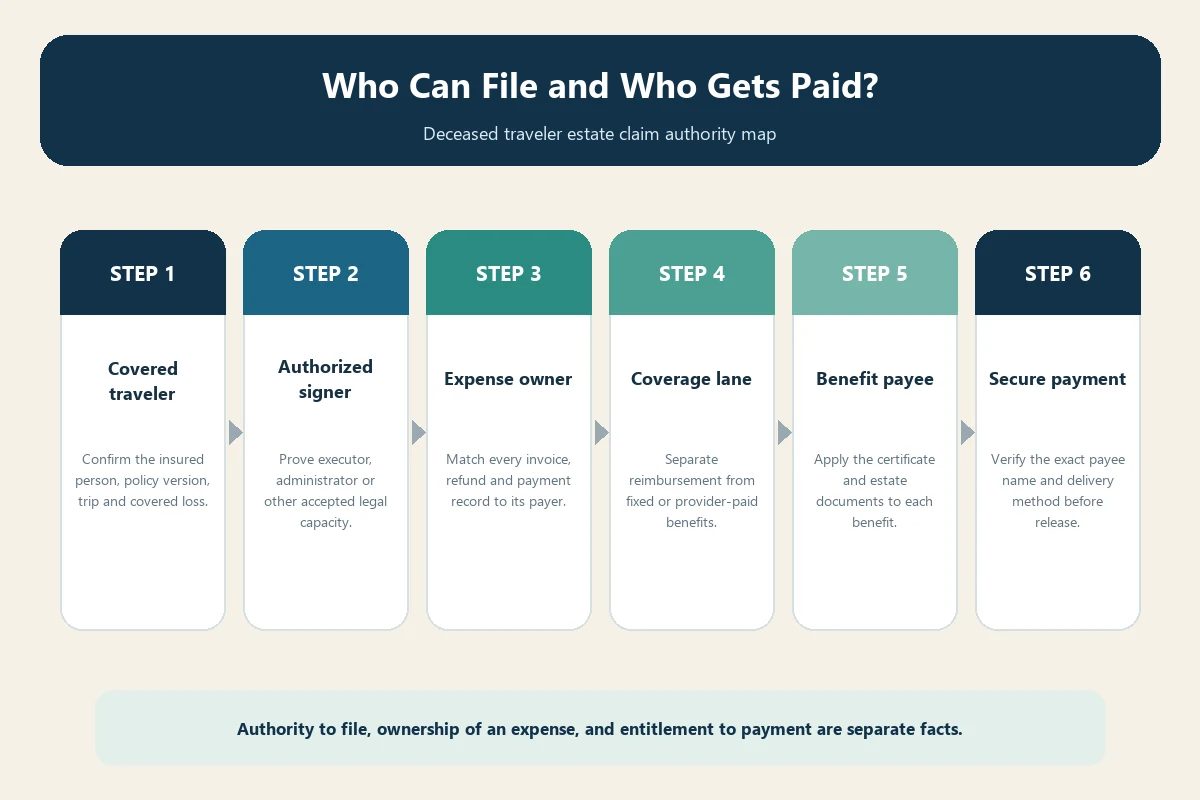
Start with four separate questions
- Who was insured? Confirm the deceased traveler appears on the policy schedule and the relevant trip.
- Who may file and sign? This may be an executor, court-appointed administrator, authorized representative, or another person the insurer accepts under the policy and state law.
- Who paid the loss? A spouse may have paid the hotel, a child may have paid the funeral transport deposit, and the estate may own a refund.
- Who receives payment? Reimbursement, accidental-death benefits, and return-of-remains expenses do not necessarily have the same payee.
Do not use “next of kin,” “beneficiary,” and “executor” as interchangeable labels. State the capacity of every participant and support it with the appropriate document.
Notify the assistance and claims teams promptly
Contact the emergency-assistance number if arrangements are still underway, then open a formal claim with the claims administrator. These are different functions; our assistance-versus-claims guide explains the distinction. Record the date, time, representative, case number, claim number, and every instruction.
Ask in writing which coverage sections may apply, the notice and proof deadlines, whether original documents are required, and what evidence establishes authority. Prompt notice does not guarantee coverage, but it reduces avoidable disputes about delay and missing records.
Collect the death records appropriate for U.S. use
For a death abroad, obtain the local death certificate and ask the nearest U.S. embassy or consulate about a Consular Report of Death Abroad. The U.S. Department of State explains that a foreign certificate may not be accepted for U.S. insurance and estate purposes and that a CRODA can be used to settle estate matters.
Keep the original foreign record, certified copies, the CRODA, and any required English translation as separate files. Do not write on originals. If the cause of death is pending, submit the available record and explain what supplemental certificate or report will follow.
Prove the signer’s legal capacity
An insurer may request letters testamentary for an executor named in a will, letters of administration for an intestate estate, a small-estate affidavit where permitted, or another court document. The title alone is insufficient: include the issuing court, date, case number, scope, and whether the appointment remains effective.
A will may nominate an executor, but nomination and court appointment are not always the same event. Likewise, being a spouse or adult child does not automatically prove authority to bind the estate. Ask the administrator which document it accepts rather than sending unrelated sensitive probate files.
Do not assume a power of attorney survives death
A power of attorney commonly ends at the principal’s death under state law. A person who handled the traveler’s finances during incapacity may therefore need a different post-death capacity. If incapacity preceded death, preserve both timelines: what the agent did while authority was active and what the executor or administrator did afterward.
For a living but incapacitated insured, use our incapacitated traveler claim guide. Do not extend that authority into the estate phase without confirmation.
Map each expense to the person who paid it
Create a ledger with date, vendor, purpose, traveler, original currency, amount, payment method, payer, refund status, and requested coverage. Attach the invoice and proof of payment to the same row. A card statement proves who paid; an invoice proves what was purchased. Both may be needed.
Examples include unused prepaid trip costs, emergency medical bills, additional lodging, transportation for a companion, local funeral-home charges, and repatriation of remains. Never combine unrelated household expenses into an estate total. Our family claim allocation method helps divide shared bookings without double counting.
Separate reimbursement from fixed benefits
Expense reimbursement generally addresses a documented net loss. A fixed accidental-death or dismemberment benefit, if included, follows its own covered-event definition and payee provisions. Medical evacuation or return-of-remains coverage may pay a provider directly or reimburse a payer. Trip cancellation and interruption calculations may depend on supplier refunds and unused value.
Open a separate worksheet tab for each coverage section. Quote the policy’s benefit name, limit, deductible, covered reason, exclusions, and payee language. Do not assume that proof of death alone establishes an accidental-death benefit.
Identify refunds, credits, and other recoveries
Request written refund decisions from airlines, cruise lines, hotels, tour companies, and booking platforms. Record cash refunds, card reversals, vouchers, taxes returned, and amounts retained. Insurance commonly addresses the remaining covered loss, not the original gross booking amount.
Use our supplier-refund statement guide and disclose pending recoveries. If a credit is issued to the deceased traveler’s account, ask the supplier and insurer how ownership and usability will be documented.
Build a reliable medical and event timeline
List the policy purchase, first trip payment, departure, onset of symptoms or accident, medical contacts, admission, death, assistance calls, arrangements, refunds, and claim submissions. Use local dates and time zones. Link each event to a record rather than relying on a narrative alone.
The CDC Yellow Book identifies consular officials, insurers, airlines, tour operators, and other organizations that may support families after a death abroad. Their records can also establish what occurred and when.
Handle foreign-language records carefully
Retain the source-language document and translation together. Label the translator, date, method, and whether the translation is certified or informal. Do not replace names, dates, or diagnoses to make them look consistent; explain transliteration differences in a cover note.
Our foreign medical bill and translation guide provides a file-naming and translation checklist. Ask whether the insurer needs a full translation or only specified pages.
Protect sensitive identity and bank information
Confirm the claims administrator’s official upload portal or mailing address independently before sending death certificates, probate papers, identification, or bank data. Avoid replying to unexpected payment emails. Redact information only with the administrator’s permission because over-redaction may prevent verification.
A U.S. Chubb travel claim form illustrates that payment may be directed to an insured, guardian, or beneficiary and may require account and routing information. Review the actual form for your policy; never copy payment instructions from a different product.
Choose the payee only after authority is confirmed
Ask the insurer to state the approved payee name exactly before entering banking information. The correct recipient might be the estate, a named beneficiary, a person who incurred an expense, or a provider. A convenience account belonging to the family’s claim coordinator is not automatically appropriate.
If payment must go to an estate that has no bank account, ask for available alternatives and obtain probate or banking advice. Do not alter the payee name after approval without a documented request and written confirmation.
Create a submission index
- Claim form and signer-capacity statement
- Policy schedule and certificate version
- Death certificate, CRODA, and translations
- Letters testamentary, letters of administration, or accepted authority document
- Trip itinerary and proof of insured trip payments
- Expense ledger with invoices and payment proof
- Medical, police, carrier, funeral-home, and assistance records as relevant
- Supplier refund and credit decisions
- Payee and secure payment instructions
- One-page chronology and unresolved-items list
Number every item and use neutral filenames such as 07-hotel-invoice-paid-by-spouse.pdf. Keep a read-only copy of the exact submission and its delivery receipt. The broader travel insurance filing guide explains how to assemble a claim packet.
Respond to follow-up requests by issue
When the adjuster asks for more information, restate the request, identify the attached response, and say what remains unavailable. If a court appointment is pending, provide the filing receipt and expected next step only if the insurer agrees. Do not guess at legal capacity or submit a signature with an inaccurate title.
Maintain a request log with the request date, deadline, owner, response date, and delivery proof. Ask for written confirmation when an item has been accepted or waived.
Avoid these common estate-claim errors
- Calling a family coordinator the beneficiary without checking the policy
- Submitting only a foreign death certificate when a U.S.-usable record is requested
- Using a power of attorney after death without verifying continuing authority
- Claiming gross expenses without supplier refunds or payer evidence
- Mixing estate-owned losses with costs personally paid by relatives
- Sending bank details through an unverified email link
- Assuming all death-related benefits share one payee
When professional help is appropriate
Consult a probate attorney or qualified estate professional when no representative has been appointed, multiple people claim authority, the estate spans states or countries, a minor may receive funds, or the insurer’s requested payee conflicts with court documents. Contact the relevant state insurance department for claim-handling complaints, not for probate advice.
Final review before submission
Confirm that every signature includes the signer’s exact capacity, every expense identifies its payer, every benefit identifies its proposed payee, and every foreign record has the required translation. Reconcile totals to refunds and prior payments. Then verify the portal, submit once, save the receipt, and calendar follow-up.
The strongest deceased-traveler claim packet does not rely on family relationship as a shortcut. It demonstrates coverage, event, authority, ownership, net loss, and payment eligibility as separate facts—making the file easier to evaluate and safer for everyone involved.
