
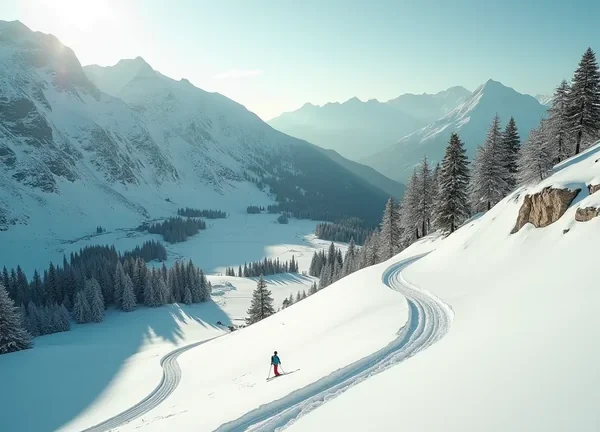
Skiing is one of the few holidays where the activity you booked and the activity your policy covers can be two different things. A standard travel plan usually treats downhill skiing on a marked, open run as ordinary. Step past the rope, ski a bowl with no piste markers, or clip into touring bindings and climb, and you have crossed a line the policy drew in its definitions long before you left home.
The frustrating part is that the line is not where most skiers assume. It is not about difficulty, and it is not about how confident you are. It is about where you were, whether the run was open, and whether somebody qualified was leading.
Off piste skiing insurance: where the cover line is drawn and how to move it
Everything that follows comes down to a single question an adjuster will ask if you make a claim: at the moment of the accident, what were you doing, and does the policy’s own wording put that inside or outside the covered activity? Working out the answer before you buy is cheap. Working it out afterwards is not.
What “off piste” means in a policy, and why that differs from the mountain
On the mountain, off piste is a description of snow. In a policy it is a definition, and it usually turns on three tests rather than one.
- Was the terrain within the ski area boundary? Many wordings cover unmarked snow that still lies inside the resort’s patrolled perimeter, and stop at the boundary itself. Skiing a powder field between two marked runs and skiing out of the ski area through a gate can be treated completely differently even though the snow looks the same.
- Was the run open? Almost every winter sports wording excludes terrain that ski patrol has closed or roped, and closure is usually decided on avalanche risk. A closed run is generally the clearest exclusion in the entire document.
- Were you accompanied? A large share of policies extend to off piste only when a qualified guide or instructor is leading. Skiing the same line alone the following morning can fall outside the same policy.
None of those tests mention gradient or grading, which is why an experienced skier on gentle unpatrolled terrain can be uncovered while a beginner falling on a marked black run is covered without argument.
The four activities insurers keep separate
| Activity | How a winter sports add-on usually treats it | What to look for in the wording |
|---|---|---|
| Off piste inside the ski area boundary, run open | Most commonly included once winter sports are added | Whether “off piste” appears in the covered list or only in the exclusions |
| Off piste with a qualified guide, outside the boundary | Frequently covered, conditional on the guide | How the policy defines a qualified guide, and whether a local instructor counts |
| Off piste unguided, outside the boundary | Commonly excluded, or available only as a named upgrade | Whether an unguided extension exists at all, and its own conditions |
| Ski touring, heli-skiing and cat-skiing | Treated as separate activities, rarely inside a basic add-on | Each named individually in the hazardous activity schedule |
Ski touring is worth separating out even though skiers think of it as adjacent. Climbing under your own power introduces exposure a resort day does not have, and many schedules list it apart from off piste skiing, sometimes with an altitude ceiling attached. Heli-skiing and cat-skiing are almost always their own line, because the transport itself is part of the risk. Our guide to the winter sports exclusions that void cover goes through how those schedules are structured.
The conditions that quietly switch cover on and off
Even inside a policy that names off piste skiing, cover is normally conditional. The conditions are stated once, in plain language, and then never mentioned again.
- Guide requirement. The most common condition, and the most commonly overlooked when a group splits up for an afternoon.
- Avalanche safety equipment. Some wordings require a transceiver, shovel and probe to be carried in off piste terrain. Carrying them is not only a claims condition, it is the thing that makes companion rescue possible at all.
- Local warnings and closures. Ignoring a posted avalanche bulletin or an official closure will usually be read as a breach, independent of the guide question.
- Alcohol and drugs. A standard exclusion everywhere, and one that is more likely to be examined after a mountain accident than after a hotel slip.
- Competition and speed events. Racing, timed sections and organized competition are typically excluded even on piste.
- Helmet use. Less often a hard condition than skiers assume, but it does appear, so it is worth reading rather than guessing.
Search and rescue is not the same benefit as medical evacuation
This is the distinction that decides how badly an off piste accident hurts financially, and it is the one most often collapsed into a single idea. Two separate services can be involved, and two separate parts of a policy pay for them.
Getting you off the mountain
Mountain rescue is the operation that locates you and brings you to a road or a landing zone. Depending on the country, that service may be run by a public authority, a resort, a volunteer organization or a private operator, and in several alpine countries the person rescued is billed for it directly. A policy that covers this will have a search, rescue and mountain recovery benefit with its own limit, distinct from the medical section. How that benefit is structured is set out in our mountain rescue coverage guide, and the specific question of aerial recovery in our helicopter rescue guide.
Getting you to the right hospital, and then home
Medical evacuation is a different service with a different trigger: moving you from the first hospital that receives you to one capable of treating the injury, and eventually repatriating you. It is decided by your insurer’s medical team together with the treating doctors, and it carries its own limit, which is the figure that matters most for a mountain injury in a region without a nearby trauma center. We cover choosing that limit in what the evacuation limit has to be.
A policy can carry a generous medical limit and a thin rescue benefit, or the reverse. Read both numbers, not one.
The benefits that have nothing to do with injury
Winter sports add-ons usually bundle several trip-side benefits alongside the activity cover, and they are the ones most likely to be used on an uneventful trip: equipment loss, hire or delay; ski pass refunds when an injury ends the week early; and piste closure payments when a lack of snow or a resort-wide closure keeps the lifts shut. These are worth checking against the trip you have actually booked, and are covered in our overview of what ski trips need from a policy.
Third-party liability belongs in the same category. A collision on a busy run that injures another skier can produce a claim against you personally, and some winter sports sections include a liability benefit while others leave it to a separate policy entirely.
Checking your own policy in about ten minutes
- Find the definitions section and read the definition of off piste, ski area and qualified guide. If those words are not defined, that is itself an answer.
- Find the hazardous or adventure activity schedule. Look for skiing off piste as a named line, then for ski touring, heli-skiing and cat-skiing separately.
- Read the conditions attached to that line, not just the fact that it appears.
- Find the search and rescue benefit and its limit, then the medical evacuation limit, and note them separately.
- Check the exclusions for closed runs, ignoring official warnings, competition and unguided terrain.
- If anything is ambiguous, ask the insurer for the answer in writing before departure, and keep it. A verbal assurance is not part of the contract.
The broader logic of how insurers classify anything they consider hazardous is worth understanding once, because it applies well beyond snow: see what counts as a hazardous activity.
Off piste skiing is not uninsurable. It is conditionally insurable, and the conditions are written down. The skiers who have trouble are almost never the ones who read them and decided to hire a guide or buy the upgrade; they are the ones who assumed that adding winter sports to a policy covered everything they might do on a mountain.