
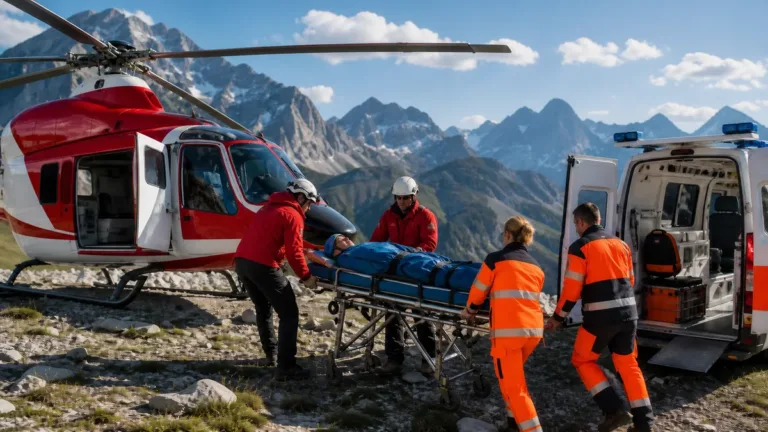
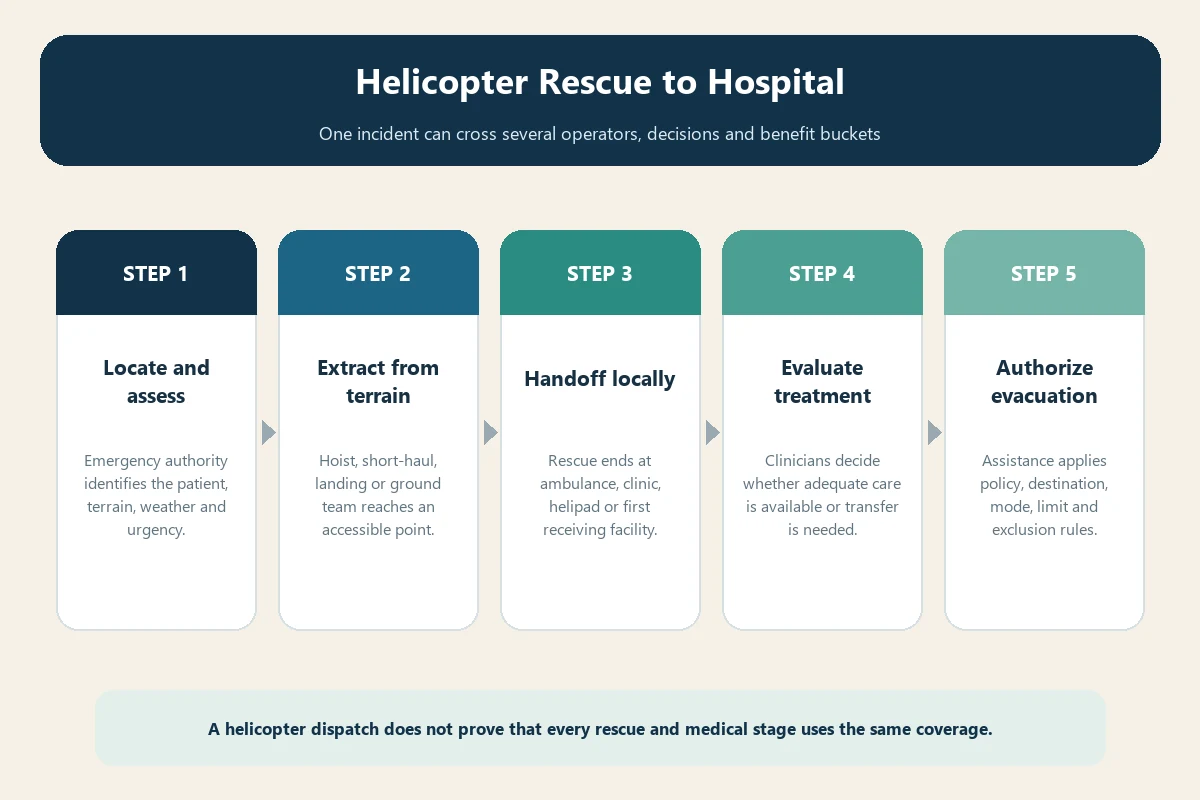
Medical evacuation insurance helicopter rescue coverage depends on which job the helicopter is performing. It may search for a missing traveler, extract an injured person from terrain, carry the patient to a local facility, or transfer the patient between hospitals. Those stages can have different operators, limits, exclusions, and authorization rules.
In an emergency, contact local rescue authorities and obtain appropriate care. This guide is educational, not medical, insurance, aviation, mountaineering, or legal advice. Rescue availability and policy forms vary; no insurance can guarantee a safe or timely helicopter response.
Key takeaways
- Search and rescue can be separate from medical evacuation.
- A helicopter extraction may end at a trailhead or local facility.
- Activity, altitude, guide, and licensing rules can decide eligibility.
- Weather, terrain, aircraft, and rescuer safety control operations.
- Preserve the handoff record from dispatch through hospital transfer.
Reviewed August 16, 2026. The word “airlift” does not identify the benefit. Copy the policy definitions for search and rescue, emergency evacuation, ambulance, and medically necessary transportation.
Four helicopter roles that look similar
A helicopter may conduct aerial search, insert rescuers, hoist or short-haul a patient, land near the scene, fly to a local helipad, or provide an equipped interfacility air ambulance. A news report can call all of them “evacuation.”
The remote-trip evacuation guide explains why terrain access and medical transport must be planned separately.
Stage 1: Search for the traveler
A missing or overdue traveler may trigger a search before anyone knows whether medical transport is needed. Authorities choose ground teams, aircraft, drones, dogs, boats, or other resources based on jurisdiction and conditions.
The National Park Service visitor-protection aviation page says NPS search-and-rescue missions can use helicopters, satellite technology, snow vehicles, and watercraft, often with local, county, state, or other partners. Insurance does not command those public resources.
Stage 2: Technical extraction
Once located, a patient may need a hoist, short-haul line, litter carry, or rescuer insertion because landing is impossible. Extraction moves the patient from dangerous terrain to an accessible point.
That service can be a search-and-rescue benefit, a public response, an operator charge, or an excluded activity expense. It is not automatically the same as a medically equipped flight between hospitals.
Stage 3: Local medical handoff
The rescue helicopter may deliver the patient to a trailhead ambulance, small clinic, local hospital, or regional helipad. The first goal can be assessment and stabilization, not transportation home.
Record the handoff time, receiving provider, patient condition, rescue agency, and whether a separate ambulance or hospital bill begins. The destination ladder explains why local assessment often comes before a suitable-facility decision.
Stage 4: Interfacility medical evacuation
After assessment, clinicians may find that adequate treatment is unavailable. A different helicopter or fixed-wing aircraft can then transfer the patient to a suitable hospital.
This stage commonly requires medical necessity, transport fitness, receiving-facility acceptance, and insurer authorization. The approval-chain guide maps each actor.
Why one helicopter can create several bills
Charges can include search time, rescuer insertion, extraction, aircraft time, medical crew, supplies, ground ambulance, hospital care, and later transfer. Different agencies or vendors can bill each line.
Ask for an itemized mission record rather than a single “helicopter” label. The insurer needs to assign each charge to the applicable benefit and limit.
Search-and-rescue sublimits can be much smaller
A plan may display a large emergency-evacuation maximum and a separate smaller search-and-rescue maximum. The larger number does not automatically absorb field extraction.
A state-specific Travel Guard policy example lists up to $250,000 for emergency evacuation and repatriation of remains, but up to $10,000 for search and rescue. Use the structure as a warning, not the figures as a quote.
The activity must be eligible
Mountaineering, skiing, diving, paragliding, backcountry travel, motorcycling, climbing, racing, or professional participation can be excluded or require an adventure-sports option. A rescue does not waive the activity exclusion.
The CDC adventure-travel chapter warns that policies may exclude wilderness rescue and activities such as diving, mountaineering, and skiing. It also says insurance does not guarantee rescue.
Altitude and route rules matter
A certificate can impose altitude limits, named-route rules, guide requirements, or restrictions on off-piste and remote activities. Compare the planned high point and every side trip with the definitions.
Save the operator itinerary, map, permits, guide credentials, activity description, and policy endorsement. Do not describe a technical climb as an ordinary hike if the facts show otherwise.
Local rescue authority controls dispatch
Calling an insurer does not necessarily dispatch a public rescue helicopter. Contact the destination’s emergency or rescue authority according to local instructions. Then notify the assistance administrator as soon as practical.
Jurisdiction can sit with a park, county, police, military, coast guard, private operator, tour company, or resort. Ask who requested the aircraft and who accepted financial responsibility.
Weather and rescuer safety can prevent flight
Wind, cloud, visibility, darkness, icing, heat, altitude, terrain, landing zones, airspace, aircraft capability, and crew duty can stop or delay a mission. A policy maximum cannot make a flight safe.
The NPS Denali mountaineering FAQ says rescue may not be timely because of wind, visibility, altitude, and terrain, and that missions are undertaken at agency discretion with rescuer safety first. It also separates NPS rescue from later hospital or air-ambulance costs.
Authorization may occur at different stages
Immediate public rescue may happen before insurance contact. A planned private extraction or interfacility medevac may require advance coordination. Do not assume the same emergency exception applies to every stage.
Follow the issued policy and assistance instructions. The existing assistance-line guide explains the real-time coordination record and why later reimbursement is a separate step.
Payment responsibility varies by jurisdiction
Some public agencies do not bill for search and rescue; other destinations, resorts, private helicopter companies, hospitals, and ambulances can charge. Never assume a U.S. park practice applies abroad.
Ask the tour operator and destination authority which stages can be billed, whether payment is required before dispatch, and which local rescue or sports insurance is expected.
A locator beacon does not guarantee a helicopter
A satellite messenger or personal locator beacon can improve location and communication. It cannot guarantee that a signal reaches the right authority, that weather permits flight, or that an aircraft is available.
Leave a route plan and emergency trigger with a trusted contact. Carry redundant communication and survival equipment appropriate to the itinerary.
Build the rescue-to-claim file
- Record the emergency call and dispatch authority.
- Obtain the search, extraction, and mission report.
- Document the activity, route, altitude, guide, and permits.
- Preserve the patient handoff and local medical record.
- Save assistance contacts and authorization messages.
- Itemize rescue, ambulance, hospital, and later evacuation charges.
- Submit other-insurance or membership responses if required.
The claim-denial guide helps audit exclusions, notice, documentation, and other-insurance problems if a charge is disputed.
Questions before an adventure trip
- Does the policy define search and rescue separately?
- What is the rescue sublimit?
- Does it include helicopter extraction or only medical transport?
- Are the planned activity, altitude, route, and guide eligible?
- Who must authorize a private helicopter?
- What happens when immediate public rescue occurs first?
- Where does the rescue hand the patient to medical care?
- Does later interfacility evacuation use another limit?
Helicopter rescue on water or islands
Maritime incidents can involve a vessel operator, coast guard, local rescue authority, winch helicopter, boat transfer, port ambulance, and later air ambulance. The aircraft may rescue from the vessel but deliver only to the nearest safe landing point.
Record vessel position, distress call, coordinating authority, pickup method, port handoff, and receiving facility. Cruise medical care, rescue, deviation, and onward evacuation can be separate expenses.
Tour-operator duties do not replace policy review
A trek, ski, dive, or expedition operator may include emergency coordination or require proof of rescue coverage. Ask what it actually provides, which local helicopter company it uses, and whether the traveler must pay a deposit.
Save the operator’s insurance requirement and emergency plan. A guide’s assurance that “a helicopter is available” does not prove weather access, insurance authorization, or a receiving bed.
If ground rescue is the only safe option
A helicopter may be requested but unavailable. Litter carry, snow vehicle, boat, animal, or ground team might move the patient slowly to access. Coverage should be checked for the service actually used, not the aircraft initially imagined.
Preserve why aviation was rejected and who selected the alternative. Operational safety decisions should not be rewritten as traveler preference after the incident.
After the helicopter lands
The patient can still face hospital deposits, specialist transfer, lodging for a companion, unused-trip loss, and a revised return itinerary. Helicopter coverage does not answer those benefits.
Build a separate claim folder for each stage and request supplier refunds. This prevents a rescue invoice from obscuring medical, interruption, or additional-transport evidence.
Bottom line
Medical evacuation insurance helicopter rescue coverage cannot be answered from the aircraft alone. Identify whether the helicopter searches, extracts, delivers to local care, or performs an interfacility medevac. Then apply the correct benefit, sublimit, activity and altitude rules, dispatch authority, authorization provision, and handoff evidence. Rescue safety and availability always come before the insurance spreadsheet.
Mountain rescue and medical evacuation can use different contracts and limits. Use the mountain rescue insurance audit to test the planned activity, route, altitude, field rescue, medical handoff, sports rider, authorization, and claim record.
