
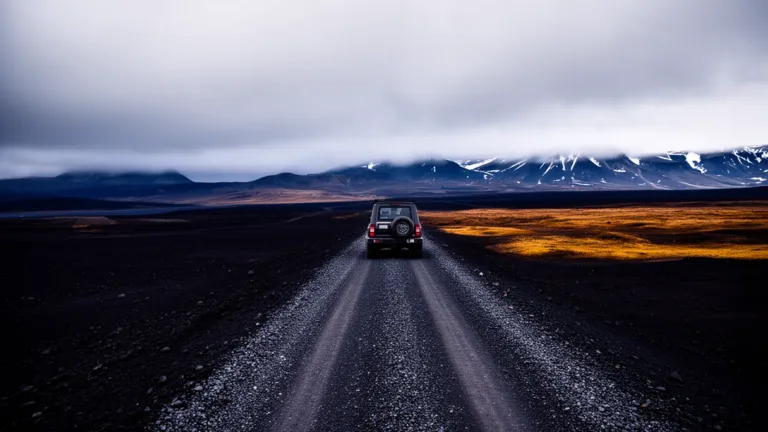
Iceland does not require US visitors to hold travel insurance for a short stay, and its hospitals are good. What makes an Icelandic policy different from a French or Italian one has almost nothing to do with medicine. It is the weather, the terrain, and a rental car exclusion that is close to unique to the country.
Iceland is in the Schengen area, so Schengen visa applicants face the same requirement as elsewhere: medical cover of at least EUR 30,000, valid across the Schengen area, covering emergency treatment and repatriation. Visa-exempt US visitors are not asked for a certificate. Beyond that, the paperwork is unremarkable and the terrain is not.
Sand, ash and the car door: the exclusion nobody expects
Start here, because it costs Icelandic visitors more money more often than anything medical. Standard rental car damage waivers in Iceland commonly exclude two categories of damage that are ordinary events in Iceland and almost unheard of elsewhere. The first is paintwork and glass damage from wind-driven sand and volcanic ash, which on an exposed south-coast road can strip a car in minutes. The second is damage caused by wind catching an opened door and bending it back against its hinges.
Rental companies sell these as separate add-ons, often labeled sand and ash protection. Your travel insurance does not fill the gap: a travel policy is not motor insurance, and vehicle damage sits with the rental agreement and the cover sold alongside it. Where travel insurance stops and rental car cover starts sets out that division, and it is worth reading before you decline anything at the rental desk in Keflavík.
Two related points. Driving onto the interior F-roads is normally prohibited under standard rental agreements unless the vehicle is specified for it, and river crossings are typically excluded outright — water damage to an engine is one of the most expensive ways to end an Icelandic trip. Breaching the rental terms can void the cover you did buy.
What this means: in Iceland the decisive documents are often the rental agreement and the activity schedule, not the medical section. Read what the hire car cover excludes before you sign, and add the protection the counter offers if your route includes the south coast or the highlands.
Search, rescue and where the policy responds
Iceland’s search and rescue capability rests heavily on a volunteer organization, and the culture around it is not one of aggressively billing casualties. That is not a reason to travel uncovered. What a policy is actually being asked to do after an incident in remote terrain is usually the medical treatment that follows, any transfer to a better-equipped hospital, and repatriation home if the injury is serious — and those are the expensive parts.
Read the wording rather than assuming. Some policies name mountain rescue or search costs explicitly; many restrict them to activities on the covered list; and the evacuation benefit almost always requires the insurer or its assistance company to authorize and arrange the movement before it happens. How evacuation limits work covers that mechanism.
Glaciers, ice caves and the activity schedule
Most of what visitors come to Iceland to do sits somewhere on an insurer’s activity list. Glacier walking, ice caving, crampon and ice-axe use, snowmobiling, quad biking, cold-water diving and snorkelling between the tectonic plates at Silfra are all commonly conditional, restricted to guided operation, or excluded from standard cover and sold as an add-on. Hiking is usually fine until altitude, technical ground or off-trail routes bring it inside a restricted clause.
The reliable approach is to list what you have actually booked and check each item against the schedule. The adventure and winter sports exclusions covers how these clauses are typically drafted and which words to look for.
| Icelandic situation | Which cover normally responds |
|---|---|
| Sand or ash damage to a hire car | Rental add-on only; not the travel policy |
| Wind damage to a car door | Rental add-on only; commonly excluded from standard waivers |
| Road closure forcing a missed flight | Delay or missed connection wording, if the cause is covered |
| Injury on a guided glacier walk | Only if the activity sits inside the policy schedule |
| Transfer to a larger hospital | Evacuation benefit, subject to insurer authorization |
| Cancelling because of an eruption already in the news | Usually not; a known event when you bought is normally excluded |
Weather, closures and volcanic activity
Iceland closes roads. Storms, whiteouts and high winds shut routes at short notice, and the practical result is a missed flight or an unusable booking rather than a medical claim. Whether that produces a payout depends on the delay and cancellation wording — the covered causes, the minimum delay before the benefit starts, and the daily cap. How weather delays are actually treated goes through that.
Volcanic activity follows the known-event principle that governs all cancellation cover. Once an eruption or an alert is public knowledge, it is generally no longer an unforeseen event for policies bought afterwards, so cancellation cover for that specific cause typically stops being available. Buying earlier is what preserves the option. Check road and weather conditions daily on the official Icelandic road and meteorological services, and treat their closures as instructions rather than advice.
The checks worth doing before you fly
Work through the itinerary rather than the brochure. List every booked activity and check each against the policy’s activity schedule, adding cover where the answer is no. Decide the rental question at the same time: if the route includes the south coast, the highlands or any exposed stretch in winter, price the rental company’s sand, ash and wind protection into the trip rather than treating it as an upsell to refuse at the desk.
Then confirm the ordinary things. The medical limit, whether evacuation and repatriation are named benefits, and whether the delay section’s covered causes include road closure and severe weather rather than only carrier-caused disruption. Save the assistance number offline, because much of Iceland has no usable mobile signal and a number sitting in a webmail inbox is a number you cannot reach.
Finally, buy early. Cancellation cover is the one benefit whose value is decided before anything happens, and in a country where the disrupting events are volcanic and meteorological, the known-event rule bites harder than almost anywhere else. When to buy travel insurance covers why the purchase date does so much work.
Frequently asked questions
Do I need travel insurance for Iceland?
Not as a legal requirement for visa-exempt US visitors. Schengen visa applicants must show medical cover of at least EUR 30,000 valid across the Schengen area. The practical case rests on rescue, transfer and repatriation costs in remote terrain rather than on any rule.
Does travel insurance cover sand and ash damage to a rental car?
No. That is vehicle damage, so it belongs to the rental agreement and the cover sold with it, and standard waivers in Iceland commonly exclude sand, ash and wind damage specifically. Buy the rental company’s add-on if your route is exposed.
Will my policy pay for mountain rescue?
It depends entirely on the wording and on whether the activity you were doing is on the covered list. Some policies name search and rescue costs; many do not. What follows a rescue — treatment, transfer and repatriation — is where the larger sums usually sit.
Can I still get cancellation cover if a volcano is erupting?
Generally not for that eruption. Cancellation cover responds to unforeseen events, and an eruption already in the news when you bought the policy is normally treated as known. Buying earlier is what keeps the cover available.
Planning a European road trip? The Europe road trip travel insurance guide separates medical cover, rental-car liability and damage, roadside assistance, borders and claim documents.