
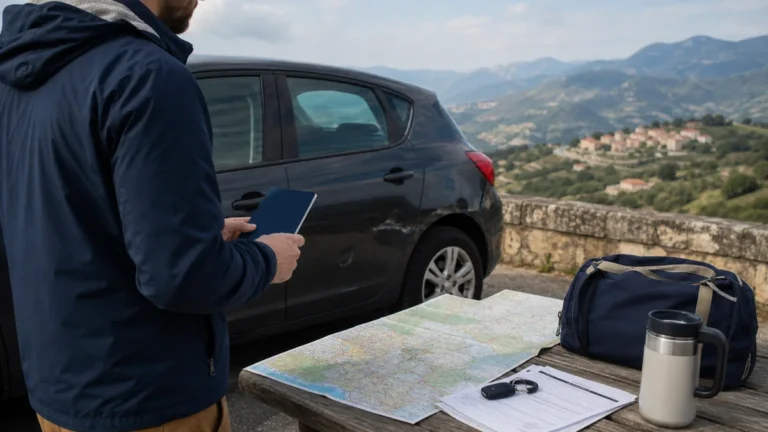
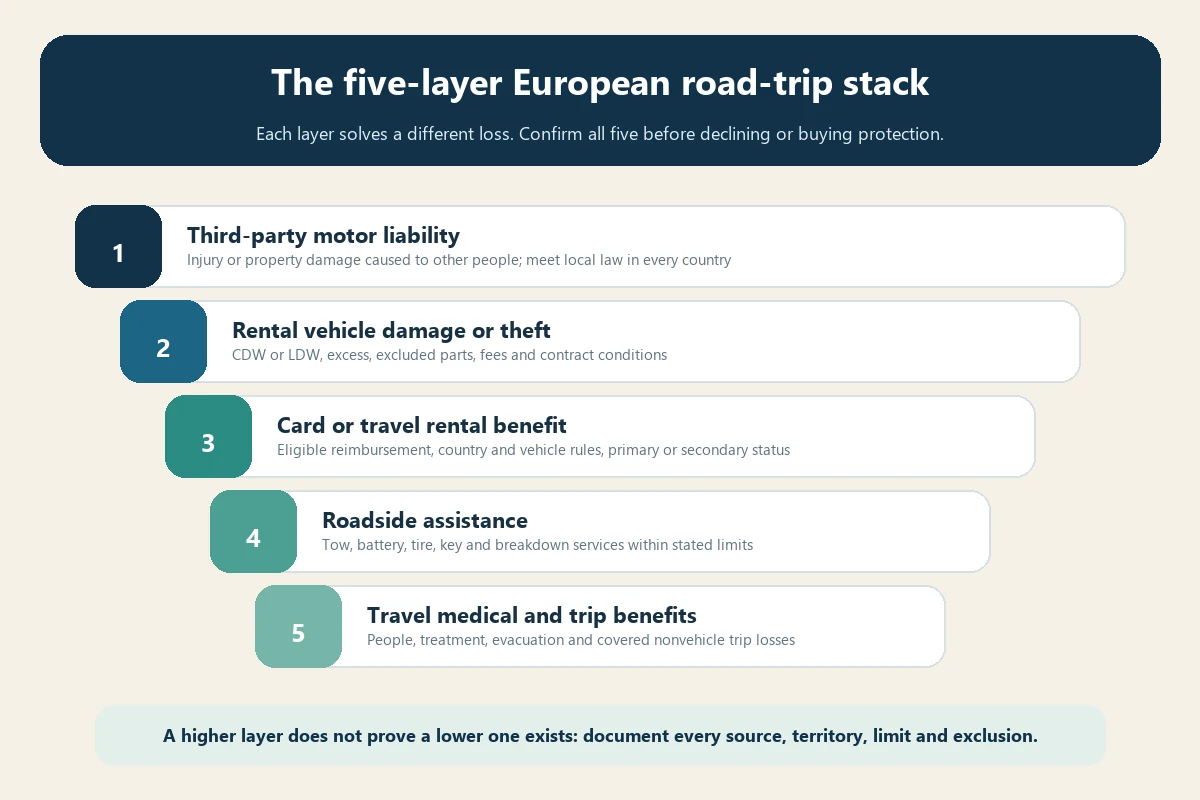
Europe travel insurance for road trips protects the traveler and the prepaid trip, but it does not replace valid motor insurance. A complete plan separates five layers: third-party liability, damage to the rental vehicle, card or travel-policy rental benefits, roadside assistance, and travel medical or trip protection. Each layer has different exclusions, documents and claims.
Key takeaways
- Travel insurance is not a substitute for local vehicle liability coverage.
- Rental-car damage benefits often exclude liability, injuries and some fees or vehicle parts.
- Every border, ferry, driver and road type must be authorized by the rental agreement.
- Roadside assistance and insurance solve different problems.
- License validity, an IDP and compliance with local law can affect coverage.
The five-layer road-trip coverage stack
A rental desk can compress several products into the word “coverage.” Split them before comparing price.
| Layer | Main job | Typical source |
|---|---|---|
| Third-party liability | Injury or property damage caused to others | Mandatory motor cover included or arranged with the rental |
| Vehicle damage or theft | Financial responsibility for the rented vehicle | Rental agreement’s CDW/LDW or equivalent |
| Rental damage reimbursement | Eligible damage, theft or deductible under stated terms | Credit card or travel-policy benefit |
| Roadside assistance | Tow, jump-start, tire, fuel or key service | Rental company, auto club or separate program |
| Travel protection | Medical care, evacuation and covered trip losses | Travel medical or comprehensive travel insurance |
The Your Europe rental-car guidance states that rental vehicles in the EU need third-party liability insurance valid across EU countries. It also warns travelers to tell the rental company in advance when driving between EU and non-EU countries. That required liability layer is not the same as protection for damage to the rented car.
What travel insurance can cover on a road trip
Emergency medical care
A traffic injury is first a medical event. Travel medical coverage can address eligible treatment, subject to deductibles, exclusions and other-insurance rules. Auto liability or personal-accident protection may also be involved, so the claims path can include more than one payer.
Check whether the travel policy excludes injuries connected to an unlicensed driver, intoxication, unlawful conduct, racing, off-road use or a particular vehicle type. A scooter, motorcycle, camper or large van may not be treated like a standard passenger car.
The CDC Yellow Book recommends assessing the itinerary, destination, duration, transportation and planned activities when identifying medical needs abroad. Use the Europe travel medical insurance guide to review medical and evacuation protection separately from the vehicle.
Trip cancellation and interruption
These benefits depend on covered reasons, not merely on a road trip becoming inconvenient. A covered illness before departure may activate cancellation. A covered event during the trip may activate interruption. A rental company failing to supply the preferred car is not automatically a covered reason.
Insure the eligible prepaid nonrefundable arrangements that would actually be lost. The rental agreement’s cancelation and no-show terms should be included in the trip-cost sheet, along with hotels, tours and ferries.
Travel delay and road closure
Many delay benefits are written around a common carrier, which a self-drive rental car is not. Some certificates list road closure, traffic accident or severe weather as covered events; others do not. Read the clause before assuming that a highway closure will reimburse lodging or a missed hotel night.
If weather is a key exposure, use the weather-delay guide to check the named event, waiting period, known-event rule and evidence.
Baggage and personal property
Property left in a vehicle is frequently subject to locked-vehicle, visible-property and unattended-baggage exclusions. The vehicle’s damage waiver does not cover the traveler’s laptop, camera or suitcase. Check a homeowners or renters policy and the travel policy, then use secure storage practices regardless of coverage.
What a rental-car damage benefit does not automatically cover
A travel policy or credit card may offer rental-vehicle damage protection, but the title of the benefit is only the starting point. Read:
- eligible countries and rental duration;
- eligible vehicle types and value limits;
- which drivers must appear on the rental contract;
- whether the full rental must be charged to a specific card;
- whether the rental company’s damage waiver must be declined;
- primary or secondary status;
- damage, theft and vandalism definitions;
- tires, glass, roof and undercarriage treatment;
- administrative fees, towing and loss-of-use charges; and
- off-road, unpaved-road, border and ferry exclusions.
Most importantly, confirm whether the benefit covers liability to other people, damage to other vehicles, medical bills, personal belongings or roadside breakdown. Many rental-car damage benefits do not. The guide to where travel insurance and rental-car coverage separate examines those gaps in detail.
CDW, excess and reimbursement are not the same
A collision damage waiver or loss damage waiver is part of the rental contract. It can reduce the renter’s financial responsibility for eligible damage or theft, subject to an excess and exclusions. It is not a broad travel policy and does not necessarily eliminate every charge.
An excess-reimbursement benefit works differently. The rental company may charge the renter under the agreement, and the traveler then files a separate claim for eligible reimbursement. That creates a cash-flow need and a document-heavy process.
Before declining the rental company’s option, obtain the card or policy Guide to Benefits and confirm the country, vehicle, rental length and payment rules. Our credit-card versus standalone policy guide explains why a card benefit should be verified, not assumed.
Cross-border permission is a coverage condition
A road route may cross borders without a visible checkpoint, while the rental contract still restricts where the vehicle can go. Send the complete country list to the rental company and obtain written authorization. Include:
- every EU and non-EU country;
- microstates and islands;
- ferry or train transport carrying the vehicle;
- one-way return in another country;
- mountain, winter or unpaved roads; and
- all drivers who may operate the car.
Ask whether additional fees, documents, vignettes, toll devices, winter equipment or insurance certificates are required. A travel policy’s geographic territory does not override a rental agreement that prohibited the vehicle from crossing a border.
The Your Europe license and insurance page advises drivers to confirm that their license and motor insurance are valid in each country. US-license recognition is governed by national rules, so check every destination rather than extrapolating from the first rental country.
License and IDP rules belong in the insurance checklist
The U.S. Department of State driving-abroad guidance says travelers should verify local license and insurance requirements. It notes that many countries require an International Driving Permit and that US auto insurance may not cover driving abroad.
An IDP translates and accompanies a valid US license; it is not a stand-alone license. Obtain it before leaving the United States if the destination or rental company requires it. Then check whether the rental and insurance documents impose their own driver-eligibility conditions.
Do not overlook driver age, license-holding period, additional-driver registration and maximum-age rules. A person who is legally able to drive may still be outside the rental contract’s eligibility terms.
Roadside assistance is service, not broad insurance
Roadside assistance may send a tow truck, change a tire, jump a battery, deliver fuel or help with a locked vehicle. It usually does not pay third-party liability, medical bills, damage repairs or a disrupted vacation. The scope depends on the program.
Record:
- the 24-hour number and whether it works in every country;
- towing distance and approved repair locations;
- who pays at the scene;
- keys, tires, fuel and misfuelling terms;
- replacement-vehicle and continuation-of-trip rules; and
- what happens after hours or in a remote area.
If a breakdown causes extra hotels or missed bookings, do not assume the travel policy pays. Check whether mechanical breakdown of a rental vehicle is a covered trip-delay or interruption event and whether assistance must approve the expense.
Before pickup: complete a route and contract audit
- Map every country, ferry, mountain pass and planned road type.
- Verify license and IDP requirements from official country guidance.
- Get written cross-border and ferry permission from the rental company.
- Identify liability, vehicle-damage, roadside and travel-policy layers.
- Compare exclusions, excesses and claims processes.
- Save the reservation, rental terms and benefit guides offline.
- Photograph the entire vehicle at pickup and return.
- Record existing damage on the signed condition report.
For a multi-country route, use the multi-country Europe insurance worksheet. Then use the Europe policy comparison worksheet to normalize the medical and trip benefits.
After a crash, theft or breakdown
Protect people first and contact local emergency services when needed. Follow local law and the rental company’s instructions about moving the vehicle, police reporting and approved towing. Then notify the relevant insurer or card benefit administrator.
Preserve:
- rental agreement and condition reports;
- driver and vehicle documents;
- police or incident report;
- photographs and witness details;
- repair estimate and final invoice;
- rental-company demand and proof of payment;
- itemized towing or roadside invoice; and
- statements from every other insurer or benefit program.
Do not sign a settlement you do not understand. Ask the rental company to identify every fee and the contract clause supporting it. A reimbursement administrator will usually need proof of the charge and the outcome of any primary coverage.
A European road-trip insurance checklist
- □ Valid license and required IDP for every country.
- □ Every driver named and eligible under the rental contract.
- □ Written permission for borders, ferries and road types.
- □ Third-party liability confirmed for the full route.
- □ Damage waiver, excess and excluded parts understood.
- □ Card or travel rental benefit verified from its current guide.
- □ Roadside scope and phone number saved offline.
- □ Medical and evacuation coverage valid while driving.
- □ Weather, closure and breakdown trip-benefit terms checked.
- □ Pickup and return evidence plan ready.
Complete the broader Europe trip insurance checklist for traveler details, trip costs, policy documents and the review-period audit.
Frequently asked questions
Does Europe travel insurance include rental-car liability?
Do not assume it does. Third-party motor liability is a separate layer tied to local law and the rental agreement. A travel or credit-card rental benefit may cover eligible damage to the rented vehicle without covering injury or damage caused to others.
Can a credit card replace the rental company’s damage waiver?
Only if the current Guide to Benefits covers the country, vehicle, driver, rental duration and payment method and tells you how to handle the rental company’s waiver. Verify exclusions and whether the benefit is primary or secondary before pickup.
Does travel insurance pay when a rental car breaks down?
Roadside assistance may handle the vehicle. Travel insurance pays extra trip costs only if the certificate lists a matching covered event and all conditions are met. Mechanical breakdown of a rental car is not universal trip-delay coverage.
Can I drive a rental car across every European border?
No assumption is safe. The rental company may restrict countries, ferries, one-way returns or vehicle classes. Obtain written permission and confirm the motor cover and documents for the complete route.
Adding Austria to the route? Use the Austria travel insurance guide for U.S. travelers to check Alpine rescue, activity exclusions, medical payment and cross-border connections.
Planning Estonia in winter? Use the Estonia travel insurance guide for U.S. visitors to check rental cars, icy roads, medical payment and Baltic ferries.
Driving into Finnish Lapland? Read the Finland travel insurance guide for U.S. visitors to check winter vehicles, remote medical transport, activities and route buffers.
Planning Latvia by road or ferry? Read the Latvia travel insurance guide for U.S. visitors for winter equipment, rural care, sailing disruption and evidence checks.
Connecting trains through Lithuania? Use the Lithuania travel insurance guide for U.S. visitors to audit ticket structure, missed connections, medical payment and Baltic routes.
Traveling through Poland by train or car? Read the Poland travel insurance guide for U.S. visitors to check advance medical payment, rail remedies, rural access and winter disruption.
Driving into the Romanian Carpathians? Use the Romania travel insurance guide for U.S. visitors to separate rental protection, road disruption, mountain rescue and medical care.
Hiking or skiing in Slovakia? Read the Slovakia travel insurance guide for U.S. visitors to distinguish HZS rescue costs, medical treatment, evacuation and winter-activity clauses.
Driving or hiking in Slovenia? Use the Slovenia travel insurance guide for U.S. visitors to audit Alpine rescue, cave activities, medical transport and cross-border rental-car wording.
Combining Bulgaria’s coast and mountains? Read the Bulgaria travel insurance guide for U.S. visitors for medical proof, rescue, winter-sports and secondary-road checks.
Planning a Cyprus road trip? The Cyprus travel insurance guide for U.S. visitors separates travel-policy territory from rental-car insurance, medical care, diving and evacuation.
Driving through Serbia? Read the Serbia travel insurance guide for U.S. visitors for entry proof, medical payment, Balkan borders, road documentation and evacuation checks.
Taking Albania’s coastal or mountain roads? Use the Albania travel insurance guide for U.S. visitors to plan remote medical response, hiking, vehicle cover and evacuation.
Combining the Bay of Kotor with mountain roads? Read the Montenegro travel insurance guide for U.S. visitors for boat, rescue, medical-payment, border and driving checks.
Combining Lake Ohrid with North Macedonia’s mountain roads? Read the North Macedonia travel insurance guide for U.S. visitors for private-care payment, lake activities, winter roads and evacuation checks.