

Europe travel insurance for pilgrimage routes should be built around the walking stages, not only the flight to Europe. A Camino or another multi-day route can involve changing lodging every night, daily baggage transfers and prepaid services that become unusable after one injury. The policy must fit the activity, duration, medical response and way the itinerary can be recovered.
Key takeaways
- Walking for a religious or cultural purpose does not define the insurance activity.
- Voluntarily stopping is different from medically necessary trip interruption.
- Unused stages need a supplier-by-supplier value and refund record.
- Baggage in a transfer company’s custody may not be treated like airline baggage.
- Emergency evacuation, route transport and repatriation home are distinct services.
Describe the route as an insurer would
Give the insurer facts rather than the word “pilgrimage.” State the countries, total days, daily distances, highest elevation, terrain, guided or independent format and whether any stage uses a bicycle. Mention remote sections, planned detours and organized events.
The CDC Yellow Book adventure-travel guidance treats hiking, trekking and backpacking as active travel and highlights terrain, weather, duration and footwear. A well-serviced Camino stage may be ordinary walking under one policy and a trekking activity under another. Only the issued definition answers the coverage question.
Ask the insurer to confirm the exact route activity in writing. Check whether there is an altitude threshold, off-trail exclusion, competition rule, equipment condition or required guide. Our guide to adventure-activity exclusions explains how a base policy and an activity endorsement can differ.
Turn the pilgrimage into a stage ledger
A route that feels like one continuous journey may contain dozens of small contracts. Create one row for each date with:
- starting point and planned destination;
- lodging supplier and cancellation deadline;
- baggage-transfer booking;
- guide, meal or activity payment;
- rail, bus or taxi connection;
- amount prepaid and amount refundable; and
- confirmation and receipt location.
This ledger proves the unused portion after an interruption. It also shows which nights are flexible. A donation-based bed, cancellable room and nonrefundable walking package do not create the same financial loss.
If the itinerary is independently assembled, our self-guided Europe trip guide explains how to map route stages, luggage services and catch-up transport without treating them as one tour contract.
Check trip length from the first flight to the return
A long pilgrimage can cross a policy’s maximum trip duration. Count travel days before the first stage, rest days, post-route sightseeing and the flight home. The certificate’s end date should not be the day the walker expects to reach the destination.
If the route may be extended, ask whether the policy can be lengthened while the traveler is abroad and before the original coverage expires. Some products do not permit extension after departure, or they apply waiting periods to new coverage.
The long-stay and backpacker insurance guide compares duration limits, return-home rules and multi-country scope. A long policy is not automatically the right policy if its activity wording excludes the intended walk.
Medical interruption needs more than sore feet
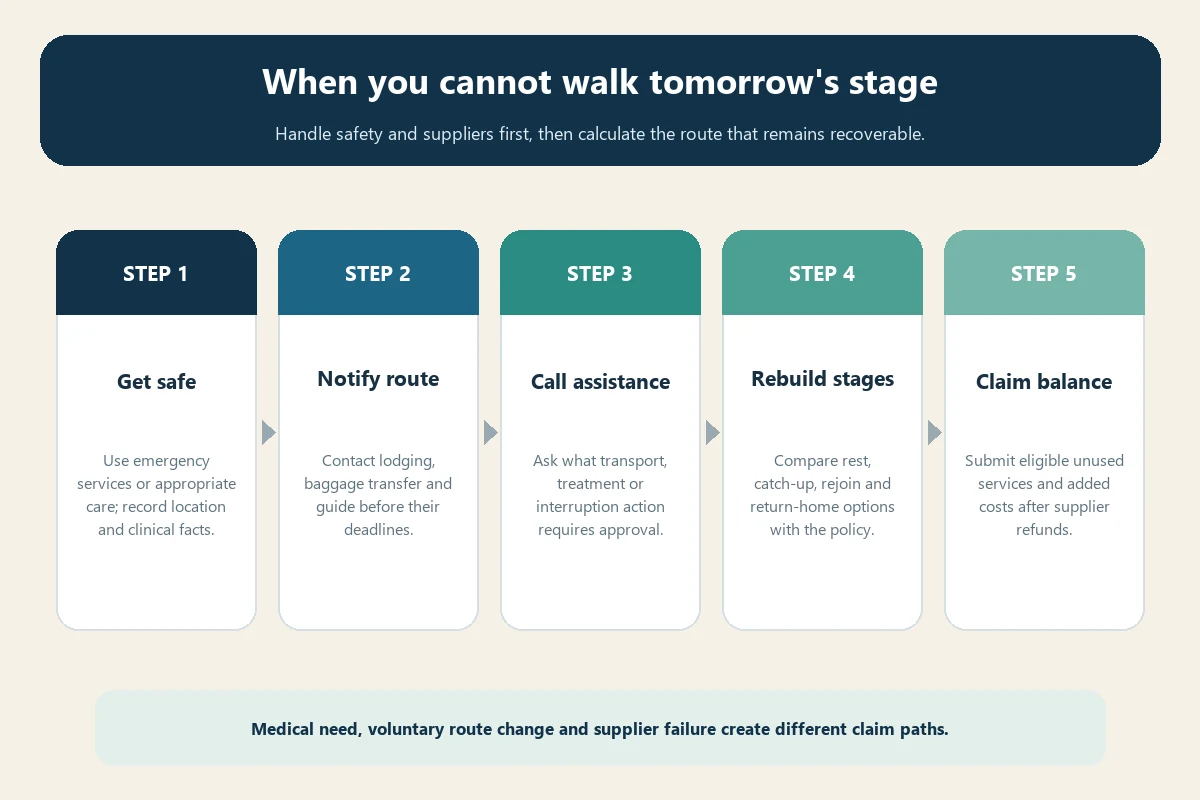
Blisters, tendon pain and overuse injuries can stop progress without automatically creating an insured interruption. The policy may require a physician to determine that the traveler cannot continue, plus prompt notice to the assistance service.
When care is needed:
- move to a safe location and seek appropriate treatment;
- contact emergency assistance when the policy requires it;
- obtain a clinical record with diagnosis, treatment and travel restriction;
- notify upcoming lodging and transfer suppliers; and
- preserve refunds and new transport receipts.
Do not ask a clinician to make an insurance decision. The clinician documents the medical facts; the policy determines whether those facts meet its benefit definition.
Keep receipts for replacement supports, medication and medically necessary local transport, but do not assume every walking aid is reimbursable. A medical benefit, baggage benefit and trip-interruption benefit can classify the same purchase differently, so attach the clinician’s instruction and the insurer’s authorization when available.
Pre-existing injuries need an early review
A stable knee, foot, back or cardiac condition can still fall inside a policy’s look-back definition if treatment, symptoms or medication changes occurred during the stated period. Review this before the first trip payment deadline passes.
A pre-existing-condition waiver may depend on purchase timing, fitness to travel and insuring required prepaid costs. Our pre-existing-condition look-back guide shows how records are evaluated without assuming that a familiar condition is excluded forever.
Travelers should discuss training, footwear, medication and symptom plans with an appropriate clinician. Insurance is a financial contract, not a substitute for preparation or treatment.
Stopping, resting and rejoining create different losses
One rest day
The traveler may need a taxi to the next booked town and an extra local night. Check whether a covered medical event and physician instruction are required for additional transport or lodging. A discretionary rest day may remain the traveler’s expense.
Skipping several stages
Ask assistance before arranging expensive catch-up transport. The policy may pay only a reasonable route to resume the itinerary, may impose a daily limit or may not cover catch-up costs at all. Supplier refunds reduce the remaining claim.
Returning home
Trip interruption, medical evacuation and repatriation are not synonyms. Interruption can address eligible unused trip cost and additional return transport. Medical evacuation generally moves a patient to appropriate care under assistance control. Repatriation home can require medical necessity and approval. The medical evacuation limit guide explains what the headline amount does not reveal.
Know who controls a transferred bag
Daily luggage transfer changes custody from the traveler to a local service. Check the transfer company’s terms for maximum weight, excluded valuables, delivery time, unattended-drop rules and compensation. Then read the policy’s baggage definition and exclusions for property entrusted to another party.
Keep the transfer tag, booking, bag description and proof of delivery to the pickup point. If the bag does not arrive, notify the service immediately and obtain a written incident record. A phone call alone is difficult to prove later.
The baggage delay and lost luggage guide distinguishes delayed essentials, permanently lost property, depreciation and supplier reimbursement. Airline waiting periods may not apply to a road transfer between villages.
Emergency access is not the same as insured evacuation
The Your Europe emergency guidance states that 112 reaches emergency services throughout the EU free of charge. Save it, but also record local route information and the insurer’s assistance number.
Emergency responders decide the immediate public-safety response. An insurance assistance company decides what transport it authorizes under the contract. A taxi from a trailhead, ambulance to a hospital, transfer to another facility and flight home can sit under different provisions.
The Spanish government’s Camino road-safety resource emphasizes route planning, appropriate equipment, visibility and first-aid preparation. Download official route information for offline use and share each day’s destination with a trusted contact.
Weather and route closure require a named event
Heavy rain, heat, wildfire risk or a closed section may make walking unpleasant or unsafe. Insurance still needs a covered event stated in the policy, such as a qualifying official evacuation, carrier disruption or unusable prepaid accommodation. A personal decision to avoid poor weather may not qualify.
Save the issuing authority, affected segment, publication time and reopening notice. Record the alternative route or transport offered. If the traveler changes plans before an official event exists, later coverage may be affected by foreseeable-event or voluntary-change rules.
Protect documents and small valuables
Shared rooms and daily packing increase the chance of leaving or losing property. Use secure storage, carry the passport and medication appropriately, and avoid placing excluded valuables in a transferred bag.
For a theft claim, follow local reporting requirements and keep the police or accommodation incident record. The policy may impose per-item limits and require proof of ownership. Replacement cash, document fees and the item’s insured value are separate questions.
Build the claim around the route decision
A useful claim file shows why the traveler stopped, what assistance authorized and which stages could not be recovered. Include the stage ledger, medical record, route notice, supplier responses, original and revised transport, refunds and itemized receipts.
Calculate only the eligible unused amount. If the traveler rejoins later, remove the services ultimately received. If a hotel issues a credit, disclose it even if the traveler would prefer cash. Our claim documentation guide provides the full evidence sequence.
Pilgrimage insurance checklist
- Does the policy classify the exact route as walking, hiking or trekking?
- Is every day from US departure through return within the maximum duration?
- Which stages, rooms and transfers are prepaid and nonrefundable?
- What medical evidence is required to stop, rest or return home?
- Are catch-up transport and additional lodging addressed?
- How are bags handled while in a transfer company’s custody?
- Who authorizes evacuation, facility transfer and repatriation?
- Are existing conditions, route changes and weather events covered as expected?
The U.S. Department of State’s travel insurance guidance advises travelers to examine overseas medical and evacuation protection. For a pilgrimage, combine that review with the stage ledger and exact activity wording.
General information, not insurance or medical advice. Benefits, activity classifications and emergency systems vary by plan and country. Read the issued policy and obtain professional guidance for personal health and route conditions.
