
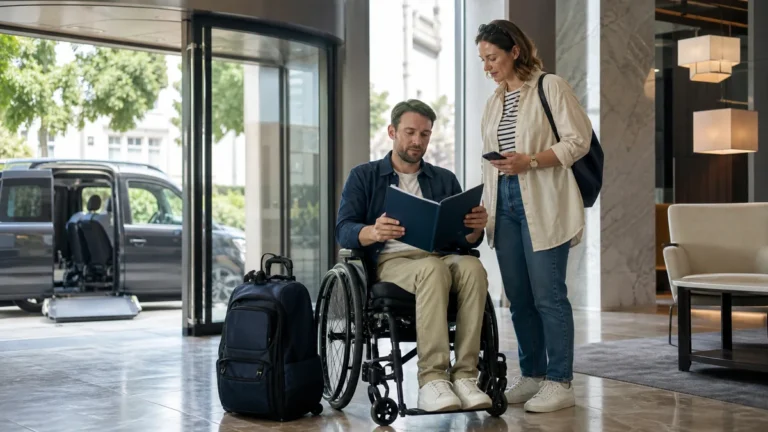
Europe travel insurance for accessible travel should protect continuity, not merely reimburse a generic booking. A wheelchair user, traveler with sensory access needs or person carrying essential medical equipment may need a specific room, vehicle, seat, assistance service and companion arrangement. Compare policies against those real dependencies and keep carrier or supplier rights separate from insurance benefits.
Key takeaways
- Insurance does not make an inaccessible service accessible or replace a confirmed accommodation.
- Mobility and medical equipment need an inventory, value and temporary-replacement plan.
- Carrier remedies should be used before claiming the same loss from insurance.
- Accessible lodging and transport must be confirmed by features, not a generic label.
- Companion costs, pre-existing conditions and evacuation require specific policy wording.
Build an accessibility dependency map
List what must work for the trip to remain usable. The map can include step-free boarding, an aisle chair, wheelchair dimensions, battery type, room entry, bathroom transfer space, a lift, refrigeration for medication, visual alerts, captioning, quiet space or an accessible vehicle.
Describe functional requirements to each supplier without assuming one country’s label matches another. Ask the hotel, carrier or tour operator to confirm the requested feature in writing and name the reservation. Keep photographs or diagrams supplied by the property when they affect the decision to book.
The U.S. Department of State’s accessibility guidance recommends researching destination conditions, assistive-device rules, equipment repair and health coverage in advance. That practical file becomes part of the insurance comparison because a generic replacement may not meet the traveler’s needs.
Insurance and accessibility rights solve different problems
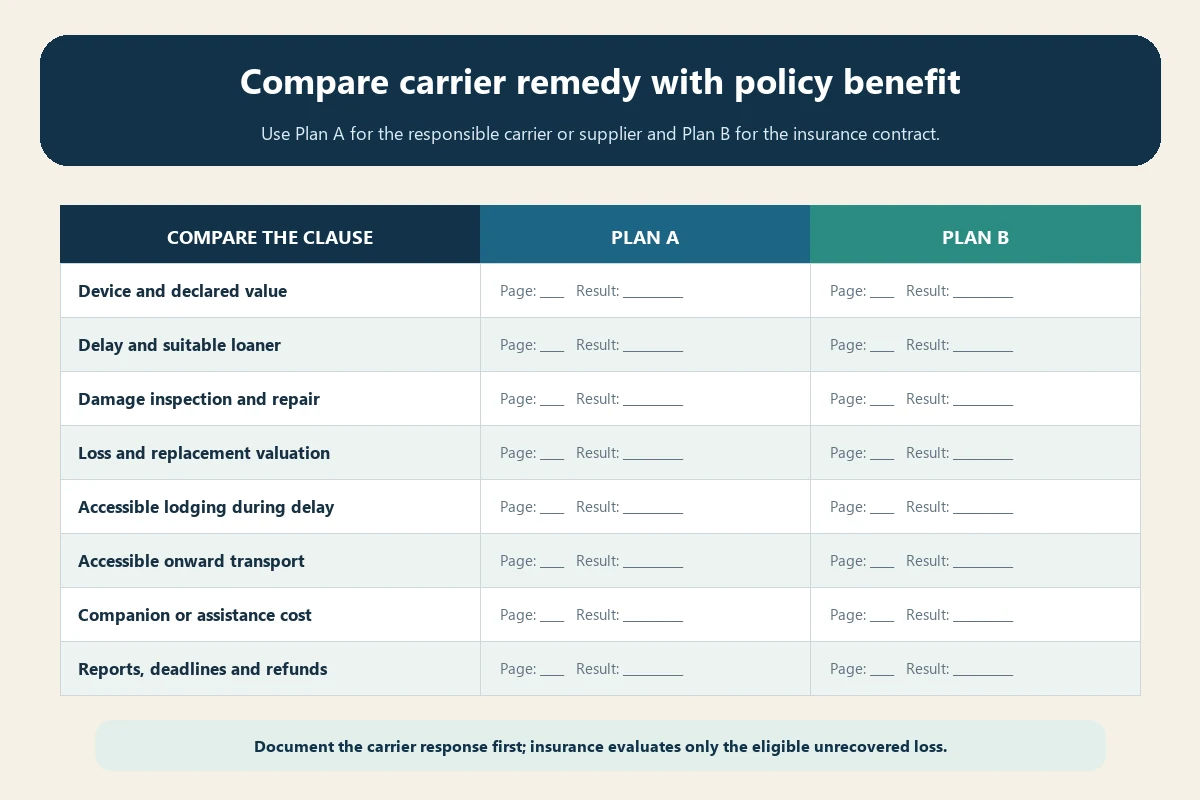
A carrier or supplier may owe assistance, correction, replacement or compensation under its contract or applicable passenger rights. Insurance pays only under the purchased policy. Use the responsible carrier or property first, document its response and then calculate the eligible unrecovered loss.
The Your Europe passenger-rights guidance for travelers with disabilities or reduced mobility describes assistance across air, rail, bus, coach and ship travel, subject to mode-specific rules and safety limitations. Those rights do not automatically extend an insurance benefit, and insurance does not erase the notification process for assistance.
For US-linked flights, the U.S. Department of Transportation Airline Passengers with Disabilities Bill of Rights explains assistance and remedies for assistive devices. Preserve the carrier’s incident report and Complaint Resolution Official information rather than treating a baggage desk receipt as the complete claim.
Create an assistive-equipment inventory
Record every essential item before departure:
- make, model, serial number and purchase date;
- current replacement and repair estimate;
- dimensions, weight, folding points and lifting instructions;
- battery chemistry, watt-hour information and removable parts;
- photographs from all sides before handoff;
- spare parts, tools and local repair contacts; and
- the minimum usable temporary substitute.
Do not assume a baggage maximum applies in the same way to a wheelchair or other assistive device. Carrier liability and policy property coverage can use different rules. Ask the insurer whether the device is covered, whether a special item limit applies and whether scheduled-property or home insurance should be considered.
Our baggage delay and lost luggage guide explains waiting periods, essential purchases and supplier recovery. Use it as a starting point, then obtain device-specific confirmation.
Plan for delay, damage and loss separately
If equipment is delayed
Ask the carrier for delivery timing, a suitable loaner or rental process and written authorization for necessary expenses. The cheapest available wheelchair or hearing device may not be functionally equivalent. Document why a proposed substitute does or does not meet the traveler’s needs.
If equipment is damaged
Photograph the damage before leaving the airport when possible, file the carrier report and protect the device from further harm. Obtain a qualified repair assessment. Do not authorize an irreversible repair or discard parts until the carrier and insurer have given instructions, unless immediate action is necessary for safety.
If equipment is lost
Request the carrier’s tracing record and escalation route. Ask the insurer about temporary rental, replacement valuation, depreciation and proof of ownership. Keep each expense linked to the period when the essential device was unavailable.
Accessible lodging must be a defined booking
“Accessible room” can conceal different layouts. Confirm the features that matter: route from entrance, door operation, bed transfer, bathroom configuration, shower access, lift dimensions, emergency communication and access to breakfast or other included services.
If the confirmed room is unavailable, ask the property to provide an equivalent room or relocation first. Record the failed feature, manager’s response, alternative offered and extra transport cost. A policy may not cover a supplier’s failure unless a named benefit and covered cause apply.
The European vacation-rental insurance guide shows how to preserve amenity promises and distinguish a host remedy from an insurance claim. Apply the same evidence discipline to hotels and tour lodging.
Map an accessible transport chain
Record assistance requests and confirmation numbers for every flight, station, port and transfer. Include connection time, boarding method, lift or ramp availability, seat needs and who handles equipment at each handoff. A tight connection that is legal on paper may not be practical for the required assistance process.
For rail travel, check whether tickets form a through journey, when assistance must be requested and what happens during disruption. Our Europe train-trip insurance guide separates carrier rerouting, missed connections and insurance waiting periods.
If a disruption removes the accessible option, request an accessible alternative from the carrier before self-booking. Document any instruction to arrange transport independently and retain the vehicle specification, not only the fare receipt.
Companion and personal-assistance costs are not automatic
A companion may be essential to the itinerary, but the policy may view that person as another insured traveler, a traveling companion or neither. Define both travelers in the application and check how cancellation, interruption, bedside travel and return transport apply to each.
If a nonprofessional companion becomes ill before departure, coverage depends on the policy’s covered-person and covered-reason definitions. If paid personal assistance is used, ask whether the service cost can be insured and what happens if that provider cancels.
Do not assume a medical evacuation benefit pays a companion’s airfare, lodging or specialized ground transfer. Record companion benefits and sublimits separately in the Europe coverage-limits worksheet.
Medical coverage should preserve continuity of care
The CDC Yellow Book guidance for travelers with disabilities recommends planning for equipment, airline arrangements and any underlying health condition. Carry a clinician’s letter when appropriate, sufficient medication and usable emergency information.
Compare medical policies for provider access, upfront payment, assistance communication, durable medical equipment, prescriptions, home nursing and emergency transport. A policy can cover an acute illness while excluding routine supplies or replacement of a device that simply wears out.
Our US health insurance abroad guide helps confirm what the domestic plan pays. Ask how the travel plan coordinates with it and whether the travel coverage is primary or secondary.
Pre-existing conditions require precise, fair analysis
A disability is not itself proof of an unstable medical condition. Read the policy’s actual pre-existing-condition definition and look-back period. The relevant question is how the contract treats diagnoses, symptoms, treatment or medication changes during that window.
If a waiver is available, eligibility can depend on prompt purchase, insuring required trip cost and fitness to travel. Our look-back period guide explains the document sequence. Obtain insurer clarification without accepting vague statements that conflate disability, equipment use and medical instability.
Evacuation planning must include functional needs
Emergency evacuation usually focuses on moving the patient to appropriate medical care under assistance control. Ask how the service handles a wheelchair, ventilator, communication support, service animal or companion. Essential equipment may travel separately or be subject to transport constraints.
Repatriation home is a separate question. The insurer may decide the medically appropriate destination and mode, not the traveler. Review the medical evacuation coverage guide for authorization, nearest-appropriate-facility wording and return-home conditions.
Cancellation must connect to a covered event
Concern that a destination may be difficult does not necessarily create a covered cancellation. Obtain written accessibility confirmations before the penalty period, and use flexible bookings where a critical feature cannot be verified.
If a documented change makes a confirmed service unusable, request the supplier remedy and ask the insurer which benefit could apply. A broken hotel lift, unavailable accessible vehicle and changed aircraft can create different contract paths. Cancel For Any Reason may provide broader flexibility when purchased and used under its conditions, but it is not a full refund.
Build a two-part claim file
Part one proves the right or supplier failure: assistance confirmation, device handoff, incident report, room specification, transport contract and supplier response. Part two proves the insurance loss: policy clause, medical evidence when relevant, receipts, refunds and unrecovered balance.
Keep communication accessible to the traveler. Ask the insurer how it supports relay services, written communication, authorized representatives or alternative formats. The claim documentation guide provides the general sequence for a complete file.
Accessible-travel policy checklist
- Are essential accessibility features confirmed by each supplier?
- What carrier rights and complaint processes apply to each transport mode?
- Are assistive devices identified, valued and covered outside ordinary baggage limits?
- Who pays for a suitable temporary device, repair or accessible relocation?
- How are companion and personal-assistance arrangements defined?
- Does medical coverage address continuity, equipment and communication needs?
- Are pre-existing-condition rules being applied to medical facts rather than assumptions?
- Can the claim and assistance process be used in the traveler’s preferred accessible format?
General information, not insurance, legal or medical advice. Accessibility rights, supplier duties and policy benefits vary by route, country and contract. Confirm personal needs directly with suppliers and qualified professionals.
Wheelchairs and mobility equipment need a separate payer analysis. Use the travel medical insurance for mobility aids guide to compare airline liability, baggage limits, repair, rental and medical benefits.
A wheelchair or scooter loss can involve airline liability, travel-policy sublimits, equipment insurance and an urgent temporary rental. Use the senior mobility-equipment travel insurance recovery stack to document the device, protect the handoff, restore function and prove the remaining claim.