

Travel insurance for transpacific cruise itineraries should cover the whole chain from home to embarkation, long sea-day stretches, foreign ports and the flight home—not only the days shown on the ship’s invoice. The defining problem is distance: one disruption can involve an airline, cruise line, shipboard clinic, port agent and overseas hospital.
Key takeaways
- Insure and document the trip from the U.S. departure through the final return.
- Test missed embarkation, shipboard care, medical diversion and interruption as separate clauses.
- Map passports and visas for every scheduled or potential disembarkation point.
- Ask how the policy handles port changes, international date-line records and supplier credits.
- Compare plans with one realistic mid-Pacific medical scenario.
Planning information reviewed August 16, 2026. Routes, port rules, health guidance, ticket contracts and policy terms can change. Recheck official sources, the cruise line and the issued certificate for the actual sailing.
Map the entire transpacific journey
List the home airport, connection, embarkation city, pre-cruise hotel, ship, every scheduled port, post-cruise stay and return flight. Add transfers and separately booked excursions. Record the calendar date, local time and supplier for every handoff.
Transpacific itineraries may cross the international date line. Preserve the cruise line’s official itinerary and any revised schedule so medical records, card charges and receipts can be reconciled correctly. Do not “correct” a local date without retaining the original.
Read the cruise contract before the policy
The passenger ticket explains what the cruise line promises when it changes a port, shortens a voyage, denies boarding or ends the trip early. Record refund, future-credit, medical-disembarkation and passenger-conduct terms. The insurance claim is calculated after those supplier rights are considered.
The cruise insurance clauses guide provides a side-by-side checklist. Compare the passenger contract with the policy definitions of cruise, common carrier, trip, covered reason and nonrefundable cost.
Protect the embarkation chain
Identify the last flight that could reasonably reach the ship, the cruise check-in cutoff and the next port where joining may be lawful and practical. Ask whether missed connection, missed embarkation or travel delay applies to the actual airline disruption and waiting period.
Arriving a day or more early can reduce risk, even if the hotel is a personal planning cost. If a flight fails, contact the airline, cruise line and assistance team before buying catch-up travel. Save the operational reason and every alternative or refund offered.
Separate delay, cancellation and interruption
Cancellation occurs before departure, interruption after the trip begins, and delay usually pays defined additional expenses after a waiting period. One event can involve more than one section without allowing duplicate recovery.
The delay, interruption and cancellation guide helps classify a hotel near the port, unused cruise days and an early flight home. Read benefit triggers, time limits and caps rather than assuming the broadest label applies.
Understand shipboard medical care
The CDC’s current cruise ship health guidance explains that ship medical centers treat many illnesses and injuries, while some cases require shoreside consultation or evacuation. Travelers with medical needs should ask the cruise line what care a specific ship can and cannot provide.
Ask the policy whether shipboard physician fees, tests, medicines and treatment are eligible as emergency medical expenses. Shipboard accounts may be charged to the cabin immediately. Keep the full medical record and itemized onboard statement, not only the final card total.
Model a medical diversion at sea
A seriously ill traveler might be stabilized onboard, diverted to a port, transferred to a local hospital and later moved to another facility. Ask who determines medical necessity, selects the port or receiving facility and authorizes each transport stage.
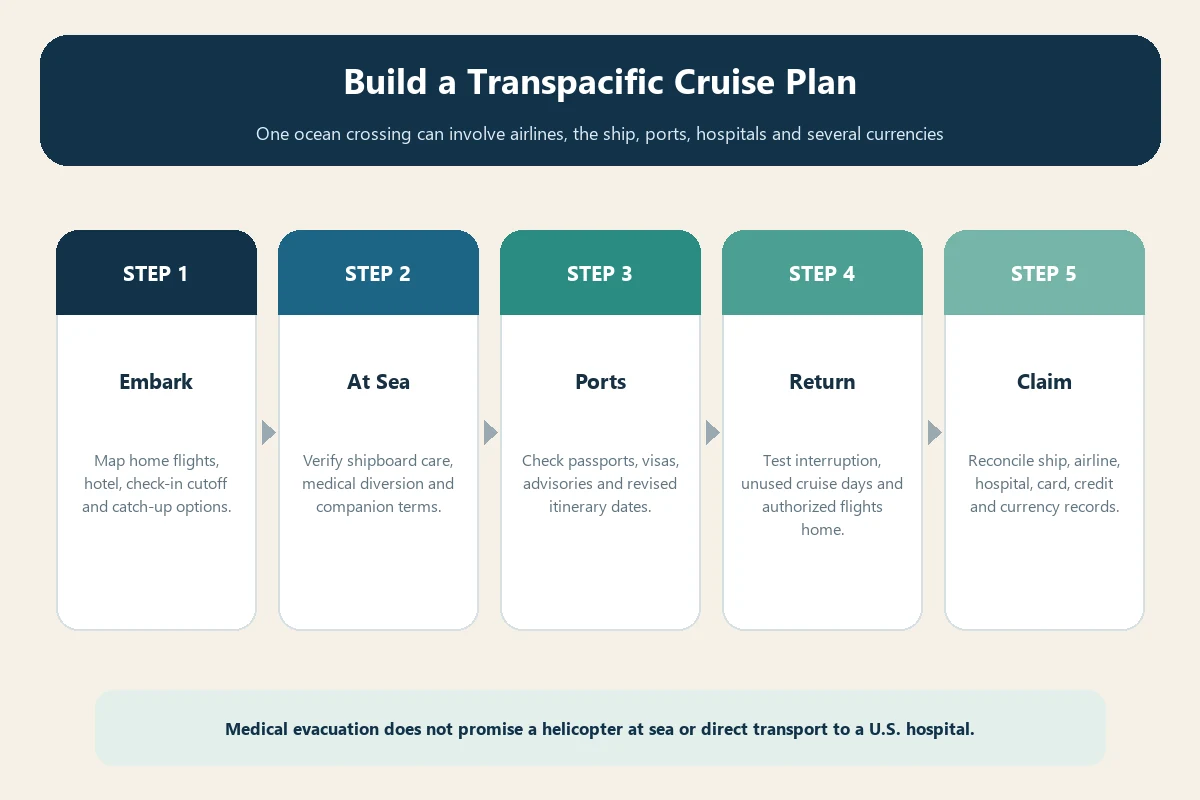
Medical evacuation does not necessarily mean a helicopter from the middle of the ocean or direct return to a U.S. hospital. The ship’s master, weather, distance and operational authorities influence what is possible. Use the evacuation limit guide to test the wording.
Distinguish diversion from interruption
A ship’s operational diversion moves the vessel; a medical disembarkation removes a traveler; and trip interruption addresses eligible unused arrangements and additional travel after a covered event. Ask how the certificate treats a companion who remains with the patient.
Check provisions for added lodging, economy airfare, medical escort, family visit and return to the trip. Each may have separate conditions. Ask whether assistance must approve travel before it is booked.
Check U.S. government cruise advice
The U.S. Department of State’s cruise ship guidance recommends medical and emergency evacuation insurance and reminds passengers to hold the documents and visas required for all stops. Cruise lines may impose passport rules beyond government minimums.
Review official country information for every scheduled port, even when the traveler plans to stay aboard. Also ask the line which unscheduled diversion ports are reasonably possible. Entry permission in an emergency is controlled by authorities, not by an insurance promise.
Audit every country and territory
Create a route table for the United States, Canada, Mexico, Hawaii, Pacific island nations, Australia, New Zealand, Japan or other stops actually on the sailing. Record passport validity, visa or authorization, health guidance and current advisory for each jurisdiction.
Do not publish one universal answer for all transpacific routes. A repositioning cruise from Vancouver to Sydney differs from Los Angeles to Tokyo. Update the table whenever the cruise line alters the itinerary.
Prepare for domestic health-plan limits
State guidance notes that U.S. Medicare and Medicaid do not cover medical costs abroad. Ask any private U.S. health plan how it treats shipboard care, foreign hospitals and out-of-network emergency services. Request the response in writing.
Ask the travel insurer whether it can arrange a payment guarantee ashore and whether medical coverage is primary or secondary. The health insurance abroad guide helps document both payers without assuming either will pay directly.
Review illness and isolation scenarios
CDC guidance discusses respiratory, gastrointestinal and other illness in the close ship environment. Ask the line about its current medical and isolation procedures, and ask the insurer how a physician-ordered isolation differs from a passenger’s voluntary choice.
Preserve the ship clinician’s instruction, cabin restriction, test result, daily account, missed services and any cruise-line credit. A diagnosis alone does not establish every claimed expense. Each cost must connect to policy wording and remain unreimbursed.
Test skipped-port and itinerary-change wording
A missed port can be disappointing without creating an insurance benefit. Check whether the policy has a specific itinerary-change provision and what documentation it requires. The cruise contract may permit substitutions without a cash refund.
Save the captain’s or line’s notice, reason, revised itinerary and compensation. Do not label the whole cruise “canceled” when the ship operated. Claim only a benefit whose definition matches the event.
Build a weather and carrier timeline
For a storm, swell or port closure, keep an official bulletin with the airline, port or cruise-line action. Add local issue time and the route segment affected. A forecast by itself does not prove that a prepaid service became unusable.
The weather delay guide explains the difference between an official disruption and a voluntary schedule change. Record when the event became known compared with the policy purchase and each payment.
Compare cruise-line protection and third-party insurance
Use the actual documents, not product labels. Compare when coverage begins and ends, eligible trip costs, medical expense, evacuation, interruption, supplier default, pre-existing-condition rules, assistance and the form of any cancellation benefit.
A cruise-line plan may include a future credit for some events, while an insurance policy may pay money only after a covered reason. Neither structure is automatically better. Match it to the traveler’s airfare, hotels, medical history and tolerance for supplier credit.
Price one mid-Pacific scenario
Use identical travelers, dates and costs for each quote. Test chest pain after several sea days, assessment onboard, diversion or disembarkation at a foreign port, hospitalization, a companion’s hotel and medically approved travel home.
- Is shipboard treatment an eligible medical expense?
- Who authorizes shoreside transfer?
- Which facility is considered suitable?
- What companion costs are included?
- How are unused cruise days calculated?
- Which line, airline or card refunds reduce payment?
Document the answer and policy section. Avoid unsupported evacuation cost estimates and arbitrary limit recommendations.
Use assistance without losing the medical record
Store the policy, assistance line, ship name, booking number and route offline. When a medical issue occurs, notify the ship’s medical center and assistance team as soon as practical. Record case numbers, local or ship time, clinician recommendations and authorizations.
The assistance versus claims guide explains why opening a case is not final payment approval. Request written confirmation before costly nonemergency arrangements whenever conditions allow.
Build a multi-currency claim ledger
Keep shipboard charges, port-agent invoices, foreign hospital bills, lodging, flights and ground transport on separate lines. Record the original currency, transaction date, actual card settlement and refund. Note the time zone used on each document.
The claim documentation guide helps reconcile the cruise line, airline, card and health-plan recoveries. Submit only the remaining eligible loss and retain the supplier correspondence that explains each credit.
Create a ship-to-shore response card
List passport name, allergies, medicines, policy number, assistance contact, ship, cabin, emergency contact and key ports. Add lawful prescription documentation and a brief medical summary. A companion should know where these records are stored.
Carry enough medication for the voyage plus a reasonable disruption margin after checking every jurisdiction’s rules. Do not place the only copy in checked baggage. Ask the cruise line in advance about refrigeration, mobility or other special needs.
Know what the policy cannot guarantee
Insurance cannot command the ship to divert, guarantee a helicopter, open a closed port, issue a visa, reserve a hospital bed or erase the passenger contract. It cannot make every missed port or uncomfortable sea day reimbursable.
The State Department’s general travel insurance checklist recommends checking every destination, trip duration, emergency care, medical transport, current condition, planned activity and 24-hour help line. Apply it to the full ocean-crossing route.
Bottom line
The right transpacific cruise comparison follows the traveler from home to ship and back. Verify missed embarkation, shipboard medical care, diversion, interruption and entry-document terms; then test them against a realistic sea-day emergency. Keep one dated route and one reconciled claim ledger across every supplier.
A cruise medical event can cross six separate operational and insurance stages. Use the cruise ship medical evacuation guide to trace onboard care, rescue authority, port handoff, local hospital treatment, and any later insured transfer.
