

Europe travel insurance for language schools needs to protect more than an ordinary vacation. A short course can combine nonrefundable tuition, a homestay or student residence, transatlantic airfare and medical exposure in one booking. The right comparison begins by separating those costs and checking which contract responds if the student cannot start, must leave early or the school changes the program.
Key takeaways
- Tuition is insurable only if the policy treats it as an eligible prepaid trip cost.
- School cancellation and student withdrawal are different events with different refund paths.
- Coverage must run from departure through the final side trip and return home.
- Proof required by a school or immigration authority is separate from a policy’s broader usefulness.
- Medical, evacuation, repatriation and assistance services remain important on a short course.
Why a short language course is its own trip type
The European Education Area’s short-term study guidance includes language courses among programs that can range from brief summer opportunities to longer study periods. A traveler attending morning classes for four weeks is neither a conventional tourist nor necessarily a resident student.
That middle ground changes the insurance file. The school may collect tuition, registration fees, accommodation and airport transfer in one invoice. Flights may be booked separately. Weekend travel may cross national borders. A program plan might cover medical emergencies but exclude cancellation before departure.
This article focuses on short, defined courses rather than a semester or degree. Travelers planning a term overseas should use our separate guide to coverage for a semester abroad, where residence, mental-health support and long policy-duration limits require a different analysis.
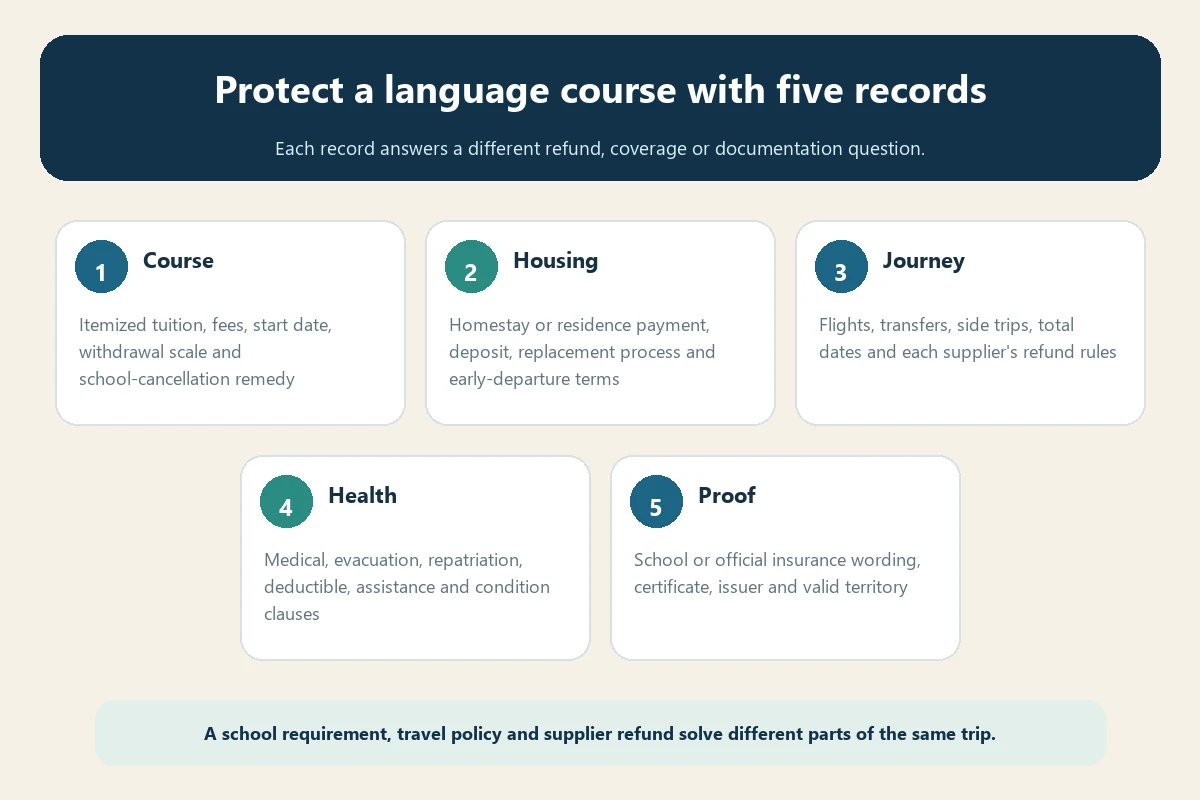
Start with a five-record course file
Before comparing plans, create one folder with five records:
- Course invoice: tuition, materials, registration, exam and activity charges.
- School terms: withdrawal deadlines, course cancellation, class substitution and refund method.
- Housing terms: homestay, residence or rental dates, deposit and early-departure rules.
- Travel itinerary: every flight, rail ticket, transfer and personal side trip.
- Insurance evidence: certificate, policy wording, assistance number and any proof required by the school.
The file shows which organization owes the first remedy and which cost might remain. It also prevents the word “program” from hiding several independent contracts.
Confirm whether tuition is an eligible trip cost
Do not assume tuition counts because it was prepaid. Look for the policy’s definition of trip cost, trip payment or prepaid arrangement. Then confirm that an educational course supplied by the named school fits that definition. Some policies may accept eligible tuition; others may protect only traditional travel services.
Ask the insurer in writing:
- whether tuition, registration and materials can be included in insured trip cost;
- whether school-arranged housing is treated differently from tuition;
- whether refundable amounts should be excluded from the insured total;
- what proof establishes the initial trip payment date; and
- whether course interruption is valued by unused days, unused weeks or another method.
Our guide to reading a travel insurance policy explains how definitions, benefit sections and exclusions work together. Keep the insurer’s answer with the issued policy; a sales-page summary is not a substitute for contract wording.
Separate school cancellation from student cancellation
If the school cancels the course
The school’s own terms come first. Request the available refund, replacement course or credit and preserve the dated cancellation notice. Insurance should evaluate only the eligible amount that the supplier does not return. A school closing the class because enrollment is low is not automatically the same covered reason as a traveler’s illness.
If the traveler cannot start
A standard trip-cancellation benefit normally requires a reason listed in the policy, such as a qualifying illness supported by the required evidence. A work conflict, change of interest or failed placement test may not appear on that list. The covered-reasons guide shows why the event, timing and evidence must align.
If the school changes the class
A timetable change, merged level, remote lesson or different campus may disappoint the student without canceling the service. Compare the change with the school’s written promise and complaint process. Do not describe a preference dispute as a canceled trip.
Buy with the tuition refund calendar in view
Course terms can become more restrictive as the start date approaches. Insurance also has time-sensitive provisions measured from the first trip deposit. Record the first payment date, each school refund deadline, the final balance date and the policy purchase date on one calendar.
If the traveler wants a pre-existing-condition waiver or an optional Cancel For Any Reason benefit, eligibility can depend on prompt purchase and insuring the required costs. The exact conditions differ. Our Europe insurance timing guide provides an order of operations without assuming that late purchase can restore expired options.
Cancel For Any Reason is not a full refund and typically has its own deadline, percentage and timing rules. It can be relevant when the concern is outside standard covered reasons, but only the issued policy can show whether the course cost is eligible.
Match the policy duration to the real stay
Use departure from the United States as the beginning and the final return home as the end. Include orientation days, early arrival, housing after the last class and personal travel before or after the course. A policy ending on graduation Friday may leave a weekend trip and Monday flight outside the coverage period.
Check the maximum trip length as well as the dates printed on the certificate. If the student extends the course or changes the return flight, ask whether the policy can be extended before the original end date. Do not rely on automatic continuity.
For weekend travel, confirm geographic scope, excluded destinations and whether independent activities remain within the plan. The school may cover only program-sponsored outings while a personal trip to another country sits outside its arrangement.
Medical cover must work for a US student in Europe
The CDC Yellow Book guidance for student travel recommends medical, evacuation and repatriation protection for the duration of travel. It also advises students to plan for routine medication, pre-existing health needs and access to care.
A US health plan may have limited overseas benefits, require payment upfront or exclude evacuation. Confirm this directly with the domestic insurer and compare the answer with our explanation of how US health coverage works abroad.
For the travel policy, record:
- medical maximum and deductible;
- primary or secondary payment structure;
- emergency evacuation and repatriation limits;
- preauthorization and assistance-call requirements;
- pre-existing-condition and mental-health provisions; and
- coverage for any planned sports, work or volunteer activity.
The European Education Area’s healthcare overview says the appropriate arrangement for non-EU/EEA students depends on the destination and circumstances. It also distinguishes travel health insurance from national coverage. Americans should not assume enrollment creates eligibility for a European Health Insurance Card; our EHIC guide for US citizens explains that distinction.
School insurance can be mandatory without being comprehensive
A language school may require proof of specified medical, evacuation or liability protection. Treat that requirement as a minimum document check, not evidence that tuition, flights and housing are covered. Ask for the full wording of any school-arranged plan before declining other protection.
Compare the school plan and an individual policy for dates, territory, medical limits, cancellation before departure, interruption after classes begin, personal side trips and who can contact assistance. If both can respond, read the other-insurance rules rather than expecting two payments for the same loss.
Entry rules and insurance terms are separate tests
The European Education Area’s student-visa overview distinguishes short study periods from stays longer than 90 days and notes that requirements vary by country. A US passport holder’s entry position can depend on destination, duration and activity. Verify the current rule with the responsible national authority or consulate.
If proof of health insurance is requested, confirm the required limit, territory, dates, wording and issuer documentation. A useful travel policy can still fail an administrative requirement if its certificate omits a required statement. Conversely, a certificate accepted for entry may not protect tuition or course interruption.
The U.S. Department of State’s study-abroad guidance directs travelers to destination information, insurance planning and the Smart Traveler Enrollment Program. Keep school emergency contacts and the nearest US embassy or consulate details outside the phone as well as on it.
Housing and personal liability need separate questions
School-arranged homestays and residences may have their own cancellation and conduct terms. Check the security deposit, early-departure refund, replacement-room process and responsibility for accidental damage. Trip insurance baggage or interruption benefits do not automatically replace a housing liability policy.
If the host arrangement fails, document what the school offered before booking a hotel. An insurer may require the supplier to correct the problem first. Save messages, photographs, receipts and the reason the original accommodation could not be used.
Build a claim file while the course is running
Keep the attendance record, course calendar and receipts. If illness interrupts classes, obtain a dated clinical record and notify the school under its withdrawal process. If transport is delayed, request the carrier’s cause and remedy. If property is stolen, follow local reporting requirements and notify the assistance service promptly.
Do not wait until returning home to reconstruct the unused tuition calculation. Ask the school for a statement showing the amount paid, service used, refund issued and balance retained. Our guide to filing a travel insurance claim lists the evidence that connects an incident to an unrecovered loss.
Language-course policy checklist
- Is the school an eligible supplier under the policy definition?
- Which tuition and housing amounts are nonrefundable today?
- Are school cancellation and traveler cancellation handled separately?
- Does the insured period include arrival, side trips and the flight home?
- Does medical coverage include evacuation, repatriation and assistance?
- Are pre-existing conditions, mental health and planned activities addressed?
- Does the certificate satisfy any school or official documentation rule?
- Who provides the first refund, and what evidence proves the remaining loss?
General information, not insurance or immigration advice. Policy wording, school contracts and entry requirements vary by issuer, program and destination. Verify each requirement with the responsible organization before paying.
Preparing for study abroad? The Schengen insurance guide for students separates visa proof, long-term health requirements and protection for independent travel.
