

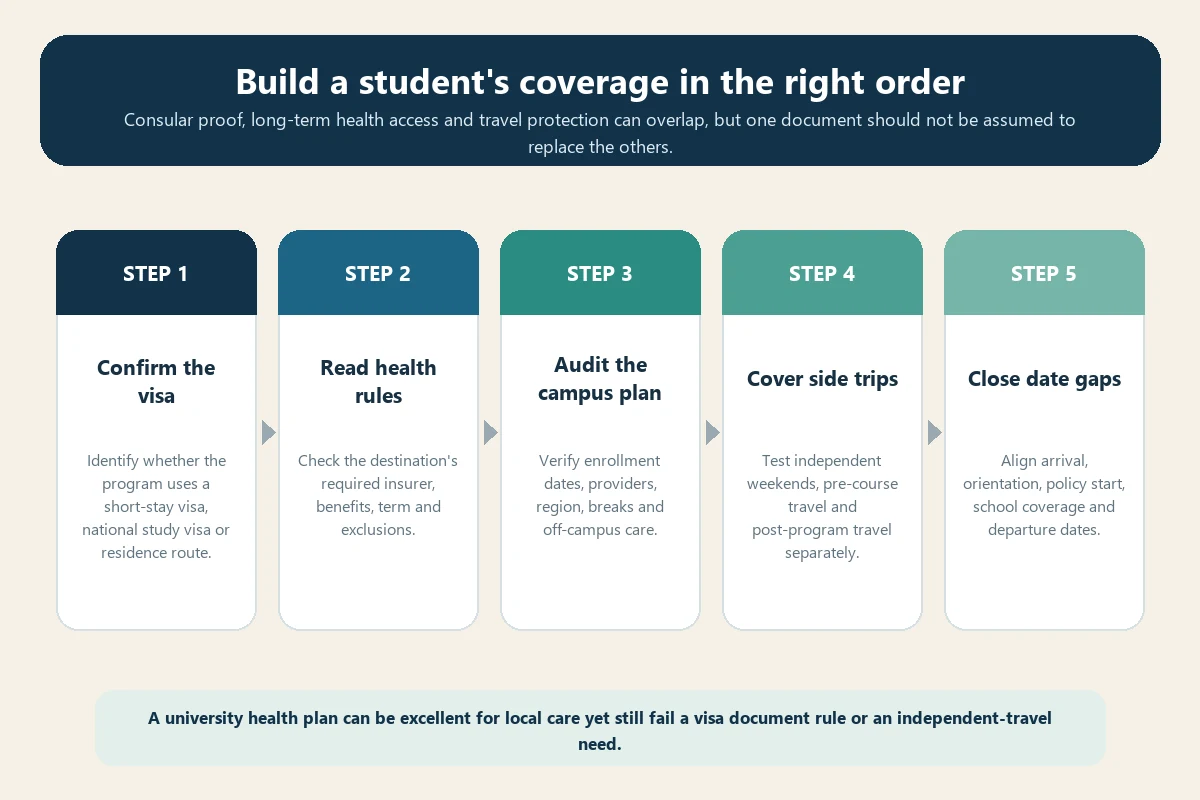
Schengen insurance for students should be built in layers, because a visa certificate, a university health plan and travel insurance are not automatically interchangeable. The correct structure depends on the program length, destination and visa route. A short course may use short-stay travel medical proof. A semester or degree program may require a national study visa and comprehensive health coverage for the entire stay.
Key takeaways
- Confirm the visa category before comparing student insurance products.
- A school plan may cover local health care yet fail a consular document requirement.
- A visa-compliant policy may still be weak for routine care, mental health or independent trips.
- Arrival, orientation, academic breaks and post-program travel create common date gaps.
- Students should carry policy details and know how to reach assistance without a parent.
Start with program length and immigration route
Write down the destination country, official program dates, arrival date and planned departure. Then identify the route on the responsible government’s website. Short programs that fit within the Schengen short-stay limit may use a Schengen visa or visa-free travel, depending on nationality. Longer programs commonly use a national study visa or residence permit.
The EU Immigration Portal directs students staying beyond 90 days to national information. The short-stay European Commission application guide instead lists medical insurance among the documents for a Schengen visa. Those paths can use different insurance standards even when the student will live in the same city.
For a short program, begin with the Schengen visa insurance requirements guide. For a national study route, use the destination’s exact official checklist. Do not let an insurer’s phrase “student Schengen plan” decide the visa category.
The three coverage layers students should separate
| Layer | Main purpose | Question it answers |
|---|---|---|
| Consular evidence | Prove the applicant meets the visa category’s insurance condition | Will this exact certificate be accepted with the application? |
| Local health access | Pay for routine and serious care during study | Where can the student receive primary, specialist and hospital care? |
| Travel protection | Address emergencies, evacuation and covered trip risks beyond normal campus life | What happens during side trips, breaks or travel before and after classes? |
One contract can serve more than one layer, but that must be demonstrated. A university plan may begin after enrollment and work through a local provider network. A travel plan may start at departure and include assistance abroad. A national visa may demand an authorized health insurer and comprehensive benefits. Compare functions and dates instead of counting documents.
National study visas can require resident-style health cover
Spain provides a useful official example. The Spanish Consulate in Washington study-visa page requires public or private health insurance from an entity authorized to operate in Spain. It says the policy must cover the risks insured by Spain’s public health system for the full authorized stay and that travel insurance is not accepted.
This example should not be generalized to every country. It shows why a student must read the national checklist. A plan that meets the short-stay Article 15 minimum could still be rejected under a study-visa standard. Conversely, a campus plan may be medically strong but unavailable early enough to generate the required certificate.
Ask the school which plan is mandatory, when it begins and whether waiver requests are possible. Then ask the consulate whether that plan produces acceptable evidence. Obtain answers in writing when the published instructions do not resolve the issue.
Audit the university or exchange-program plan
Request the full benefits document, not only a welcome-page summary. Record the insurer or administrator, coverage dates, service area, provider network, deductible, copayments, prescription rules and emergency process. Check routine care, specialist referrals, diagnostic tests, hospital services and mental-health support.
Then test common student scenarios:
- illness during orientation before classes begin;
- a weekend in another European country;
- care during winter or spring break;
- a sports injury or outdoor activity;
- ongoing treatment for an existing condition;
- a prescription that needs refilling abroad;
- travel after the final exam but before the return flight.
A school’s statement that students are “covered” is only the beginning. Determine who pays, where treatment is available and whether the plan assists with medical evacuation or repatriation. The Europe insurance guide for language schools provides a shorter-program checklist that also works for exchange courses.
Close the calendar gaps
Students often arrive before official enrollment to find housing or attend orientation. They may travel after the program, and campus coverage may end immediately when student status ends. Create a date line with flight departure, Schengen arrival, dorm access, orientation, enrollment, school-plan activation, academic breaks, final assessment and final exit.
Put the relevant policy above each day. A blank day is a coverage question. An overlapping day is not automatically wasteful if the policies serve different purposes, but coordination-of-benefits clauses can affect claims. Use the Schengen insurance dates guide to account for overnight flights and border dates.
The U.S. Department of State’s Student Abroad handout advises students to check the school’s insurance policy and consider extra insurance for independent travel. That is a practical reason to test weekends and breaks separately from the program itinerary.
Existing conditions, prescriptions and ongoing care
Do not reduce medical planning to an emergency limit. A student managing asthma, diabetes, allergies, mental-health treatment or another condition may need routine appointments and medication. Read the definition of a pre-existing condition, the lookback period, stability requirements and any waiver deadline. Coverage for a sudden worsening can differ from coverage for ordinary maintenance care.
The pre-existing condition lookback guide explains how policy definitions work. If a waiver is advertised, compare the waiver timing and eligibility rules. Ask a clinician early about medication quantity, generic names, storage and destination restrictions. Keep medicines in original labeled packaging and carry appropriate documentation.
Travel insurance is not a substitute for personal medical advice. Students should plan how to access routine care locally and should know what to do if a prescription cannot be filled under the same brand.
Compare policies with student-specific questions
- Eligibility: does enrollment status, U.S. residence or trip origin affect coverage?
- Term: can the plan cover the complete stay, including early arrival and later travel?
- Territory: are the destination, Schengen side trips and travel home covered?
- Activities: are club sports, skiing, hiking, cycling or internships excluded?
- Health services: how are routine care, mental health, prescriptions and emergencies handled?
- Assistance: can the student contact the provider at all hours and authorize treatment?
- Documents: can the insurer issue a certificate that matches the official visa checklist?
- Claims: must the student pay first, notify before care or use a specific network?
Record answers beside the policy wording. Use the Europe policy comparison worksheet to prevent a low premium from hiding a narrow network, high deductible or short maximum trip.
Prepare the visa and travel file
The certificate should use the passport name and show the correct period and territory. It should identify the insurer and make the required benefits visible. Check the certificate audit guide before filing. If the destination requests translations, originals or a prescribed form, follow that instruction exactly.
Create a smaller travel copy containing the certificate, full policy, assistance contact, student-plan card, school contact and relevant medical information. Store a secure digital copy that the student can access without a parent. Family members should know the insurer, but the student should also understand notification and claims steps.
Common mistakes in student insurance planning
- Buying a short-stay “Schengen” policy for a national study visa without checking the official standard.
- Assuming a university acceptance letter proves health coverage.
- Ignoring the weeks before enrollment or after the academic term.
- Comparing only emergency-medical limits and not routine care or networks.
- Failing to declare relevant health history accurately.
- Assuming all sports, internships and independent trips are included.
- Leaving every policy document with a parent in the United States.
Frequently asked questions
Do U.S. students always need Schengen visa insurance?
No. The answer depends on nationality, destination, length and visa route. Visa-free short travel, a short-stay visa and a national study visa use different document paths. Insurance can still be prudent even when it is not a visa requirement.
Is the university health plan enough?
It may be enough for one purpose but not every purpose. Verify whether it satisfies the consulate, covers the complete timeline and protects travel outside its service area.
Can parents buy the policy for the student?
Often yes, but the student must be the correctly identified insured person and meet all eligibility rules. The certificate and application records should match the student’s passport.
What if the visa appointment or semester dates change?
Ask whether the effective dates can be moved and whether fees are refundable after a visa refusal. Do not alter a certificate manually. Obtain a reissued document from the insurer.
Should the student buy primary medical coverage?
Primary coverage may simplify which insurer receives a claim first, but definitions and procedures vary. The primary medical coverage guide explains what to compare.
This educational guide is not legal, medical or insurance advice. Students should verify current visa instructions, school requirements and policy terms with the responsible organizations.
