

Medical evacuation insurance pets coverage is usually misunderstood because a plan may display a large human evacuation limit beside small, separate pet benefits. Emergency medical evacuation ordinarily concerns the insured traveler. It does not automatically pay veterinary bills, place an animal on an air ambulance, return a pet home, satisfy an airline, or clear a border.
The useful question is not “does the plan cover pets?” It is “which exact event, animal, expense, route, destination, and approval does each named benefit cover?” This guide is educational, not medical, veterinary, insurance, legal, carrier, or import advice. Use the issued policy and current rules for every country and carrier.
Key takeaways
- Start with the presumption that human medical evacuation covers the insured person.
- Look for a separately named pet-return or pet-transport benefit.
- Do not confuse return transportation with veterinary treatment.
- Country, transit, airline, crate, health, and temperature rules remain separate gates.
- Name a receiving caregiver and a local fallback before an emergency.
Reviewed August 16, 2026. Pet, insured person, hospitalization, unattended, return, common carrier, country of residence, and covered reason are contract definitions. Product forms, animal-entry rules, and carrier acceptance change.
The short answer: the human benefit follows the human patient
A medical evacuation benefit usually responds when an insured traveler has a covered illness or injury and medically necessary transport must be arranged. Clinical need, an appropriate destination, fitness to move, transport mode, assistance-company approval, and the policy maximum belong to that decision.
A pet is not an insured patient merely because it is traveling with that person. The home-country evacuation guide explains why even the human passenger cannot assume a preferred destination or aircraft. An animal creates additional medical, carrier, customs, welfare, custody, and payment questions.
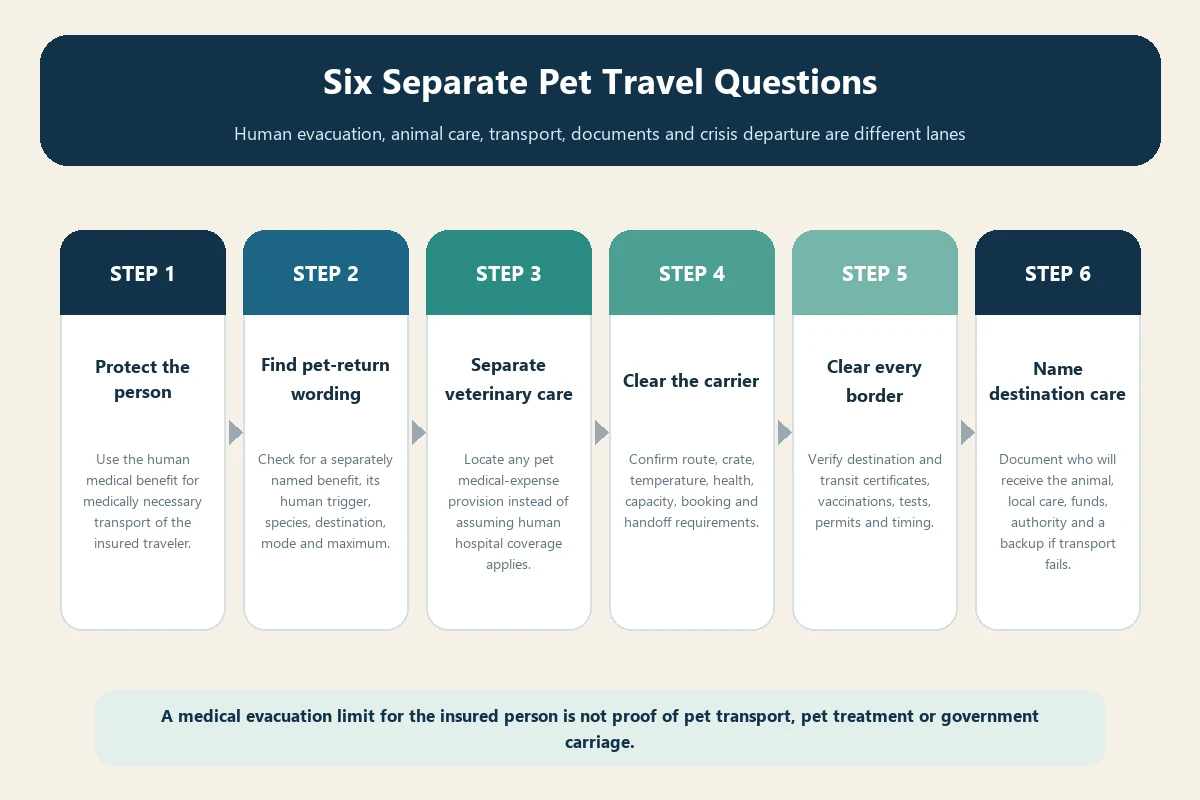
Use a six-lane coverage map
| Lane | What it may address | What it does not prove |
|---|---|---|
| Human medical evacuation | Medically necessary transport of an insured person | Any animal expense or carriage |
| Pet return | A defined route for an eligible animal after a human trigger | Veterinary treatment or any chosen destination |
| Pet medical expense | Specified emergency veterinary charges | Human evacuation or animal relocation |
| Pet-related trip protection | A listed cancellation or interruption reason | Care during the trip |
| Carrier transport | A booked animal itinerary under carrier rules | Insurance eligibility or border admission |
| Crisis departure | Transport under a defined security or government process | That a pet can board |
The travel medical benefits guide shows why a schedule line must be matched to its coverage grant, definitions, conditions, exclusions, and maximum. The same method prevents a pet-related label from becoming a promise it never made.
What a pet-return clause can actually do
Some forms contain a separately named pet-return benefit. One current 2026 IMG sample contract illustrates the narrow structure: the insured person must be hospitalized, be an adult traveling alone with a cat or dog, and the animal must be left unattended for a specified period. The example addresses a one-way economy common-carrier or ground ticket to an airport in the insured person’s country of residence.
That is one plan-specific example, not a market rule or recommendation. Another certificate may omit pet return, define a different animal, use a different trigger, require a different unattended period, pay a different amount, name a different endpoint, or impose additional conditions.
Audit the human trigger before the animal route
Pet return may turn on the human traveler’s hospitalization, evacuation, death, or inability to continue the trip. “Hospitalized” can mean formal inpatient admission rather than an emergency-department visit, observation, outpatient procedure, hotel recovery, or medical advice not to fly.
Record the admission status, diagnosis, treating facility, expected duration, current pet supervision, other travelers, and assistance case number. The presence of a spouse, friend, tour leader, sitter, or adult relative may affect whether the animal is actually unattended or whether the insured is traveling alone.
Species, weight, number, and ownership can narrow eligibility
Never translate “pet” into every companion animal. A clause may name cats and dogs only, impose a weight threshold, limit the number of animals, require the pet to be traveling with the insured, or depend on ownership and booking records. Exotic animals, birds, reptiles, livestock, service animals, and emotional-support animals can face different legal and carrier systems.
The USDA APHIS pet-travel hub explains which privately owned companion animals fall within its pet-travel process and routes other animals to different import or export rules. Insurance wording cannot expand a government category.
Return transportation is not veterinary insurance
A pet-return clause may pay an eligible ticket or transport cost after a human emergency. It need not pay for a veterinarian, examination, medication, quarantine, boarding, kennel, crate, health certificate, laboratory test, vaccination, sedation decision, missed connection, or care at the destination.
Conversely, a pet medical-expense benefit can cover specified veterinary treatment without paying to relocate the animal. A pet-related trip-cancellation reason can reimburse eligible human trip costs without paying any animal medical bill. Build a separate row for every benefit and expense.
A personal companion benefit does not convert into pet carriage
Travel-companion, bedside-visitor, dependent-child, and medical-escort provisions refer to defined people and roles. The travel-companion evacuation guide separates those roles. None should be extended to an animal unless the issued document expressly says so.
Likewise, the dependent-children guide concerns safeguarding and return authority for children. A pet needs an owner, consignee, carrier booking, animal-compliant route, and care plan rather than a child-attendant benefit.
The destination country controls entry
The USDA international pet-travel FAQ states that each destination country sets its animal-entry requirements and that there is no single U.S. pet passport. A country may require a health certificate, microchip, vaccination, laboratory test, treatment, import permit, government endorsement, advance notice, or specified arrival point.
Transit countries may add rules even when the animal does not leave the airport. Requirements can take weeks or months, and the timing window on a certificate or treatment may be short. Emergency assistance cannot lawfully invent a missing permit or make a destination accept an ineligible animal.
Returning to the United States has its own rules
The CDC animal-import portal directs travelers to species-specific federal requirements and warns that states, territories, and airlines may impose additional conditions. Dogs can have requirements based on age, health, microchip, rabies history, origin, and documentation.
Confirm the exact U.S. arrival date, country history, final state or territory, airline, animal, and documents before the ticket is issued. “Return to the airport” in a benefit is not the same as admission through the border or delivery to the owner’s home.
The carrier makes a separate acceptance decision
An assistance company may authorize an expense while the airline declines the animal, crate, route, connection, season, aircraft, or temperature. Ask the operating carrier—not only the ticketing carrier—about cabin or hold availability, breed and size restrictions, crate construction, check-in location, health documents, embargoes, connection limits, fees, and receiving-person identification.
Do not sedate an animal merely to solve a transport problem. Obtain veterinarian guidance based on the animal, condition, route, and carrier rules. Keep written confirmation because a verbal reservation note may not survive an aircraft change.
Destination custody must be as specific as the ticket
Name the person or facility that will receive the animal, the street address, opening hours, identification, authority to consent to veterinary care, payment method, and backup contact. Confirm how the carrier releases an animal and what happens after a missed connection, quarantine hold, late arrival, or rejected handoff.
A benefit can end at an airport while the animal still needs ground transport, food, medication, boarding, observation, or a veterinary appointment. Price those uncovered steps and send the receiving caregiver the same records carried with the pet. If no safe recipient can be confirmed, funded local care may be safer than an improvised international route.
Government crisis transport may not take pets
During political unrest or another crisis, pet planning becomes even more urgent. The U.S. Department of State’s crisis-response guidance says government-coordinated transportation generally cannot transport pets and advises owners to arrange local care or use pet-capable commercial options while available. Service-animal carriage depends on space, destination law, and announced rules.
Government assistance also differs from a policy benefit. Departure may only be to a nearby safe location, transport can be reimbursable, and travelers may need to arrange lodging and onward travel themselves. The evacuation destination guide reinforces why the authorized endpoint must be copied exactly.
Build a pet emergency authority file
- Policy and separately named pet benefits
- Assistance number, case number, and written authorization
- Pet description, microchip, ownership, and current location
- Veterinary record, vaccinations, tests, treatments, and medications
- Destination and transit certificates, permits, and endorsement proof
- Operating-carrier booking and crate confirmation
- Current caregiver and backup local caregiver
- Named receiver, address, identification, and acceptance
- Funds for uncovered care, fees, boarding, and route changes
- Receipts, unused-ticket credits, denials, and handoff evidence
Use this call script before anyone books
- “Is there a separately named benefit that applies to this animal?”
- “What human event triggers it, and is the traveler’s status sufficient?”
- “Which species, weight, number, and traveling arrangement qualify?”
- “What destination, mode, maximum, deductible, and excluded charges apply?”
- “Must you arrange the carrier, and what may we arrange ourselves?”
- “Who must provide country, transit, carrier, and veterinary documents?”
- “Who will receive the animal, and what proof closes the claim?”
Ask for answers in writing. The international hospital-transfer guide uses the same discipline for a human route: acceptance, access, authorization, handoffs, and evidence must align before movement begins.
The practical conclusion
Medical evacuation insurance does not cover pets merely because a pet shares the trip. Begin with the human medical benefit, locate any separately named pet provision, and map veterinary care, transport, documents, carrier acceptance, border entry, destination custody, and crisis options independently.
The most resilient plan has two routes: an authorized return if every gate can be cleared, and funded local care if it cannot. That protects the animal without turning a human evacuation limit into a promise the contract, carrier, or government never made.
A service dog trip must satisfy airline, destination, transit, accommodation, veterinary, and U.S. return rules; ordinary travel insurance may cover only the human traveler. Use this senior service dog international travel insurance guide to map every rule and uncovered cost.
