
Travel insurance arbitration third-party beneficiary disputes arise when the company or person seeking to enforce a clause did not sign the same document as the claimant. A platform, insurer, administrator, supplier, purchaser, insured traveler, or affiliate may invoke a specific state-law nonsignatory theory.
This U.S. consumer guide explains how to map the actors, contracts, intended benefits, enforcement language, transactions, claims, and alternative doctrines. It is not legal advice.
Begin with a complete actor map
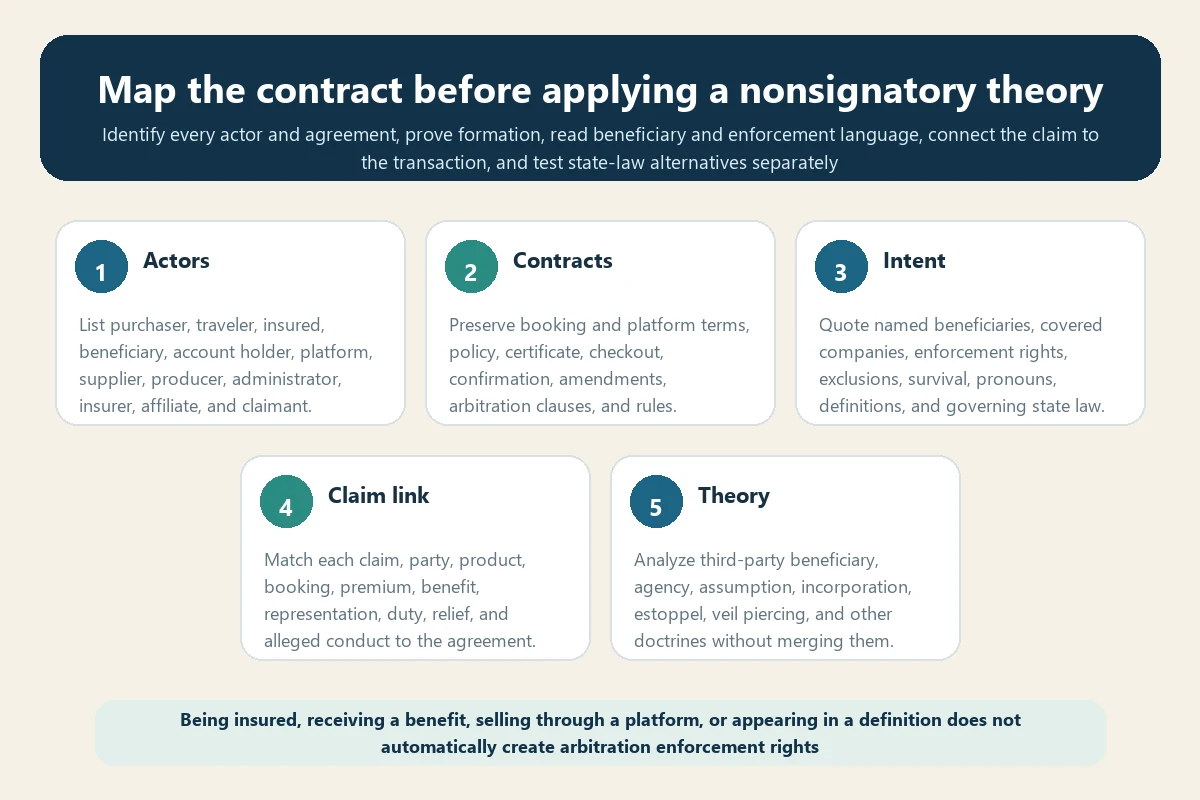
List the purchaser, account holder, payer, traveler, policyholder, insured, beneficiary, claimant, booking platform, travel supplier, producer, insurer, claims administrator, assistance company, affiliate, and party requesting arbitration.
Record the legal name and role of each. Similar brand names and shared corporate ownership do not make every entity a contracting party.
Build a contract-by-contract inventory
Preserve platform terms, booking terms, supplier rules, policy, certificate, checkout screen, confirmation, account terms, amendments, and incorporated arbitration rules. Identify which actors are parties to each document.
A single purchase can create several agreements. Do not combine them merely because they appeared in one checkout.
Prove formation before beneficiary status
A third-party beneficiary theory ordinarily begins with a valid contract between other parties. Reconstruct notice, assent, terms version, purchaser identity, and transaction proof.
The clickwrap agreement guide helps audit the exact screen, hyperlink design, assent action, terms, and attribution.
Identify the governing state law
Federal arbitration law recognizes that traditional state-law contract doctrines can permit enforcement by or against nonsignatories. The specific third-party beneficiary test, evidence, and defenses depend on the applicable state law.
Record choice-of-law language, transaction contacts, forum, and any dispute over which law governs. Do not use a general national checklist as the legal rule.
Read the contract’s intent language
Search for “beneficiary,” “third party,” “provider,” “affiliate,” “supplier,” “companies offering products,” “on behalf of,” “agents,” “covered parties,” and “may enforce.” Quote the full clause and definitions.
The central question is often whether the contracting parties intended to confer an enforceable benefit, not whether a third party happened to gain an incidental advantage.
Separate receiving benefits from enforcement rights
An insured traveler receives policy protection but may not have accepted a platform’s service terms. A supplier may receive sales through a platform without being granted arbitration rights. An administrator may process claims without becoming a policy party.
Identify the specific duty or enforcement right allegedly intended for the nonsignatory.
Study a travel-insurance platform example
In In re Generali COVID-19 Travel Insurance Litigation, the court examined Vrbo terms stating that companies offering products through the platform were beneficiaries of the arbitration agreement. It analyzed whether travel-insurance defendants could invoke that language.
The result depended on the terms, transactions, claims, and governing law. It is evidence of the analysis, not a universal rule for every insurance sale.
Compare current travel terms carefully
Travelocity’s official terms illustrate travel-platform provisions referring to third-party beneficiaries and travel insurance products. Faye’s official terms separately identify its service, insurer relationship, third-party content, and beneficiary language.
Current examples show drafting patterns only. Preserve the operative purchase-time version for the disputed transaction.
Analyze who can compel whom
Ask whether a nonsignatory seeks to compel a signatory, a signatory seeks to compel a nonsignatory, or one nonsignatory seeks to compel another. The direction matters.
Create a matrix with moving party, resisting party, contract, clause, state-law theory, supporting language, claim connection, and contrary evidence.
Map the arbitration clause’s defined scope
Determine whether the clause covers disputes with named parties, affiliates, suppliers, providers, companies offering products, agents, or beneficiaries. Read exclusions and the verbs granting enforcement.
A broad definition of “claim” does not necessarily identify every person who may invoke the clause.
Connect each claim to the right transaction
Match claims to the booking, insurance purchase, premium, policy, representation, claim decision, refund, benefit, customer-service interaction, and alleged wrong. A traveler may have several trips or policies.
In Generali, the court treated travel-insurance claims connected to specified Vrbo purchases separately from other claims. Transaction-level mapping prevents overbroad conclusions.
Separate policy claims from platform claims
A claim that an insurer breached the policy can relate to an insurance contract while also arising from a product sold through a platform. A claim against the platform may depend on different duties and terms.
Use the complaint versus arbitration guide to keep regulatory, contractual, and adjudicative paths distinct.
Audit purchaser and insured identities
One family member may purchase coverage for several travelers. An employer may book business travel. A travel advisor may complete checkout. Record who saw the terms, who paid, who is insured, and who submitted the claim.
Agency, authority, direct benefits, and beneficiary status require separate analysis; relationship alone is not enough.
Handle minors, estates, and representatives separately
A parent may purchase for a child, a personal representative may pursue a deceased traveler’s claim, and an attorney-in-fact may communicate during incapacity. Each role depends on its own authority document and applicable law; none should be treated automatically as assent to every contract or as third-party beneficiary status.
Identify who formed the agreement, who holds the claim, who may act now, and whose rights the arbitration request would affect. The deceased traveler estate claim guide helps separate appointment authority, expense ownership, policy benefits, signatures, and payment instructions.
Analyze assignments without skipping contract limits
A traveler may assign policy benefits to a hospital or transfer another contractual right, but an assignment of payment rights is not necessarily an assignment of the entire agreement, every claim, or an arbitration duty. Review anti-assignment language, consent requirements, scope, timing, and governing law.
Preserve the signed assignment, the right transferred, consideration, notice, acceptance, revocation, and all reservations. Then determine whether the assignee invokes the contract, receives only proceeds, or claims an independent right.
Do not confuse contract beneficiary and policy beneficiary
A policy beneficiary may be entitled to death or other benefits under insurance language. A third-party beneficiary to platform terms concerns intended contractual rights under a different agreement.
Use document-specific labels in the evidence matrix so “beneficiary” never hides which contract supplies the alleged right.
Analyze agency separately
Agency can concern authority to contract, acts within scope, disclosure of a principal, or enforcement by agents. Identify the principal, agent, act, authority source, date, and contract.
A claims administrator’s work for an insurer does not automatically prove authority to invoke every platform clause.
Analyze equitable estoppel separately
Equitable estoppel may be raised when claims rely on or are intertwined with a contract containing arbitration, but elements vary by jurisdiction. It is not another name for third-party beneficiary status.
Map which claim elements rely on which agreement and preserve inconsistent positions without assuming the doctrine applies.
Check incorporation and assumption
A separate contract may incorporate terms by reference, or a party may assume contractual duties. Preserve the incorporation language, referenced version, access, assent, assignment, novation, and performance evidence.
Corporate acquisition or servicing transfer should not be treated as assumption without the governing documents.
Review exclusions and anti-beneficiary clauses
Some contracts expressly disclaim third-party beneficiaries or limit them to named groups. Others grant selected protections without granting arbitration enforcement.
Read the whole agreement, including conflicts, survival, severability, limitation, and enforcement sections.
Separate nonsignatory status from arbitrability
Formation, beneficiary status, delegation, scope, procedural prerequisites, and merits are distinct. Identify who decides each issue under controlling law.
The arbitrability guide provides a structured gateway-issue map.
Preserve opt-out and amendment evidence
An arbitration opt-out or later terms update can change the analysis. Preserve deadlines, notices, acceptance events, delivery proof, scope, and booking treatment.
Use the updated terms guide to reconstruct the baseline, amendment authority, notice, effective date, assent, and application.
Build a claim-party-contract matrix
Create one row per claim and defendant. Add transaction, contract, formation proof, beneficiary text, enforcement verb, governing law, alternative theory, relief, defense, decision-maker, and evidence gap.
This prevents a ruling about one party or booking from being applied automatically to all others.
Avoid common third-party beneficiary mistakes
- Treating every insured or supplier as an intended beneficiary.
- Combining platform, policy, and booking contracts.
- Ignoring which party seeks to compel which party.
- Using current terms instead of purchase-time terms.
- Reading broad claim scope as an enforcement grant.
- Ignoring anti-beneficiary or limiting language.
- Merging beneficiary, agency, estoppel, and assumption.
- Applying one booking’s result to unrelated transactions.
- Confusing policy beneficiary with contract beneficiary.
Final nonsignatory audit checklist
- List every actor, role, legal entity, and transaction.
- Preserve each operative contract and formation record.
- Identify governing state law.
- Quote beneficiary, definition, and enforcement language.
- Map who seeks to compel whom.
- Connect each claim to its booking and agreement.
- Separate intended from incidental benefits.
- Analyze agency, estoppel, incorporation, and assumption separately.
- Preserve opt-out, amendment, and contrary evidence.
- Keep formation, scope, delegation, procedure, and merits distinct.
A professional third-party beneficiary analysis does not start with a brand relationship. It starts with the formed contract, governing law, intended benefit, enforcement language, transaction, claim, and direction of the requested arbitration—and tests every alternative theory on its own evidence. Preserve the result in a party-specific matrix that another reviewer can reproduce independently.
