
Travel insurance arbitration updated terms can change notice requirements, forum, fees, class waivers, delegation, opt-out rights, or claim scope after an account is created. The current webpage does not prove that a particular traveler agreed to the revision or that it governs an earlier booking.
This U.S. consumer guide explains how to reconstruct the original agreement, amendment authority, notice, effective date, post-notice assent, booking scope, and contrary evidence. It is not legal advice.
Start with the original contract baseline
Preserve the purchase-time policy, certificate, booking terms, account terms, checkout record, confirmation email, arbitration provision, change clause, incorporated rules, and free-look or opt-out terms.
Record the legal entity, effective date, version identifier, URL, saved file, and evidence connecting the baseline terms to the purchaser.
Separate platform, supplier, and insurer terms
A booking platform may update its service terms without changing the insurer’s policy. A supplier contract may govern the reservation while a separate certificate governs travel protection benefits.
Map which company issued each document and which party now seeks arbitration. An update by one entity does not automatically amend another entity’s contract.
Identify the original amendment authority
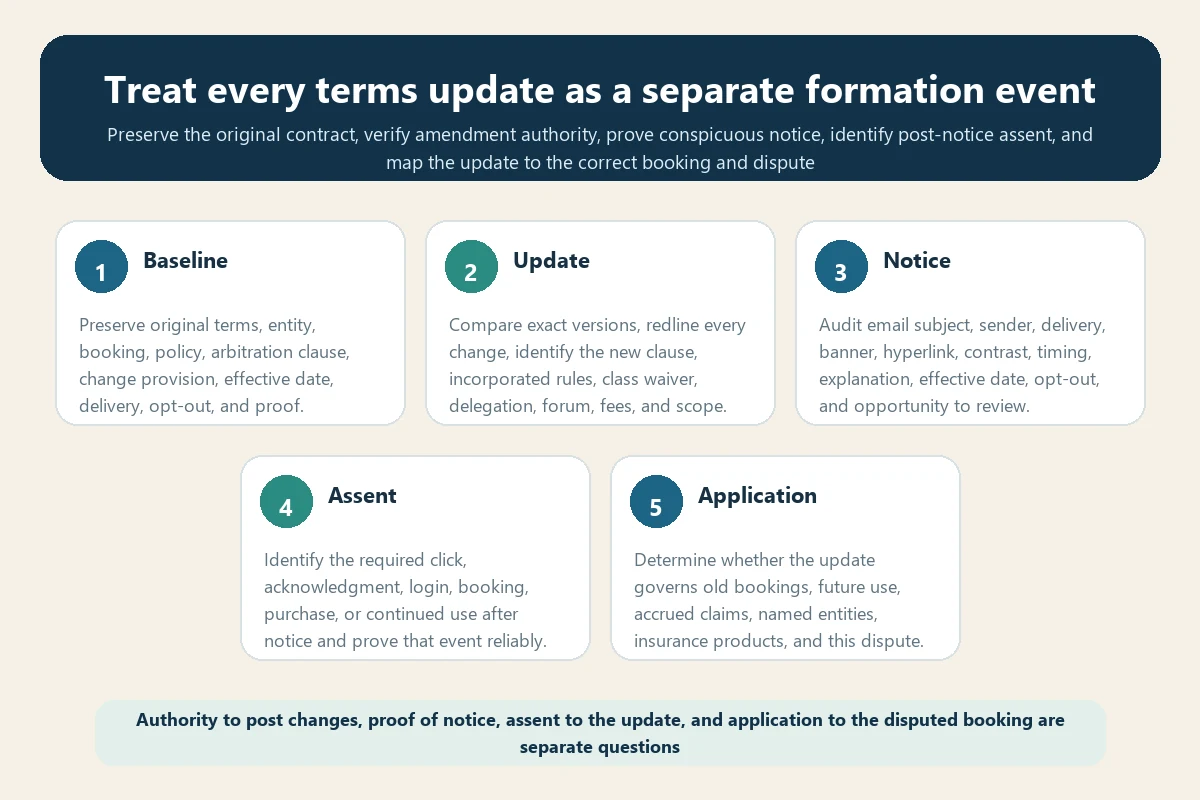
Read the baseline change clause. Determine who may amend, what may change, required notice, delivery method, advance period, effective date, rejection or termination rights, and whether continued use can express acceptance.
Do not rely solely on amendment language written into the later version. The authority claimed for the change should be traced to the agreement already in force.
Preserve both versions, not just a summary
Save complete copies of the old and new terms. Create a redline covering party names, arbitration scope, delegation, administrator, rules, fees, venue, hearing format, class waiver, mass filing, pre-filing notice, tolling, confidentiality, remedies, severability, and opt-out.
A marketing email saying “we updated our terms” cannot substitute for the actual text.
Determine whether the update is prospective
Some travel terms distinguish new activity from existing bookings. Expedia’s current official terms, for example, state that continued service use after changes take effect constitutes acceptance while existing bookings continue under the terms applicable when booked.
Quote the operative language for the actual transaction. Determine whether the dispute concerns account use, an old booking, a later booking, or a separate insurance policy.
Reconstruct the notice channel
Notice may arrive by email, account inbox, app interrupt, banner, checkout screen, billing statement, or postal mail. Preserve sender, recipient, subject line, body, hyperlink, attachment, timestamp, delivery status, and display.
Posting updated terms online is evidence of availability, not necessarily proof that a particular user received the required notice.
Evaluate how conspicuous the notice was
Review the subject line, headline, contrast, font, placement, surrounding promotions, mobile rendering, required scrolling, hyperlink design, and whether arbitration or material changes were identified.
The notice should also explain what conduct will count as acceptance and when the revision becomes effective.
Prove delivery to the correct account
Connect the notice to the user’s email or account as it existed then. Preserve bounce records, suppression lists, account changes, returned mail, and any evidence that another person controlled the address.
A bulk-send declaration should be tested against transaction-specific delivery evidence and the system’s retention rules.
Identify the claimed assent event
The update may require an “I Agree” click, checkbox, interrupt-screen acknowledgment, login, purchase, booking, or continued use after the effective date. Write down the exact action and language connecting it to acceptance.
The clickwrap agreement guide helps reconstruct screen design, terms version, assent action, purchaser attribution, and transaction proof.
Distinguish receipt from assent
Receiving an email can provide notice without itself proving agreement. Continued use may support assent only when the governing law, original contract, notice, timing, and conduct establish that consequence.
Create separate evidence rows for transmission, receipt, review opportunity, effective date, and post-notice action.
Review the Ninth Circuit’s notice principle
In Douglas v. Talk America, the Ninth Circuit explained that a party cannot unilaterally change contract terms merely by posting a revised contract online without proper notice. Continued use can imply assent only after adequate notice.
The governing state law and facts still control another dispute, but the decision shows why update availability and user notice are separate questions.
Study a modern updated-terms record
The Ninth Circuit’s 2026 Ireland-Gordy memorandum examined an email subject identifying updated terms, a contrasting hyperlink, app use after notice, and the contractual effect of continued use.
Use it to identify evidence categories, not to assume that every email, interface, user, or state’s law produces the same result.
Calculate the effective-date sequence
Build a chronology containing notice creation, send, receipt, banner display, review opportunity, opt-out window, effective date, first login, first booking, first purchase, and claim accrual.
Conduct before the effective date should not be silently treated as acceptance after the effective date.
Audit the update’s opt-out process
Determine whether the baseline or update permits rejection, arbitration opt-out, account termination, or continued use under old terms. Preserve deadline, required content, recipient, delivery method, receipt, and scope.
Use the arbitration opt-out guide to keep opt-out, cancellation, waiver, and claim appeal distinct.
Check whether an old opt-out survives
An earlier opt-out may apply to future revisions, or a new clause may claim to alter that result. Compare survival, amendment, and rejection language across every version.
Do not assume that failure to send a second opt-out revives arbitration without analyzing the original opt-out’s scope and applicable law.
Separate account rejection from booking rights
A traveler who rejects updated account terms may be allowed to stop using the platform, close the account, or avoid future transactions. That choice does not necessarily cancel an existing reservation, insurance policy, pending claim, refund request, or contractual deadline.
Before closing anything, preserve records and identify which services remain necessary to access confirmations, receipts, policy documents, claim messages, credits, or dispute notices. Download the complete account history and confirm how future communications will arrive.
If a pre-arbitration notice is already pending, use the notice-of-dispute guide to protect delivery, receipt, cure, waiting-period, conference, and filing proof independently from any account decision.
Map accrued claims and existing bookings
Record when the booking was made, insurance was purchased, covered event occurred, claim was filed, denial issued, update became effective, and dispute arose. Different clauses may define scope by facts, claims, or transaction dates.
Keep the policy merits separate from the amendment question. The update can govern procedure without deciding coverage.
Separate amendment formation from delegation
A new delegation clause cannot answer its own formation unless the applicable law permits that sequence and the update itself became part of the contract. Identify which gateway issue a court or arbitrator decides.
The arbitrability guide separates agreement formation, delegation, scope, procedural conditions, and merits.
Audit material changes individually
Flag additions or expansions involving arbitration, class waiver, jury waiver, mass filing, forum, fee allocation, damages, limitation periods, notice, confidentiality, and amendment power.
Notice of a privacy edit should not be assumed to provide conspicuous notice of a new dispute-resolution burden without examining the communication and governing standard.
Preserve contrary evidence
Keep bounced emails, outdated addresses, screenshots without a banner, logs showing no post-update use, an earlier opt-out, a transaction governed by old terms, inconsistent versions, and statements that existing bookings remain under prior terms.
An evidence matrix should show gaps and conflicts, not only the records favoring one conclusion.
Build a version-control evidence matrix
Create rows for baseline contract, amendment authority, update version, redline, notice, delivery, review opportunity, effective date, assent event, opt-out, booking date, claim accrual, entity, scope, and contrary proof.
For every row, identify proposition, native record, custodian, authenticity, date, missing evidence, and follow-up.
Preserve every related deadline
An amendment dispute does not automatically pause policy notice, proof of loss, appeal, suit limitation, complaint, small claims, arbitration, or court deadlines. Calendar each from its own authority.
The deadline tolling guide helps identify covered clocks, start and end events, calculations, and proof.
Avoid common updated-terms mistakes
- Using current terms as proof of purchase-time terms.
- Ignoring the original amendment clause.
- Treating website posting as user-specific notice.
- Confusing notice delivery with assent.
- Failing to identify post-effective-date conduct.
- Applying new terms to an excluded existing booking.
- Ignoring an earlier or later opt-out.
- Merging platform, supplier, and insurer contracts.
- Assuming delegation decides update formation.
- Discarding contrary logs or versions.
Final updated-terms checklist
- Preserve baseline and updated terms completely.
- Identify amendment authority in the baseline contract.
- Redline every material dispute-resolution change.
- Prove the notice channel, content, and delivery.
- Calculate review, opt-out, and effective dates.
- Identify and prove the claimed assent event.
- Map existing bookings, accrued claims, and future use.
- Separate entities, formation, delegation, scope, and merits.
- Preserve contrary evidence and unresolved gaps.
- Keep every independent deadline active.
A reliable updated-terms analysis is a version-control project. It connects a valid baseline change power to a specific revision, conspicuous notice, timely review opportunity, provable assent, and the correct booking and dispute—without assuming that today’s webpage governs yesterday’s purchase. Preserve every version and event in chronological order so the conclusion can be independently reproduced from the underlying evidence.
