
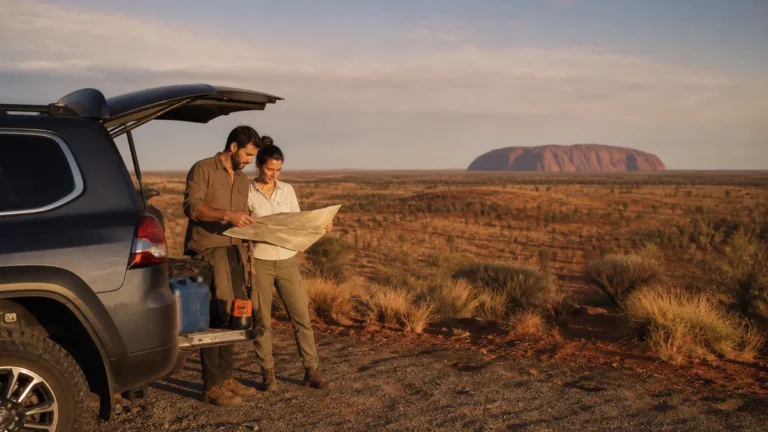
Travel insurance for Australia from USA trips should match the traveler’s medical eligibility, total driving distance, remote stops and prepaid bookings—not a generic countrywide price. Australia can combine excellent city hospitals with outback routes where communications, roadside help and higher-level care are many hours away.
Key takeaways
- U.S. visitors do not gain Australian Medicare access through a reciprocal health-care agreement.
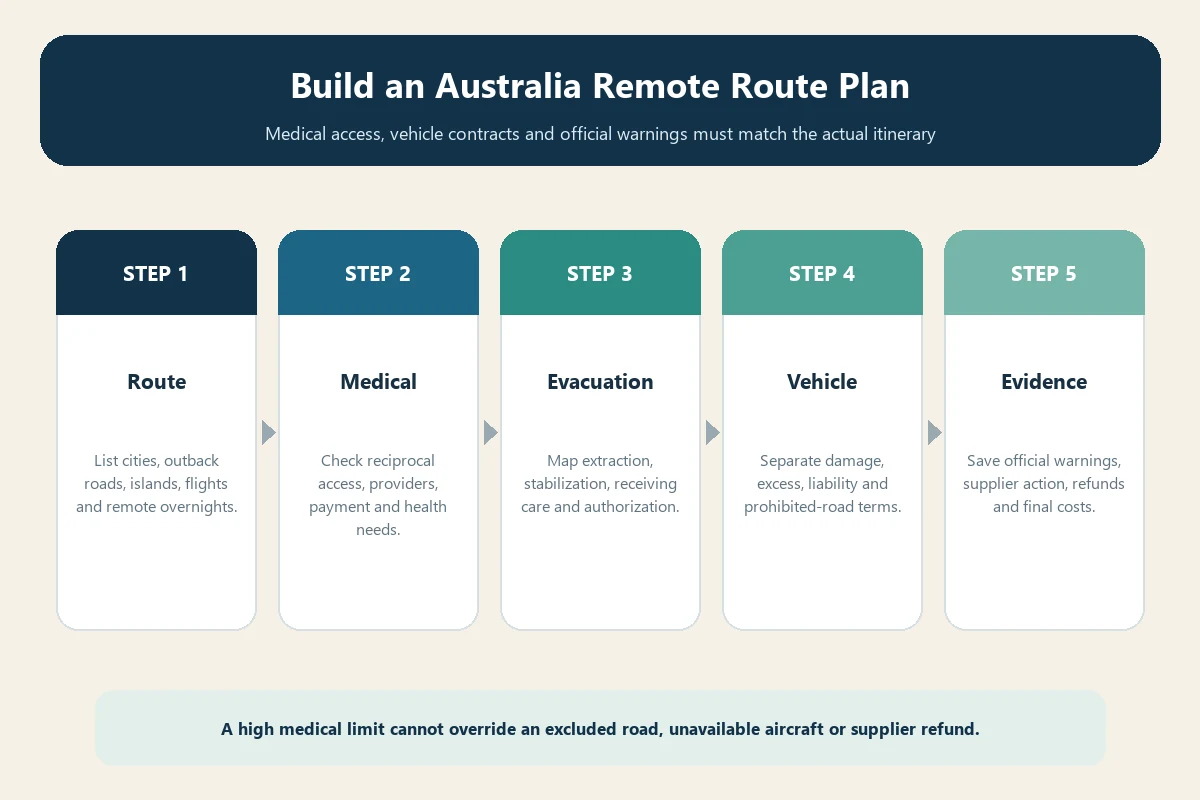
- Map every remote road, hike, reef trip and island segment before choosing medical and evacuation limits.
- Separate travel medical cover from rental-vehicle damage, excess and third-party liability.
- Save the official warning and the airline, hotel or operator action for a weather claim.
- Ask who chooses a receiving hospital and authorizes each stage of an evacuation.
Planning information reviewed August 16, 2026. Entry rules, health guidance, natural-hazard warnings, supplier operations and policy terms can change. Recheck official sources and the issued certificate for the travel dates.
Start with the Australian Medicare question
Australia’s Medicare is its public health system; it is not the same program as U.S. Medicare. Services Australia lists the countries that have a Reciprocal Health Care Agreement with Australia, and the United States is not on that list. Its visitor guidance says travelers who are not from a reciprocal country should arrange private insurance and can be responsible for the full cost of hospital, ambulance and doctor services.
Call the U.S. health plan and ask about emergency care abroad, claim forms, deductibles and coordination. Do not treat a U.S. wallet card as proof that an Australian provider will bill the plan. The health insurance abroad guide provides a question list for that call.
Build a route before comparing policies
List Sydney, Melbourne, Brisbane, Cairns, Perth, Adelaide, Hobart and every regional or outback stop separately. Add domestic flights, rental periods, ferries, reef boats, guided tours, hikes and prepaid lodging. Record the longest distance from a major airport or hospital.
A city break and a self-drive route through the Red Center do not present the same operating problem. Give the insurer the actual itinerary, vehicle class, activities and highest prepaid amounts. Use the same facts for every quote so price differences are meaningful.
Plan the full outback medical chain
Current U.S. Department of State Australia travel guidance warns that phone service may be unavailable outside major towns and recommends water, extra fuel and an emergency satellite phone or locator beacon for outback travel. It also notes that rural medical response can take longer.
For each remote overnight, write down the first practical response point, a stabilization facility, a higher-capability hospital and the nearest suitable airport. Ask whether the policy covers ground ambulance, remote extraction, air ambulance and later repatriation as distinct stages. The remote evacuation guide explains why those stages should not be merged.
Test who controls an evacuation
A high limit does not mean the traveler can select any hospital or arrange a charter independently. Ask whether medical necessity must be certified, whether assistance selects the receiving facility and whether preauthorization is required when reasonably possible. Confirm how an emergency is handled when mobile service fails.
Ask about transport to the nearest suitable facility, a later transfer closer to home and return of dependent children or a travel companion. The evacuation-limit guide turns the headline limit into questions about destination, approval and practical capacity.
Keep the rental-car contract separate
Travel medical coverage does not automatically pay for damage to a rental car or another person’s property. Record the rental company, driver, vehicle class, permitted roads, base damage liability, excess, excluded surfaces and roadside-assistance terms. Ask what happens to tires, glass, roof, underbody, water damage and single-vehicle accidents.
Some travel policies reimburse an eligible rental excess, but that is not necessarily primary collision cover or third-party liability. The rental-car insurance guide separates the rental agreement, card benefit and travel policy. Get written confirmation before declining a rental-company product.
Audit unsealed roads and remote vehicle use
A four-wheel-drive booking does not prove every road is permitted. Match the itinerary to the rental contract and local closure information. Ask whether beach driving, river crossings, tracks, after-dark use or travel outside a defined region changes damage coverage or roadside support.
Preserve the pre-rental inspection, dated photos, fuel and tire condition, contract, roadside calls and towing invoices. If weather closes a road, save the authority notice and rental-company instruction. A voluntary detour and an official closure can produce different insurance outcomes.
Use official warnings for the correct hazard
The Australian Bureau of Meteorology publishes warnings and alerts for severe weather and related hazards. Australia’s size means conditions can be local rather than national. Save the state, district, issue time, warning type and affected period that relate to the booked route.
A cyclone warning in northern Australia does not prove that a Sydney hotel is unusable. A bushfire warning does not by itself show that an airline canceled a flight. Connect the official record to the supplier decision and the resulting unreimbursed cost.
Distinguish cancellation, delay and interruption
Record when the policy was purchased, when the hazard became known, and when each supplier acted. Ask what covered reason must cause cancellation before departure, a delay in transit or an interruption after the trip begins. Minimum waiting periods and eligible transport definitions can differ.
Keep airline notices, airport status, hotel messages, tour cancellations, alternate offers and refunds. The delay, interruption and cancellation guide helps assign each expense to the correct benefit rather than treating every weather cost as cancellation.
Check traveler health before the purchase deadline
The CDC maintains current Australia traveler health guidance. Review it with a clinician for the traveler’s age, medical history, season and activities. Carry necessary medicines in lawful packaging and enough supply for a reasonable delay.
Ask how the certificate treats pre-existing conditions, acute complications and purchase deadlines for any waiver. A medical evacuation benefit does not remove an exclusion. If a condition may limit long drives, heat exposure, diving or walking, build a route that can be changed safely.
Match reef, diving and hiking activities
List snorkeling, scuba depth, liveaboard segments, surfing, sailing, canyoning, climbing and every guided hike. Give the insurer the operator, certification, equipment, maximum depth or altitude and remoteness. Ask about medical treatment, search and rescue, evacuation and unused activity costs separately.
The activity-exclusions guide provides a comparison method. An activity can be legal and commercially offered while still falling outside a standard policy because of depth, equipment, guide or competition wording.
Compare one realistic Australia scenario
Use identical travelers, dates and prepaid costs across quotes. Include a city stay, domestic flight, outback rental, unsealed-road restriction, remote illness, possible air transfer and a severe-weather warning that affects one operator.
- Which medical expenses are eligible without reciprocal Medicare access?
- Who selects the first suitable hospital?
- Does the route require remote extraction before medical transport?
- Which rental-car loss is paid by which contract?
- What official or supplier action triggers weather benefits?
- How do refunds reduce the final claim?
Read the certificate, rental terms and card benefits together. No single daily premium answers the full scenario.
Prepare for upfront payment and assistance
Ask the insurer whether assistance can locate a suitable provider, open a case and arrange a payment guarantee. Carry secure backup payment capacity because a guarantee may not be immediate or accepted. Request the diagnosis, itemized bill, prescription, payment proof and discharge record.
Store the policy number and international assistance contact offline. The assistance versus claims guide explains why coordination is not final benefit approval. Record representative names, times, instructions and case numbers.
Build a claim ledger by event
Create separate folders for medical care, evacuation, rental vehicle, airline, lodging and activities. Give each cost a date, location, currency, payer, supplier and policy section. Preserve card conversion records rather than applying one estimated exchange rate later.
Add every supplier refund, credit, card benefit and health-plan reimbursement to the related line. The claim documentation guide shows how to calculate the remaining loss without duplicate recovery.
Write an offline remote-route card
Put the traveler’s passport name, allergies, medicines, policy, assistance number, rental contact, lodging coordinates and route on paper and two offline devices. Give the same route to a home contact and define a missed-check-in time.
Include the local emergency number 000, but do not promise that a call creates immediate coverage or response in every remote location. Preparation reduces communication delay; it does not replace water, fuel, safe routing, official advice or operator competence.
Price a remote-route failure before departure
Choose one exposed day and calculate the consequences of a breakdown, medical stop or closed road. Include towing, an extra regional night, a replacement domestic flight, unused lodging and a companion’s changed plans. Mark which amounts are refundable and which are only estimates.
Then ask the insurer which event, evidence and authorization would be required for each line. Vehicle recovery may belong to the rental contract, while added accommodation could require a covered delay. A companion’s expenses may require a separate provision. This exercise exposes gaps that a total trip-cost field cannot show.
Also price the safer design: daylight driving, a buffer night before the long-haul flight, a satellite communicator rental and fewer consecutive kilometers. These may be ordinary trip costs rather than insured losses, but they can reduce the chance that a manageable event becomes an emergency. Keep the final route with the policy file so assistance receives the same version.
Bottom line
A strong Australia policy starts with the absence of reciprocal Medicare access for U.S. visitors, then follows the exact medical, road and weather chain. Map remote care, audit every vehicle contract and preserve the official and supplier evidence that connects a covered event to the final loss.
