

Travel insurance for Antarctica cruise from USA trips should begin with the expedition operator’s written requirement and the real evacuation chain. Antarctica has no ordinary hospital network, weather can stop transport, and a missed gateway connection can forfeit an expensive voyage. Verify each dependency before paying a large deposit.
Key takeaways
- Obtain the operator’s exact medical and evacuation minimum in writing.
- Confirm Antarctica territory and every planned activity in the policy.
- Map vessel care, weather delay, transport and gateway hospital acceptance.
- Protect the gateway arrival with realistic buffers and contract evidence.
- Insure prepaid costs within purchase and full-cost deadlines.
Planning information reviewed August 16, 2026. Operator requirements, itineraries, weather, gateway rules and policy terms can change. Recheck the exact expedition contract and official sources before travel.
Do not turn an operator rule into a universal law
Google results often describe Antarctica cruise insurance as “mandatory” and then quote a universal dollar minimum. The current U.S. Department of State Antarctica travel guidance strongly recommends comprehensive travel, medical and evacuation insurance. It does not publish one boarding minimum for every commercial voyage.
An expedition operator can impose its own proof requirement through the passenger contract. Ask for the exact medical, evacuation and repatriation limits, acceptable insurer rating, territory, deductible, document language and submission deadline. Save the contract version.
Request a letter from the insurer naming the traveler, dates, Antarctica or the Antarctic Treaty area, cruise or expedition activity, and relevant limits. A generic wallet card may not satisfy the operator, while an operator-approved letter does not broaden the policy.
Verify territory beyond the word worldwide
Read the territory definition, exclusions and assistance availability. Ask whether Antarctica, waters south of 60 degrees south latitude, the Drake Passage, the Falkland Islands or South Georgia are included when they appear on the itinerary.
The Antarctic Treaty Secretariat’s official tourism and non-governmental activities page explains that most Antarctic tourism is vessel-based and that visitor and operator guidelines apply. It also links current site guidance and tourism rules.
Do not infer insurance eligibility from an operator’s membership or permit compliance. Territory, activities and medical transport definitions still control the claim.
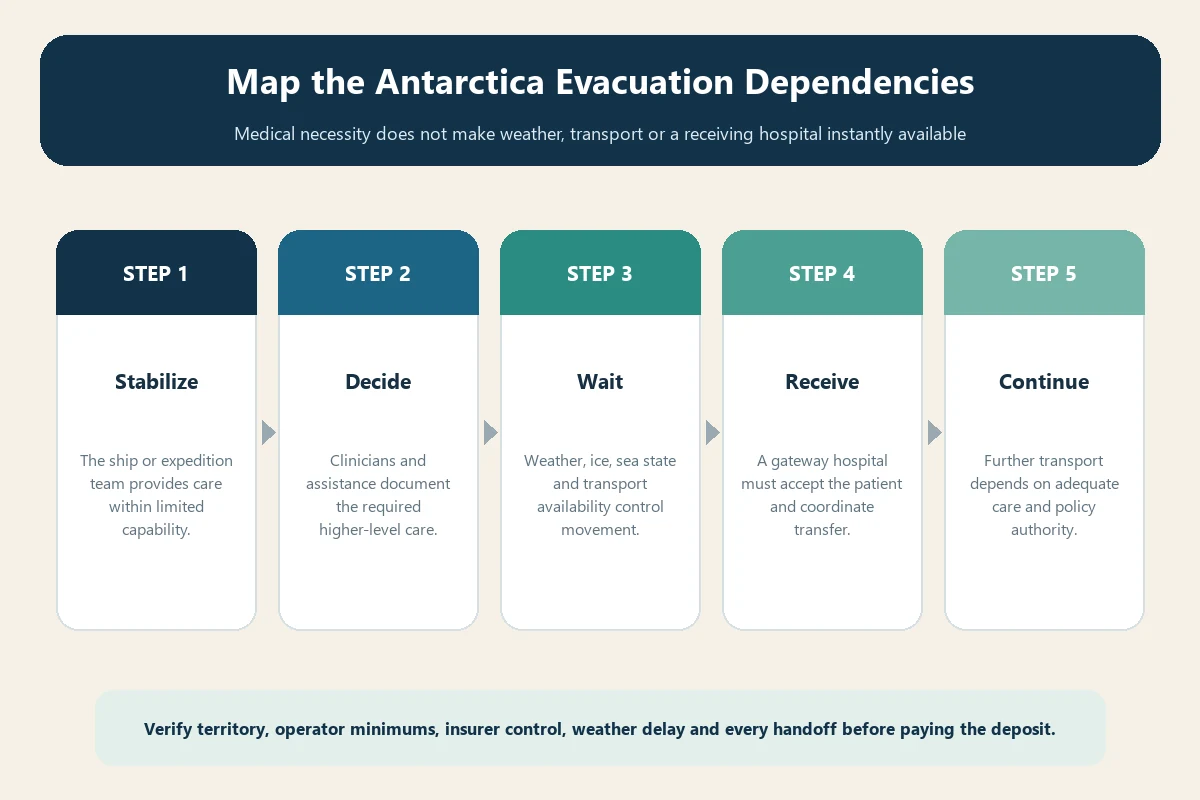
Map evacuation as a dependency chain
The State Department says Antarctica has no hospitals, pharmacies or doctors’ offices. Ship and expedition medical capability is limited. A serious case may need long-distance evacuation, and weather can prevent transport even during an emergency.
Break the chain into onboard stabilization, clinician assessment, insurer contact, transport availability, movement to a gateway, receiving-hospital acceptance and possible onward transfer. Ask which operator and insurer controls each handoff.
The emergency medical evacuation guide explains medical necessity and appropriate-care language. The evacuation limits guide helps expose sublimits, excluded transport and companion rules.
Test the policy against a delayed medical transfer
Give each insurer an identical case: the ship doctor determines that a passenger needs care beyond the vessel, but sea state and weather prevent immediate movement. The operator diverts toward a gateway and asks assistance to confirm a hospital.
Ask when the claim begins, who approves the diversion-related medical transport and how extended onboard care is documented. Determine whether the patient or companion’s lodging and onward commercial flight require separate authorization.
Ask what happens if the operator arranges transport under its emergency plan before the insurer can be reached. Locate the emergency exception, notification deadline and required evidence in the certificate.
Separate search and rescue from medical evacuation
A traveler can need rescue after becoming separated, stranded or unable to continue without being medically ill. Search and rescue, nonmedical extraction and medical evacuation may be three benefits with different limits.
Ask about Zodiac operations, kayaking, camping, snowshoeing, mountaineering, skiing and polar plunges by exact activity. State certification, guide, equipment and whether the activity occurs from the insured ship.
The adventure activity exclusions guide provides a comparison method. An operator waiver does not prove an insurer covers the activity.
Audit the expedition operator and passenger contract
Ask for the legal operator, ship, flag, medical capability, communications, ice-class information, emergency plan and proof deadline. Verify which company takes the deposit and which company operates the vessel.
Review itinerary-change clauses. An expedition may replace landings, change sites or remain at sea because of ice, wildlife protection or weather without being considered canceled. Determine when the operator owes a refund, credit or no compensation.
The Antarctic Treaty Secretariat publishes current visitor site guidelines. Follow guide instructions and environmental restrictions. A missed landing can be a normal expedition variation rather than an insured trip loss.
Protect the gateway and missed embarkation
Most U.S. travelers connect through South America, often Buenos Aires and Ushuaia, or another gateway named by the operator. Record every ticket, baggage transfer, hotel, charter and final embarkation cutoff.
Ask whether the charter flight, bus or ship qualifies under missed-connection wording. Confirm the minimum delay and covered reasons. The delay, interruption and cancellation guide helps classify replacement transport and unused expedition days.
Arrive earlier than the minimum connection. Insurance is not a substitute for a reasonable buffer. Preserve the operator’s late-arrival procedure, alternate port option and maximum replacement cost.
Use weather evidence without assuming a benefit
Drake Passage conditions, wind, ice and visibility can change vessel schedules, landings and flights. The State Department’s official cruise travel guidance advises passengers to have medical and emergency evacuation insurance and a backup return plan.
Record the operator or carrier decision, not only a forecast. Ask whether severe weather, natural disaster, common-carrier delay or destination inaccessibility is a named reason. The weather-delay guide shows how timing affects eligibility.
A canceled landing may not produce a refund under the expedition contract. A gateway flight cancellation can produce a different loss. Keep each event and supplier response separate.
Insure the correct prepaid cost on time
Expedition deposits can be large and become nonrefundable in stages. Build a ledger for cruise fare, charter, international airfare, hotels, equipment rental and tours. Add payments as they are made.
Check the policy deadline for time-sensitive benefits and any requirement to insure all prepaid nonrefundable costs. The trip cancellation guide explains named reasons, full-cost rules and supplier refunds.
If the operator changes the fare or adds a charter, update the insured amount within the required window. Do not claim refundable taxes, returned deposits or usable credits as unreimbursed loss.
Screen medical fitness and pre-existing conditions
Complete the operator’s medical form accurately and discuss the voyage with a clinician. Ask what the ship doctor can manage, how seasickness medication interacts with existing conditions and which health facts could lead the operator to deny boarding.
The pre-existing condition waiver guide helps audit eligibility and purchase timing. A waiver does not eliminate the operator’s fitness decision or make medically unsafe travel appropriate.
Carry medications in original packaging with extra supply for delays. Store a medical summary and consent offline. Antarctica has no ordinary pharmacy to replace a forgotten prescription.
Compare policies with one expedition scenario
Use identical ages, dates and prepaid costs. Include a South America gateway, separate domestic flight, operator charter, expedition fare, kayaking, shipboard treatment, weather-delayed evacuation and companion return.
- Does the proof letter meet the operator’s exact minimum?
- Are all territories and activities included?
- Who controls stabilization, diversion and evacuation?
- What pays for search or nonmedical rescue?
- Which gateway delay can trigger missed embarkation?
- Which records and deadlines control each benefit?
Read the certificate and endorsements. Record the page for every answer. Avoid choosing only by the biggest evacuation number; definitions, territory and authorization make the limit usable.
Build the expedition claim packet
Keep the passenger contract, proof requirement, insurance letter, itinerary, medical form, ship doctor note, captain or operator report, assistance case, receiving-hospital acceptance, carrier notice, refund and receipt.
The travel insurance claim guide explains coordination among suppliers, the U.S. health plan and travel insurer. Label medical, rescue, transport and trip costs separately.
Verify the gateway-country medical handoff
An Antarctica evacuation usually ends first in a gateway country, not at the traveler’s preferred U.S. hospital. Identify the likely port or airport, ambulance provider and higher-level facilities without treating any destination as guaranteed. A bed, border clearance and clinical acceptance must be coordinated at the time.
Ask whether the policy pays transport only to the nearest adequate facility or can later continue the patient home. Confirm who determines adequacy and whether a companion, medical escort, oxygen or stretcher is included. Ordinary airline tickets should not be purchased for a medically unstable traveler without clinician, carrier and insurer approval.
Carry passport, gateway visa information, medical summary and consent where a companion can reach them. The ship doctor’s note, receiving physician’s acceptance and every ground transfer record should remain separate.
Model an operator cancellation before and after departure
Before departure, an operator cancellation may produce a refund, future credit or supplier-default question. After embarkation, a mechanical problem or ice condition may shorten the voyage under a contract that permits itinerary variation. Ask the operator how each scenario is handled before relying on insurance.
Compare that answer with the policy’s supplier cancellation, financial default, natural disaster and interruption wording. Confirm whether the operator is an eligible supplier and when a financial problem becomes known. Chargebacks and refunds must be pursued and disclosed when applicable.
Keep the original passenger contract and any revised itinerary. A credit’s expiry and transferability affect its value. The final claim should show the unreimbursed balance, not the headline expedition price.
Bottom line
The best Antarctica cruise policy meets the exact operator contract and survives a realistic dependency test. Verify territory, activities, vessel care, weather-delayed transport, gateway connections and trip-cost deadlines. Then carry the proof and evidence needed to use it.
