

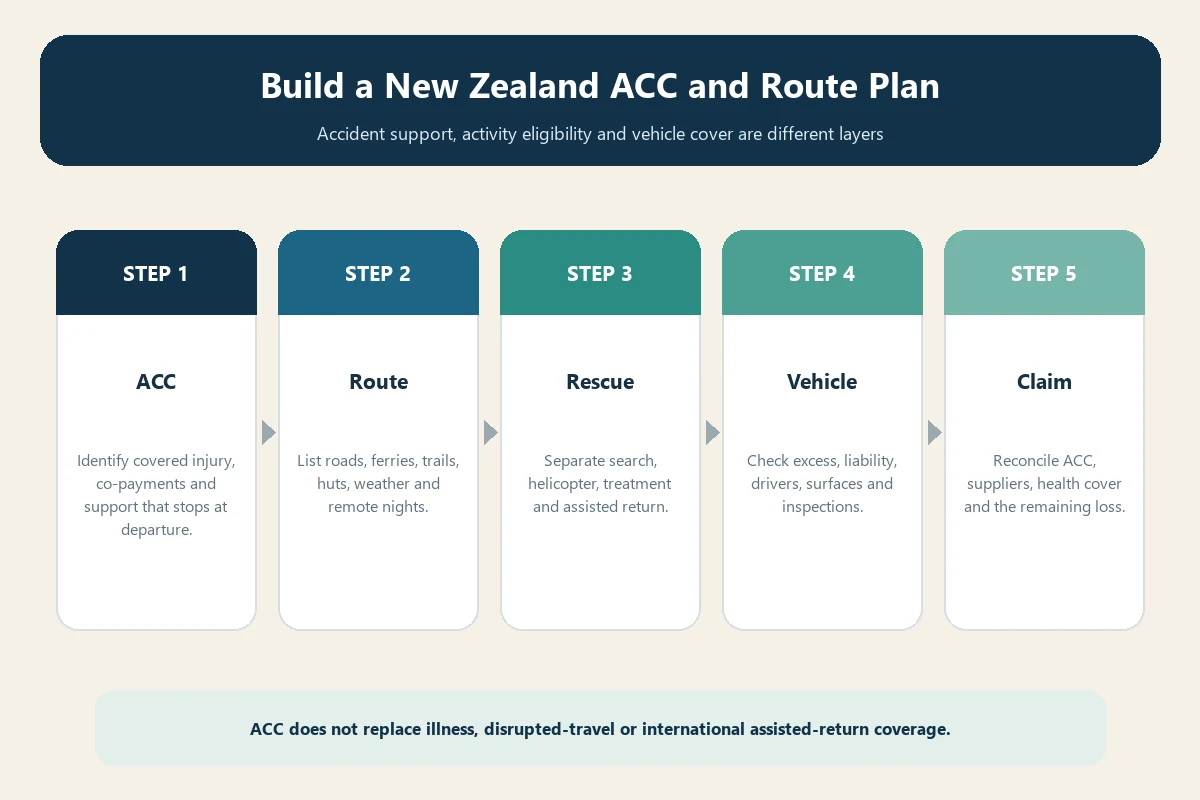
Travel insurance for New Zealand is still worth buying for a US traveler because ACC, the country’s no-fault accident scheme, covers accidental injury but not illness, disrupted travel plans, emergency travel home or treatment after you return to the United States. ACC’s own visitor guidance says exactly that and tells visitors to buy travel insurance. This guide shows how to fit a policy around ACC for a hiking, ski or self-drive itinerary: rescue versus medical evacuation, remote care and payment, the rental-car excess, ferry and flight failures, and the claim record you will need afterward.
Key facts
- ACC's no-fault scheme covers everyone injured in an accident in New Zealand, including visitors, but it does not cover illness.
- ACC does not pay for disrupted travel plans, emergency travel home, or treatment and rehabilitation after you get back home.
- ACC excludes injuries in transit to or from New Zealand, including getting on or off a plane or boat.
- CDC advises travelers to consider travel health and medical evacuation insurance for what a regular US plan will not cover.
- New Zealand Consumer Protection recommends a written inspection report and photos of existing damage before driving a rental car away.
- New Zealand's emergency number is 111; keep it on an offline card with policy, ACC and rental contacts.
Key takeaways
- ACC can help with covered accidental injuries in New Zealand, but it does not cover ordinary illness.
- ACC does not replace disrupted-travel benefits, international assisted return or treatment after the visitor leaves New Zealand.
- Separate nonmedical search and rescue from ambulance, helicopter and medical evacuation.
- Audit the rental contract’s excess, liability and road exclusions before relying on travel insurance.
- Connect earthquake, flood or weather information to a carrier, road, lodging or operator decision.
Planning information reviewed August 16, 2026. ACC rules, health guidance, hazard information, road access, supplier operations and policy terms can change. Recheck official sources and the issued certificate for the travel dates.
What ACC covers for a US visitor, and what it leaves out
New Zealand’s Accident Compensation Corporation provides no-fault support for many injuries caused by accidents in New Zealand. Its official visitor guidance says covered visitors can receive injury support even if they are not residents. That does not make all treatment free; a provider may charge a co-payment.
Keep the ACC claim number, clinical notes, invoices and proof of every co-payment. Ask the travel insurer how its benefits coordinate with ACC and which payer should receive the bill first. Do not submit the same paid amount twice.
Know the gaps ACC lists explicitly
ACC states that it does not cover illness, disrupted travel, emergency travel back to the visitor’s home country or treatment and rehabilitation after the visitor returns home. It also lists particular transport-boundary exclusions. These gaps explain why a separate travel medical and trip policy can still matter.
Test a stomach illness, a skiing injury, a missed domestic flight and a medically assisted flight to the United States as four different events. The health insurance abroad guide helps structure the separate call to the U.S. health plan.
Match the policy to the real New Zealand route
List Auckland, Rotorua, Wellington, Christchurch, Queenstown and every rural or alpine stop. Add the North and South Island handoff, domestic flights, ferries, rental days, Great Walk or day hike, ski area, boat trip and prepaid tour. Record the last practical connection for each segment.
Give the insurer trail names, maximum altitude, activity, guide, vehicle class and remote nights. “Touring New Zealand” is too broad when one traveler stays in cities and another drives mountain passes and hikes beyond road access.
Separate rescue from medical evacuation
A lost or stranded hiker may need a search team before medical transport begins. An injured hiker may require field stabilization, helicopter movement and hospital care. Ask whether search and rescue has a separate benefit, sublimit or exclusion, and whether an injury is required.
The remote evacuation guide separates extraction, local ambulance, air transfer and repatriation. Ask who authorizes each stage and what to do when emergency contact with the insurer is not practical.
Check the activity definition before hiking
List trail grade, duration, altitude, season, hut stays, guide status and any scrambling, climbing, glacier travel, mountain biking, skiing or rafting. Ask about marked-trail requirements, protective equipment, weather compliance, competition and professional participation.
The activity-exclusions guide provides a comparison method. ACC injury eligibility, operator permission and travel-policy eligibility are separate questions. One does not prove the others.
Use official hazard information as a decision input
New Zealand can experience earthquakes, volcanic activity, floods, landslides and rapidly changing weather. The National Emergency Management Agency’s official alert guidance explains the National Warning System, emergency mobile alerts and other channels. Check MetService forecasts and local authority notices for the exact route.
Save the alert text, issue time, region and expiry. Then save the road closure, carrier cancellation, park action or accommodation decision. A warning alone does not show which prepaid service became unusable.
Map remote health care and payment
Current U.S. Department of State New Zealand travel guidance says medical care is not free, private hospitals may require upfront payment or proof of insurance, and rural care can be harder to access. It also notes that remote response may require a helicopter.
For each remote stay, identify a first response point, stabilization facility and higher-capability hospital. Ask whether assistance can arrange a payment guarantee and whether the traveler may need secure backup payment. Preserve the itemized bill, diagnosis, payment proof and transfer record.
Check rental cars, driving, ferries, flights and health before departure
New Zealand Consumer Protection advises renters to check the total cost, basic and excess cover, exclusions and who may drive. Its rental-car checklist also recommends a written inspection report and photos of existing damage.
Record the maximum damage liability and whether the agreement excludes roof, underbody, glass, gravel roads, water damage or careless use. Some travel policies reimburse eligible excess; they may not replace vehicle damage cover or third-party liability. The rental-car insurance guide separates those layers.
Test left-side driving and road conditions
Record who will drive, license requirements, arrival-day fatigue, planned distances and mountain passes. State guidance notes that many rural roads are narrow and winding. A short map distance can take longer than a U.S. traveler expects.
Build daylight margins and identify a safe overnight alternative. If weather or a closure affects the route, follow official instructions and the rental contract. Insurance should not be treated as permission to continue on a dangerous or prohibited road.
Classify ferry and flight failures correctly
For every domestic flight or inter-island ferry, save the operator, departure, ticket terms, onward booking and minimum connection. Ask whether the transport meets the policy’s common-carrier definition and what delay threshold applies.
The delay, interruption and cancellation guide helps distinguish a late connection, an unused hotel and an early return. Preserve the carrier’s reason, replacement offered, actual refund and necessary added cost.
Review health guidance for the traveler
The CDC publishes current New Zealand traveler health guidance. Review medicines, routine vaccination and outdoor preparation with a clinician. Include the traveler’s conditions, season, activities and locations.
Ask the certificate about acute illness, pre-existing conditions, stability periods and waiver deadlines. ACC’s accident focus does not turn an illness into an injury, and preventive care is not the same as treatment for an unexpected covered condition.
Compare quotes on one realistic New Zealand scenario
Use the same travelers, dates and prepaid costs for every quote. Include a self-drive route, one alpine hike, a weather closure, a helicopter response, an illness unrelated to injury, a damaged rental car and a medically assisted return.
- Which treatment is handled by ACC, the U.S. plan or travel insurance?
- Is the rescue stage covered without an injury?
- Who determines helicopter and receiving-hospital necessity?
- Does the rental benefit pay damage, excess or neither?
- What carrier or road evidence triggers a disruption benefit?
- Which support stops when the traveler leaves New Zealand?
Read the full certificate. A generic provider comparison cannot resolve these boundaries.
Use the assistance line as a record
Store the policy, ACC, rental and assistance contacts offline. In a serious event, prioritize emergency response and notify the insurer as soon as practical. Record the representative, time, case number, instruction and every failed contact attempt.
The assistance versus claims guide explains why coordination is not claim approval. If a provider requires payment, preserve both the temporary card hold and final settled charge.
Keep a three-layer claim ledger and plan the trip home
Give each expense an event, date, location, New Zealand dollar amount and responsible payer. First show ACC payments or support. Then record supplier refunds, rental adjustments and any U.S. health-plan reimbursement. Finally calculate the amount requested from travel insurance.
Keep medical, rescue, vehicle and disruption files separate even when one storm or accident connects them. The claim documentation guide explains how to reconcile the final amount without double recovery.
Create an offline trail and road card
List the exact route, trailhead, hut, vehicle, lodging coordinates, local emergency number 111, allergies, medicines, policy and home contact. Define a check-in schedule and the action a home contact should take after a missed report.
Carry weather-appropriate equipment and obey closures. A locator, insurance policy or ACC claim cannot create safe flying conditions, reopen a track or guarantee immediate rescue. Practical route decisions remain the first safety layer.
Plan the handoff after leaving New Zealand
ACC says its support stops when an international visitor leaves New Zealand. Before departure, ask how continuing treatment, mobility equipment, a changed seat, medical escort and care after arrival in the United States would be handled. Get the treating clinician’s fitness-to-fly instructions and the insurer’s authorization when circumstances allow.
Preserve the New Zealand diagnosis, imaging, treatment plan, ACC claim details and discharge record. Give the receiving U.S. clinician a copy, but keep the original file for the claim. Record which payer handled each stage so the same invoice is not submitted as an unpaid loss.
If a companion changes flights or remains with the patient, document why that support was medically or practically necessary. Ask whether companion lodging, transport and return travel have their own limit or covered reason. The patient’s accepted medical claim does not automatically establish every companion expense.
Bottom line
A strong New Zealand plan treats ACC as an important but limited payer, then fills the gaps for illness, disruption, remote movement and return home. Match hiking and driving terms to the real route, preserve official and supplier evidence, and reconcile every payment before submitting a claim.
Sources and further reading
- If you're a visitor injured in New Zealand — ACC's no-fault scheme covers everyone including visitors injured in an accident in NZ; it does not cover illness, disrupted travel plans, emergency travel home, injuries in transit to or from NZ (including getting on or off a boat or plane), travel around NZ in the craft you arrived in, or treatment and rehabilitation back home; it tells visitors to buy travel insurance before the visit.
- New Zealand – Traveler view | Travelers' Health | CDC — CDC advises reviewing the home health plan and considering travel health and medical evacuation insurance for what regular insurance will not cover; carry a list of local doctors and hospitals, copies of prescriptions and extra medication for delays.
- Renting cars | Consumer Protection — Renters should check liabilities and exclusions, find out who can drive the vehicle, compare the rental company's excess reduction cover with their own insurer or travel insurance, and insist on a written inspection report plus photos of existing damage before driving away.
