

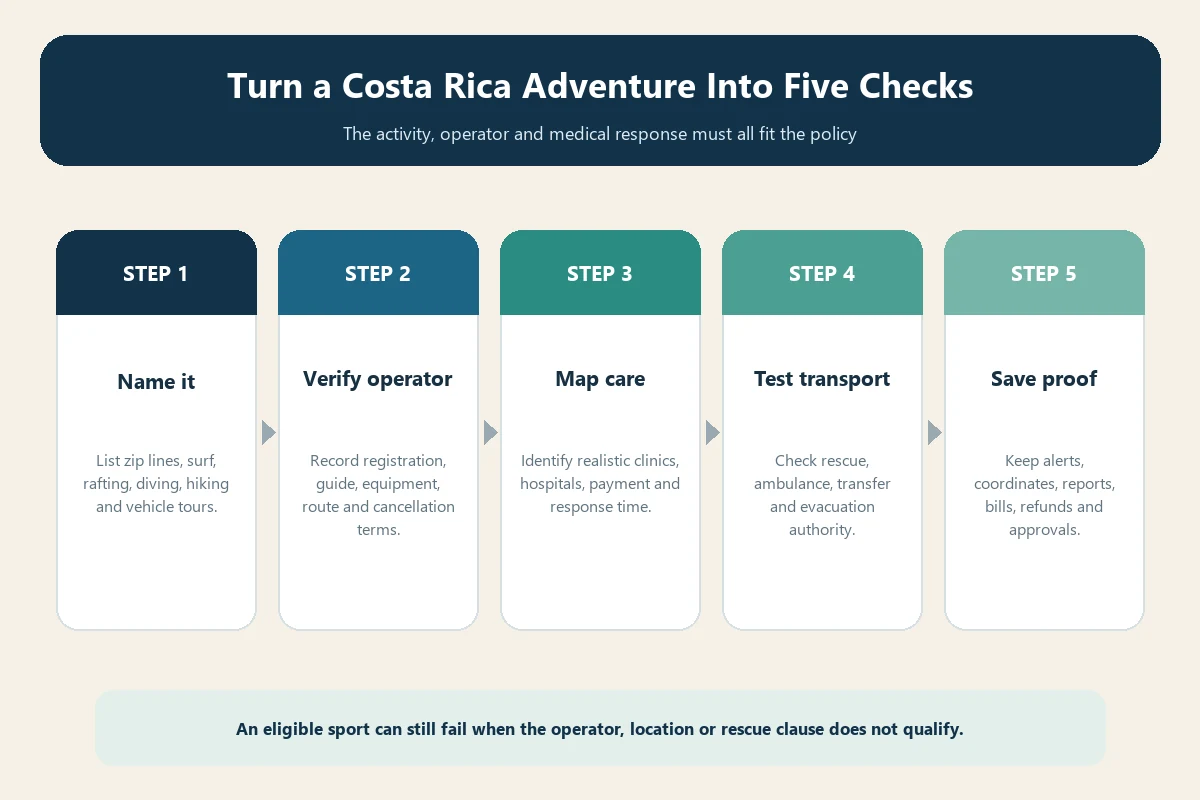
Travel insurance for Costa Rica from USA trips should be tested against the exact adventure, operator and response route. A San José hotel stay, a Pacific surf lesson and a rainforest zip-line day can produce completely different rescue, ambulance and cancellation questions. Build the policy check around the itinerary rather than treating “adventure coverage” as one broad promise.
Key takeaways
- Name every planned activity exactly as the operator sells it.
- Verify guide credentials, registration, equipment and route restrictions.
- Map realistic care from each coast, volcano area and remote lodge.
- Separate rescue, ground ambulance, medical transfer and repatriation.
- Save official alerts, coordinates, reports, bills, refunds and approvals.
Planning information reviewed August 16, 2026. Costa Rican alerts, operator status, road access and insurance wording can change. Check current official information for the exact dates and locations on the itinerary.
Start with an activity-by-activity route
Write down every overnight, transfer and paid activity. Include the province, pickup point, route, operator, altitude or water location, start time and nearest realistic medical facility. Note whether the traveler will drive, use a shuttle, board a boat or fly on a domestic segment.
The U.S. Department of State’s current Costa Rica travel information says some tourism operators are not registered and notes that traffic and road conditions can delay emergency response outside major metropolitan areas. It also advises travelers to consider medical-evacuation coverage and to use marked trails, required permits and certified guides for adventure activities.
Translate “adventure” into policy language
Do not ask only whether adventure sports are covered. Ask about the exact version of each activity: guided zip lining, whitewater rafting by river and class, recreational scuba by depth, surfing with an instructor, canyoning, ATV riding, horseback riding, volcano hiking and a hanging-bridge tour. A policy can treat those names differently.
Check exclusions for professional participation, racing, motorized vehicles, altitude, off-trail travel, water depth and alcohol. Then look for an optional sports upgrade and its medical, rescue or equipment sublimit. The adventure-activity exclusion guide provides a repeatable wording audit.
Get the answer in writing with the activity name and circumstances. A general sales statement does not replace the issued certificate, schedule and endorsement.
Audit the operator before paying
Record the legal operator name, registration or certification claimed, guide name, meeting point, equipment supplied, participant requirements and cancellation terms. Ask which emergency plan applies at the actual route and who calls local responders. Keep the booking page and waiver version used on the purchase date.
An eligible activity may still create a problem if it is performed outside a marked route, without a required guide or by an operator that does not meet the policy condition. Conversely, a signed operator waiver does not prove that medical costs are insured. Treat operator liability and traveler benefits as separate contracts.
Before departure, compare operator instructions with the Costa Rican National Emergency Commission’s official preparedness recommendations. Follow closures and safety instructions even when they reduce the value of a prepaid booking.
Map care from the Pacific, Caribbean and interior
San José and other population centers may offer more options than a remote beach, island transfer or rainforest lodge. For each overnight, identify the first clinic, an appropriate hospital and the transport needed between them. Ask the insurer whether a traveler must pay first and whether the assistance team can coordinate with the intended provider.
Call the U.S. health plan before travel. Confirm treatment outside the United States, network status, preauthorization, claim forms and prescription rules. The health insurance abroad guide helps expose gaps between emergency eligibility and actual provider payment.
Carry a concise medical summary, prescription list and allergies offline. Include the policy and assistance numbers with the route shared with a trusted contact.
Separate rescue from medical evacuation
A response may begin with a guide, boat, four-wheel-drive vehicle or local rescue team. It may continue by ground ambulance to a clinic, then by another vehicle or aircraft to an appropriate hospital. Repatriation to the United States is a separate possible stage.
Ask who determines medical necessity, selects the receiving facility and authorizes each movement. Confirm whether search and rescue has its own limit, whether transport from a trail or water location qualifies and whether evacuation ends at the nearest appropriate hospital. The remote evacuation guide explains this authority chain.
Do not arrange an expensive aircraft independently unless immediate safety makes that unavoidable. Contact emergency services first, then the insurer’s assistance line as soon as practical.
Plan the rental route as a separate risk
A travel policy, rental collision waiver and third-party motor liability solve different problems. Confirm which roads the rental agreement permits, whether river crossings or unpaved roads are prohibited, who provides roadside assistance and how far towing can extend. Photograph the car and contract at pickup.
Heavy rain, landslides, a damaged road or mechanical failure may strand the traveler without creating a covered medical event. Assign vehicle damage, towing, replacement transport, unused lodging and injury to their respective contracts. The rental car abroad guide keeps these benefits separate.
| Scenario | First wording to inspect | Evidence to save |
|---|---|---|
| Surf injury | Medical and named-activity eligibility | Instructor report, diagnosis and bill |
| Trail extraction | Search, rescue and evacuation clauses | Coordinates, responder record and authorization |
| Rental damage | Rental agreement, waiver or collision benefit | Photos, police report and assessment |
| Road closure | Delay or interruption covered causes | Official notice, timing and supplier response |
| Operator cancellation | Supplier terms and policy definitions | Cancellation notice and refund statement |
Use official alerts as timed evidence
The National Emergency Commission publishes current national, regional and municipal conditions on its official alert page. Save the alert level, affected area, issue time and later updates. An alert covering one canton does not automatically describe a different coast or province.
Insurance often depends on an event and a defined effect, such as an inaccessible destination, common-carrier delay or mandatory evacuation. A precautionary itinerary change may be sensible but may not match a listed trigger. The weather-delay coverage guide shows how to connect an official notice to the policy’s minimum delay and covered cause.
Classify cancellations by timing and decision-maker
Before departure, a covered event may be evaluated under trip cancellation. After the journey begins, unused arrangements and added transport may fall under interruption. A late shuttle or flight may be a delay. The benefit name should follow the event timing, not the traveler’s preferred reimbursement.
Ask the supplier for its refund, credit or rebooking response before claiming. Record who canceled, the reason, the time and the exact service affected. The trip cancellation guide helps test listed causes, foreseeable events and documentation.
Review medical history before the first deadline
Recent treatment, a medication change, pending testing or a chronic condition can interact with a look-back period. A pre-existing-condition waiver may require purchase soon after the first trip payment, insurance of the required trip cost and medical eligibility on the purchase date.
Use the pre-existing-condition waiver guide before the time-sensitive window closes. Keep the first deposit receipt and the policy purchase confirmation together.
Test the assistance line with a real scenario
Give each insurer the same case: a U.S. traveler is injured during a guided activity near a remote Pacific town, reaches a local clinic and needs transfer to a higher-level hospital. Ask who contacts the provider, guarantees or arranges payment, approves transport and communicates with a companion.
Also ask what happens if cellular service is unavailable, whether a local operator can call on the traveler’s behalf and which notice deadline applies. The assistance line versus claims guide distinguishes live coordination from later reimbursement.
Build an incident file while facts are fresh
Record the date, time, coordinates, activity, operator, weather, symptoms, responder and every case number. Collect an operator report, medical notes, itemized bills, proof of payment, transport records, official alerts and all supplier refunds. Photograph documents that might be surrendered.
The travel insurance claim guide provides a chronology for coordinating health-plan and travel-policy submissions without claiming the same expense twice.
Run one final Costa Rica policy comparison
Use the same trip cost and itinerary for every quote. Include the named adventures, a rural medical transfer, a road closure, an operator cancellation and an early flight home. Record exact page references for eligibility, exclusions, deductibles, rescue, evacuation, delay, interruption and preauthorization.
- Are the exact activities and guide arrangements eligible?
- Is rescue covered separately from medical transport?
- Who selects the receiving facility and evacuation endpoint?
- How do providers receive payment or reimbursement?
- Which official event can trigger cancellation, delay or interruption?
- What records and notice deadlines apply?
Choose the contract whose definitions match the route’s weakest point. A higher headline limit cannot repair an excluded activity, unqualified operator or unauthorized transfer.
Pack for a response, not only the excursion
Carry a charged phone, offline map, backup power, water, prescribed medicine and the operator’s local number. For a remote outing, share the route and return time with a trusted contact. Store a screenshot of the policy card and assistance instructions where another traveler can find them.
Ask the operator what clothing, footwear and flotation or protective equipment it supplies. If the traveler brings personal sports equipment, photograph it before transit and keep purchase records. Equipment benefits often have per-item limits and do not replace safe operator gear. A lost board or camera also follows a different claim path from a medical evacuation.
Bottom line
The strongest Costa Rica plan connects five things: the named adventure, a qualified operator, realistic medical care, authorized transport and contemporaneous evidence. Map those links before paying a deposit, then recheck official alerts before each remote or weather-sensitive stage.