
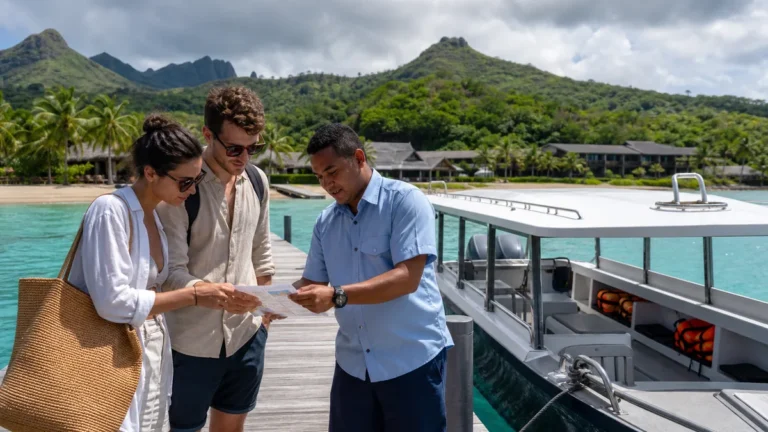
Travel insurance for Fiji from USA trips should follow the exact island chain, marine transfers, resort activities and possible route to higher-level care—not rely on a generic tropical-destination limit. A stay on Viti Levu operates differently from an itinerary that adds a remote island, small boat, scuba dives and a tight international connection.
Key takeaways
- List every island, boat, domestic flight, resort and activity before comparing policies.
- Ask how a traveler moves from an outer island to suitable care and who authorizes the transfer.
- Verify diving, recompression treatment and evacuation as separate policy questions.
- For cyclone claims, save the official bulletin and the specific supplier action.
- Prepare for limited ambulance availability and providers that may request payment before treatment.
Planning information reviewed August 16, 2026. Entry rules, medical capability, weather warnings, marine operations and policy terms can change. Recheck official sources, each supplier and the issued certificate for the travel dates.
Build the Fiji island chain first
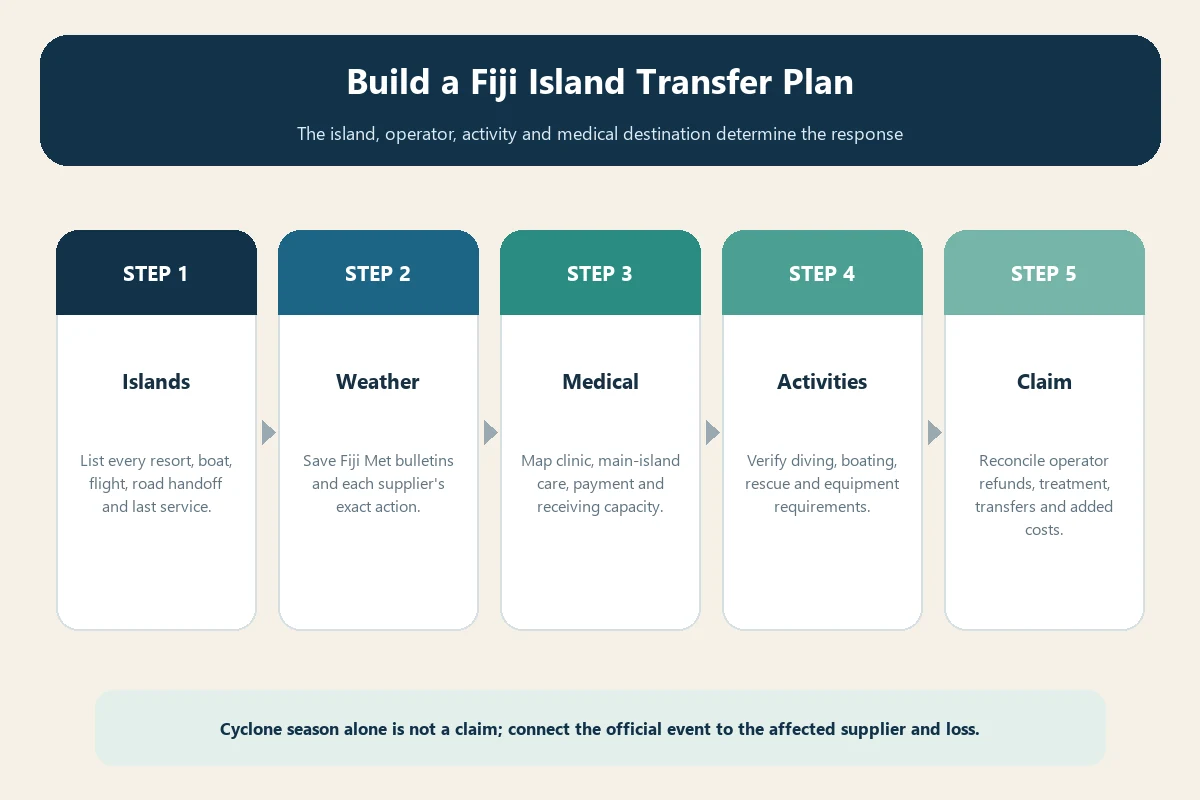
List Nadi, Suva, the Coral Coast, Denarau, the Mamanuca or Yasawa Islands, Vanua Levu, Taveuni, Kadavu and every other stop. Add the international arrival, road transfer, domestic flight, scheduled ferry, resort launch, charter boat and return connection.
Record the operator, departure point, baggage rule, last service and refund terms for each handoff. Give the insurer the complete route. “Fiji resort vacation” hides the segments most likely to complicate medical movement or a missed departure.
Map medical care from the outer island inward
Current U.S. Department of State Fiji travel guidance says ambulance services are not widely available and may not meet U.S. standards. It also advises travelers to prepare for providers that require cash payment.
For each island, identify the resort response, nearest clinic, practical boat or aircraft transfer, higher-capability facility and international departure point. Ask whether assistance can locate care, arrange a guarantee and approve transport. The health insurance abroad guide structures the separate call to the U.S. health plan.
Do not compress every transfer into “evacuation”
A resort boat to a main island, ground ambulance to a hospital, medically staffed flight and later return to the United States may fall under different benefits. Ask what counts as local transport, inter-facility transfer, medical evacuation and repatriation.
Confirm who decides that the first facility is unsuitable, who selects the receiving hospital and whether the insurer must authorize movement. The remote evacuation guide helps test each stage without promising a particular destination.
Plan diving and recompression care precisely
State Department information reviewed for this guide says Fiji’s hyperbaric chamber is not currently in service and identifies chambers in Australia and New Zealand as the nearest alternatives. Verify the current position with assistance and the dive operator before departure because facility status can change.
Give the insurer the diver’s certification, planned depth, gas, boat, operator and locations. Ask separately about boat rescue, initial treatment, recompression, third-country evacuation and an unused dive package. A chamber location does not guarantee availability, medical acceptance, weather or transport.
Audit every resort activity
List scuba, snorkeling, surfing, kayaking, sailing, jet skis, fishing, hiking, waterfalls, zip lines and motorized excursions. Ask about guide requirements, protective equipment, depth, distance offshore, racing, alcohol and unlicensed operation.
The activity-exclusions guide gives a repeatable policy test. A resort selling an activity does not establish medical, liability, equipment or rescue coverage under the traveler’s certificate.
Use Fiji’s official cyclone information
The Fiji Meteorological Service is the official first-level source for regional tropical-cyclone information. Monitor its forecast and warning products and save the bulletin, affected area, issue time and forecast period that match the itinerary.
Do not use the existence of cyclone season as a claim trigger. Record when the event became known relative to policy purchase, then preserve the airline, ferry, resort or tour decision. Coverage commonly depends on a specified event and resulting loss, not weather anxiety alone.
Separate official alerts from supplier action
A warning can cause different outcomes across Fiji. One resort may close its launch while an airline continues operating from Nadi. A road may be impassable while a prepaid room remains available. Build a timeline for each supplier.
The weather-delay guide explains why the bulletin, carrier action and waiting period all matter. Keep cancellation messages, alternate offers, refund responses and the reason a replacement was necessary.
Test inter-island transport definitions
Ask whether a scheduled ferry, domestic airline, resort boat and private charter meet the policy’s common-carrier definition. Record the published schedule, ticket, passenger name and onward connection. A complimentary launch may be handled differently from a separately ticketed public service.
If an operator cancels, request the reason in writing. Save the next available service and resort response. The delay, interruption and cancellation guide helps classify an added island night, missed flight or unused resort booking.
Review Fiji health guidance
The CDC maintains current Fiji traveler health guidance. Review vaccines, food and water, mosquito exposure, medicines and outdoor activities with a clinician. Smaller islands and rural stays can change practical access to treatment.
Ask the policy how it handles acute illness, pre-existing conditions, preventive care and prescribed medicine replacement. Bring necessary lawful medicines in original packaging with clinician documentation. Insurance cannot make unavailable treatment appear locally.
Prepare for upfront medical payment
Ask assistance what Fiji facilities it can contact and whether a provider list is contracted or informational. A directory entry does not guarantee capability, availability or direct billing. Keep secure payment capacity for a deposit or service when a guarantee cannot be arranged quickly.
Request the diagnosis, clinical notes, itemized bill, Fiji dollar amount, payment proof and discharge instructions. Preserve both a temporary card authorization and the final settled charge so a claim does not accidentally include money that was released.
Compare one realistic Fiji scenario
Use identical travelers, dates and prepaid costs for every quote. Include a mainland hotel, outer-island resort, resort launch, diving, an official cyclone bulletin, a canceled marine transfer, an urgent clinic visit and possible transfer toward higher care.
- Which boat or flight qualifies as a covered carrier?
- What activity wording applies to the planned dives?
- Who confirms recompression or third-country transfer?
- Can assistance support a cash-demanding provider?
- What supplier action activates delay or interruption benefits?
- Which resort, airline or operator refunds reduce the claim?
Read the certificate. A high evacuation limit cannot establish diving eligibility or create transport during unsafe weather.
Use assistance without confusing it with approval
Store the policy number, international assistance line, resort contact and local emergency numbers offline. In urgent circumstances, obtain necessary care, then notify the insurer as soon as practical. Record the representative, time, case number and instruction.
The assistance versus claims guide explains why a referral or transport discussion is not final claim approval. Ask for written confirmation when a costly movement is being considered.
Build an island-by-island claim file
Label every document with the island, traveler, date, local time, supplier, Fiji dollar amount and event. Keep medical records separate from boat, airline, hotel and activity records. Add official bulletins and operator messages in chronological order.
Record each refund, credit, card benefit and health-plan payment beside the related cost. The claim documentation guide explains how to show the final unreimbursed loss and actual currency conversion.
Rehearse a failed island connection
Before travel, decide what happens if the last launch is canceled, a domestic flight is delayed or the resort cannot receive guests. Identify a safe mainland hotel, next available service and the deadline for the international flight.
Ask the supplier which alternative it provides before buying a replacement. Preserve why the replacement was reasonable and necessary. A planned buffer night may be worthwhile risk reduction even when it is not an insurance expense.
Create an offline medical and marine card
List the traveler’s passport name, allergies, medicines, policy, assistance line, resort coordinates, boat operator and next medical point. Give a companion and home contact the same version. Include a check-in rule for excursions beyond ordinary phone coverage.
A card does not guarantee rescue, but it reduces delay caused by missing identity, route or clinical information. Pair it with operator briefings, life jackets, weather compliance and a realistic connection margin.
Test an outer-island companion scenario
Imagine one traveler needs care on another island while a companion remains with the luggage and future bookings. Decide who contacts the resort, who follows the patient, who manages passports and who informs the next carrier. Give both travelers access to policy and medical information.
Ask whether a companion’s boat, hotel and changed flight require medical necessity, insurer approval or a separate benefit. Preserve the clinician’s recommendation, operator availability and the reason the selected transport was reasonable. Do not combine the patient’s medical movement with the companion’s ordinary travel costs.
Confirm whether dependent children or an incapacitated traveler create additional escort arrangements, and record who approved the selected adult’s transport and lodging.
Keep essential medicine, a change of clothing and charging equipment in the accessible bag rather than checked luggage moving on a different route. Record which resort transfers or unused nights were refunded. This rehearsal makes the claim file clearer and reduces confusion when an outer-island transfer separates the party.
Bottom line
A strong Fiji policy follows the traveler across every island and transport contract. Verify activity eligibility, medical payment and the full transfer chain, then connect official cyclone information to supplier action and the final unreimbursed cost.