

Travel insurance for Jamaica should be checked against three things a resort vacation actually produces: a clinic referral arranged by the property, an upfront hospital deposit, and a transfer to Kingston or back to the United States. The CDC advises US travelers to review what their own health plan covers abroad and to consider travel health and medical evacuation insurance. Build the medical route first, then add excursions and hurricane-season disruption, and keep every referral, estimate and receipt for the claim file.
Key facts
- The Atlantic hurricane season runs June 1 to November 30, with activity peaking around September 10 (National Hurricane Center).
- CDC advises reviewing your health plan's coverage abroad and considering travel health and medical evacuation insurance for Jamaica.
- The State Department notes Jamaican hospitals often require upfront payment and some resorts have exclusive medical-provider agreements.
- Ambulances can be unreliable, especially in rural areas, and patients bear transfer costs, per the State Department.
- Buy before a named storm or other known event; a foreseeable event limits new coverage.
- CDC: bring all medicines you might need, with extra in case of travel delays.
Key takeaways
- Ask which clinic, ambulance and hospital the resort normally uses.
- Verify deposits, cash access, itemized bills and payment assistance.
- Map rural and north-coast transport to appropriate specialist care.
- Check excursions and water activities by exact name.
- Keep resort instructions, medical records, alerts, refunds and approvals.
Planning information reviewed August 16, 2026. Advisories, provider availability, road conditions, resort agreements, storm recovery and policy wording can change. Verify current information for the exact parish and property.
Map the resort-to-hospital route
List the airport, resort, excursions, road transfers and prepaid bookings. Ask the property for the clinic, ambulance and hospital it normally uses. Record the nearest major facility and travel time in daylight and during heavy rain.
The U.S. Department of State’s current Jamaica travel information says hospitals often require upfront payment and some resorts have exclusive medical-provider agreements that can limit patient choice. It also notes that ambulances can be unreliable, especially in rural areas, and patients bear transfer costs.
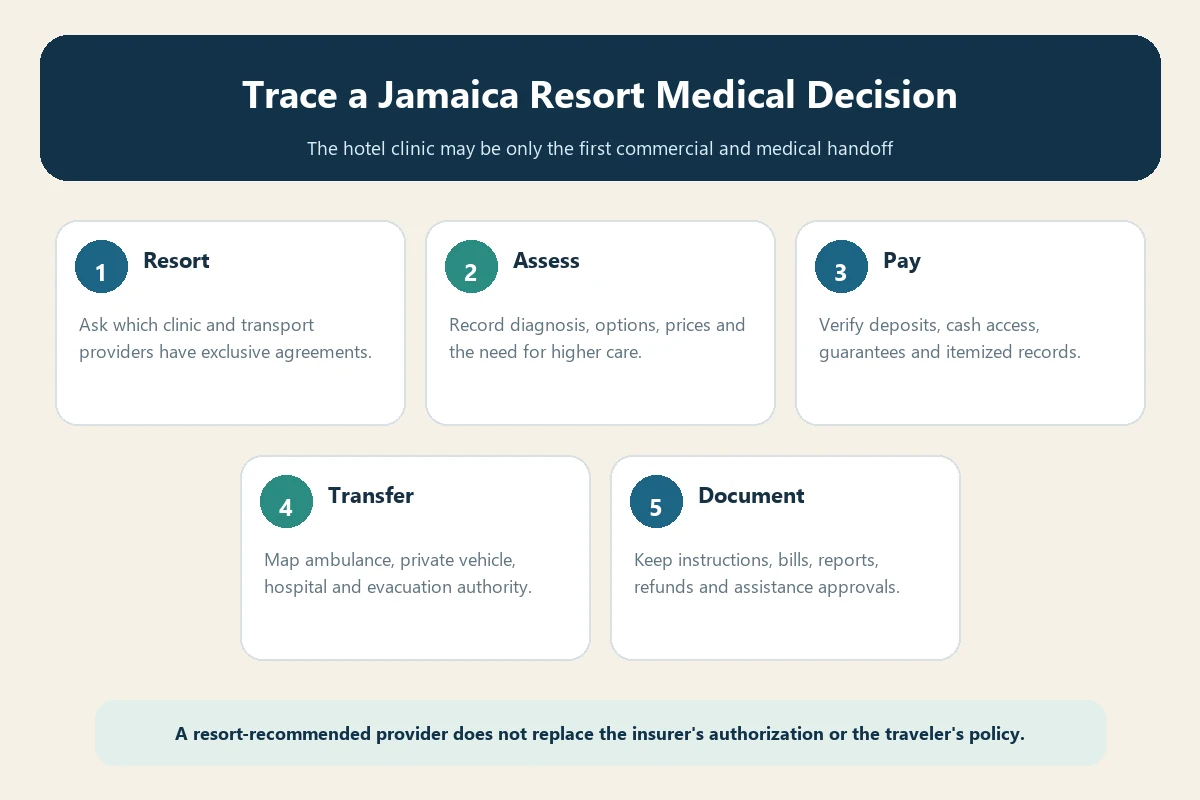
Ask how the resort medical agreement works
Request the provider’s name, location, hours, fees and relationship with the property. Ask whether the resort receives a referral or transport fee and whether the traveler can contact another provider. Keep the written answer without assuming the arrangement is improper.
A resort’s recommendation does not guarantee quality, insurer eligibility or direct payment. In a nonurgent situation, call assistance before accepting expensive diagnostics or transport. In an emergency, seek immediate care and notify the insurer as soon as practical.
Prepare for hospital deposits and cash payment
Ask likely providers what deposit, payment method and identity documents they require. Ask the travel insurer whether assistance can arrange a guarantee of payment. Keep enough financial flexibility for initial care without carrying unsafe amounts of cash.
Call the U.S. health plan about foreign treatment, reimbursement, authorization and claim forms. The health insurance abroad guide explains why a domestic card may not solve admission or payment.
Request a written estimate when practical and obtain itemized bills, diagnoses, prescriptions and proof of payment. Do not surrender the only copy of a record.
Distinguish stabilization, hospital transfer and evacuation
A hotel clinic may assess or stabilize a traveler but not provide surgery or specialist care. Movement to another Jamaican hospital can be separate from medical evacuation to the United States. Ask who determines medical necessity and selects the facility.
Confirm ambulance availability, private-vehicle alternatives, aircraft authorization and companion rules. The remote evacuation guide provides a transport-chain checklist.
Test the assistance line before departure
Give the insurer the resort and parish. Ask whether it knows the resort clinic, which hospital it would contact, how it handles a deposit and what happens when a preferred ambulance is unavailable. Save the international dialing method offline.
The assistance line versus claims guide distinguishes live coordination from later eligibility review. Assistance can arrange options without promising that every expense is covered.
Review medical history and medication supply
A recent treatment, medication change or pending test can interact with a look-back period. A pre-existing-condition waiver may require purchase soon after the first trip payment and insurance of required nonrefundable costs.
The pre-existing-condition waiver guide provides a timing checklist. Bring extra prescription medication in original packaging because some common drugs can be difficult to replace.
Audit every resort excursion
Name zip lines, river tubing, rafting, horseback riding, ATV tours, cliff jumping, diving, snorkeling and boat trips exactly. Include supervision, equipment, height, depth and motorized use. Check whether an adventure endorsement is required.
The adventure-activity exclusion guide helps test the activity and operator separately. A resort sales desk does not prove that the operator meets policy conditions.
Keep the operator’s legal name, booking page, waiver, guide, emergency plan and cancellation terms. Ask who transports an injured participant back to road access.
Plan road travel by daylight
The State Department advises against driving between cities at night and recommends licensed transportation. Record the vehicle, driver, license indicators, pickup and safe alternative. Build margin between a resort transfer and the international flight.
For a rental, verify third-party liability, collision protection, prohibited roads, towing and replacement. The rental car abroad guide separates motor losses from medical and trip benefits.
| Problem | First wording to inspect | Evidence |
|---|---|---|
| Resort clinic visit | Travel medical eligibility | Diagnosis, itemized bill and payment |
| Hospital deposit | Direct payment or reimbursement process | Deposit request and assistance response |
| Hospital transfer | Ambulance or evacuation clause | Medical necessity and authorization |
| Excursion injury | Named activity and operator rules | Operator report, route and waiver |
| Storm closure | Cancellation, delay or interruption | Official alert and supplier refund |
Check hurricane season and current storm recovery
Jamaica lies in the Atlantic hurricane belt, and recent storms can leave local effects after airports reopen. Confirm that the property, road, clinic and planned activities are operating. Do not infer island-wide recovery from one supplier’s message.
Jamaica’s Office of Disaster Preparedness and Emergency Management publishes official disaster information and response updates. The U.S. National Hurricane Center provides storm preparedness and current products.
Connect alerts to defined trip benefits
A watch, road closure, airport shutdown, resort cancellation and evacuation order are different events. Save the authority, parish, start time and actual supplier response. Ask when a storm becomes foreseeable under the policy.
The weather-delay coverage guide connects the notice to a threshold or carrier cancellation. Buy before a named storm or other known event limits new coverage.
Classify costs by event timing
A covered event before departure may be cancellation. After arrival, unused resort nights and added return travel may be interruption. Waiting for a replacement flight can be delay. Supplier credits reduce the remaining claim.
The delay, interruption and cancellation guide maps costs to timing. Keep the original itinerary, revised itinerary and every refund response.
Compare policies with one resort scenario
Give each insurer the same facts: a U.S. traveler becomes seriously ill at a north-coast resort, is sent to the contracted clinic, faces a hospital deposit and may need transfer to Kingston or the United States. Add an excursion injury and storm-closed road.
- Can the traveler choose a provider outside the resort agreement?
- How does assistance handle deposits and payment?
- Who selects the Jamaican hospital and evacuation endpoint?
- Are the exact excursions eligible?
- Which road or storm event can trigger a trip benefit?
- What notice and evidence deadlines apply?
Give a companion a clear role
Store the policy, medical summary, consent, assistance number and payment access where a companion can use them. Ask about bedside travel, added lodging and dependent return. These benefits have separate conditions.
During an incident, one person can keep the chronology and bills while another communicates with the resort, provider and assistance team.
Read the resort medical invoice line by line
A resort callout, private clinic visit and hospital admission can create separate charges even when they feel like one episode. Request an itemized estimate showing consultation, supplies, medication, imaging, ambulance and administrative fees. Ask whether the resort or clinic adds a coordination charge and whether the traveler is authorizing a fixed amount or an open balance.
Do not rely on a credit-card slip as the only record. Keep the clinical note, diagnosis, prescription, receipt and proof of currency conversion. If a deposit is taken, obtain a statement showing how it will be applied and how any unused balance is returned. The insurer may need these documents to distinguish medical treatment from convenience or nonmedical resort services.
When a provider asks the traveler to sign a broad payment guarantee, call assistance if the medical situation allows. Record the provider’s deadline and the insurer’s instruction. Emergency care comes first, but a precise written trail can prevent later confusion about what was authorized and what remained the traveler’s responsibility.
Plan the after-hours road and clinic gap
A daytime route can change after a clinic closes, rain affects a road or the resort vehicle is unavailable. Record two realistic facilities, their hours and the transport method the resort would use at night. Ask whether the nearest facility can provide only basic assessment and where it normally sends a patient who needs imaging, surgery or intensive care.
Carry the destination address offline and use a licensed driver. Save the driver’s or ambulance provider’s receipt and the reason the transfer was required. If assistance recommends a different hospital, ask for that instruction in writing. Language support, provider acceptance and payment approval should be treated as separate tasks rather than assumed from a single phone call.
Build a family and companion handoff
For a child, record parental consent, allergies, medication doses and the adult authorized to make decisions if one parent travels with the patient. Ask how the policy handles an escort, return of other dependents and added lodging. These benefits may require a treating physician to certify that the companion is medically necessary.
For an adult traveler, choose one person to communicate with assistance and one to preserve invoices and times. Include the resort referral, every provider name, deposit, ambulance departure and hospital acceptance. If a private nurse or nonmedical attendant is suggested, ask whether that service is part of covered treatment or a separately purchased convenience.
Give the companion a short script: state the policy number, exact location, current facility, treating clinician and requested next step. Then ask for the case number, representative’s name and written confirmation. A consistent handoff reduces repeated explanations while keeping the medical team—not the resort desk—in charge of clinical decisions.
Build the claim file from the first referral
Save the resort instruction, provider relationship disclosed, estimate, diagnosis, itemized bills, payment proof, ambulance record, transfer approval, operator report, official alert, supplier refund and replacement receipt.
The travel insurance claim guide provides a chronology. Disclose U.S. health-plan and supplier reimbursement and claim only the eligible balance.
Bottom line
The strongest Jamaica plan works beyond the resort desk. Verify provider choice, deposit handling, daylight transport, excursion eligibility and evacuation authority, then preserve every commercial and medical handoff in the claim file.
Sources and further reading
- Tropical Cyclone Climatology — The Atlantic hurricane season runs June 1 to November 30 and peaks around September 10 (key fact; storm section).
- Jamaica – Traveler view | Travelers' Health | CDC — CDC advises reviewing your health plan's coverage abroad, considering travel health and medical evacuation insurance, and bringing all needed medicines with extra for delays (intro, key facts, medication section, FAQ).
