
Travel insurance for Mongolia from USA trips should be built around distance, road access, communications and the exact activities on a remote itinerary. A policy that looks adequate for Ulaanbaatar may operate very differently after several days by four-wheel drive, horse or domestic aircraft.
Key takeaways
- Map every overnight stop, road leg, domestic flight and communication method.
- Do not assume a helicopter can collect a patient from a remote camp.
- Disclose horse riding, trekking, motorcycling and winter travel precisely.
- Ask who selects and authorizes transport to Ulaanbaatar or a higher-capability facility.
- Preserve the tour operator’s reroute, refund and incident records.
Planning information reviewed August 16, 2026. Advisories, entry rules, health risks, transport access and insurance terms can change. Recheck official sources, the tour operator and the issued certificate for the travel dates.
Turn the tour into a dated route grid
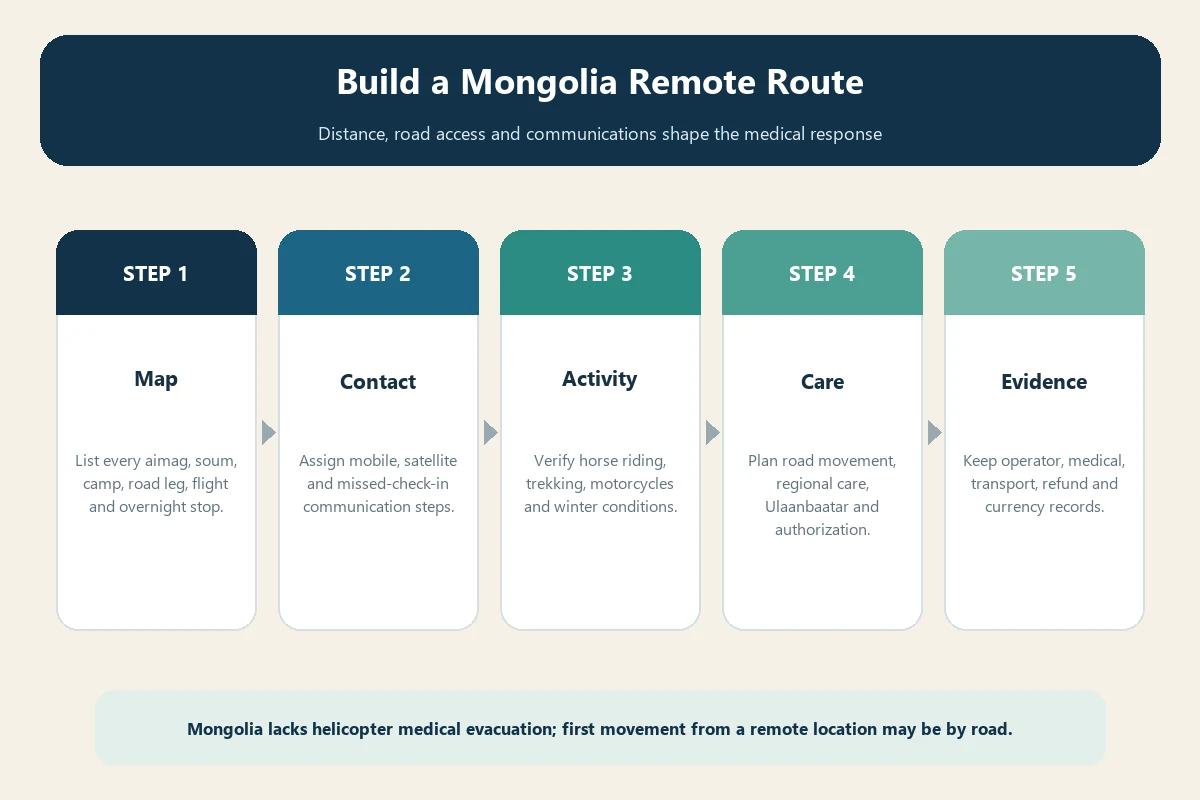
List Ulaanbaatar, every aimag and soum, camp, park, border area and overnight stop. Add road distance, expected driving time, vehicle, driver, fuel point, domestic flight and backup. Record whether the route has reliable mobile coverage, satellite communications or only scheduled camp contact.
Give this grid to the insurer when asking about remote travel. “Mongolia tour” does not reveal whether the traveler is staying in the capital or traveling for days across unpaved terrain. Keep the operator’s final route and any later change notices.
Read current U.S. destination guidance
The U.S. Department of State publishes current Mongolia travel information. It describes vast distances, limited road and communications infrastructure, severe weather and uneven emergency response outside city centers.
Review the guidance at the first deposit, at policy purchase and before departure. Ask how the certificate treats a changed advisory, inaccessible destination or operator cancellation. A government notice does not automatically create a benefit unless the event fits the issued wording.
Design the first-mile medical plan
State guidance says basic medical care is usually concentrated in or near major cities and first responders may not reach areas outside them quickly. It also states that Mongolia lacks helicopter medical evacuation. In a remote area, the first movement may be by road to a town before any commercial flight.
Ask the operator which vehicle, driver and communication device supports an incident. Identify the closest practical clinic, regional hospital and airfield without presenting them as guaranteed solutions. The remote evacuation guide helps organize the questions.
Separate extraction from medical evacuation
Policies may distinguish getting a traveler from a trail or camp from medically necessary transport between facilities. Ask whether off-road vehicle assistance, search, rescue, nonmedical extraction, ambulance and commercial air movement are covered under separate provisions.
Ask who decides medical necessity and the receiving facility. The phrase “nearest suitable facility” does not promise a hospital in the United States. Use the medical evacuation limit guide to compare authorization, escort, transport type and onward-transfer rules.
Audit horse riding line by line
Tell the insurer whether the itinerary includes guided riding, multi-day horse trekking, independent riding, racing or work with animals. Ask about guide qualifications, helmets, remoteness, altitude and any activity or professional-participation exclusion.
Do not assume a general adventure upgrade covers every version of riding. Give the operator’s activity description to the insurer and request a written answer tied to the certificate. The activity exclusions guide provides a reusable comparison sheet.
Plan for animal exposure and delayed treatment
The CDC’s current Mongolia traveler health guidance notes that rabies occurs in dogs and terrestrial wildlife and that post-exposure vaccine may be available only in larger urban facilities. Discuss the itinerary and animal contact with a travel-health clinician well before departure.
Ask how assistance would locate appropriate treatment after a bite or scratch from a dog, horse or wild animal. Coverage is not a substitute for prompt medical advice. Save the exposure time, location, wound care, animal description and every instruction received.
Test motorcycles and self-drive routes separately
Motorcycling, off-road driving and riding as a passenger can trigger different exclusions. State the engine type, rental contract, licensing, helmet, guide, road surface and planned route. Verify local liability requirements as well as medical and activity coverage.
Travel insurance is not automatically vehicle liability or collision coverage. The rental car abroad guide separates the rental agreement, local motor policy, credit-card protection and travel policy.
Prepare for domestic flight disruption
Record the operating airline, ticket number, baggage allowance, schedule, next service and onward international connection. Ask whether the domestic carrier satisfies the policy definition and whether separate tickets receive any through-protection.
If a flight is delayed or canceled, obtain the operational reason and the alternative offered. Save the tour operator’s revised route and unused services. The delay and interruption guide helps classify added road travel, extra lodging and missed international transport.
Plan for severe cold and road closure
State guidance warns that severe weather can create urgent situations and recommends suitable cold-weather equipment in vehicles during winter. Ask the operator about spare fuel, recovery gear, food, water, heat, communications and a missed-arrival escalation plan.
Insurance generally responds to defined events and losses, not to a season by itself. Save an official warning or closure with the carrier or operator action that changed the route. The weather delay guide shows how to build that timeline.
Include air quality in health preparation
State guidance notes severe winter air pollution in Ulaanbaatar and other cities and points travelers to the U.S. Environmental Protection Agency’s international air-quality resources. Travelers with respiratory or cardiac conditions should discuss exposure and medicines with their clinician.
Routine preventive decisions are not the same as a covered unexpected illness. Ask about pre-existing-condition terms, acute exacerbations and medicine replacement. Carry lawful prescriptions in original packaging and enough supply for a reasonable delay.
Verify provider payment before the trip
State guidance says most overseas providers accept cash payment and recommends supplemental evacuation insurance. Ask the traveler’s U.S. health plan what care it covers abroad. Then ask the travel insurer whether assistance can contact a provider or arrange a guarantee of payment.
Keep secure emergency payment capacity. Collect the diagnosis, itemized invoice, proof of payment, prescription, clinical notes and referral. The health insurance abroad guide helps separate primary-plan obligations from the travel claim.
Compare a real Gobi or steppe scenario
Use identical travelers, dates and costs for every quote. Test a guided ride several hours from a paved road, an injury requiring vehicle transport to a town, a missed domestic flight and a clinician-recommended move to Ulaanbaatar.
- Is the exact riding activity eligible?
- Does the policy cover nonmedical extraction?
- Who arranges the initial road movement?
- When does medical evacuation begin?
- Does the domestic airline meet the carrier definition?
- Which operator refunds reduce the claim?
Write each answer beside the policy section. Avoid relying on an advertised benefit name without its definitions and exclusions.
Choose a tour operator as part of risk control
State guidance recommends reputable operators with established safety records, especially for remote areas. Ask who drives, guides and manages emergencies; what training they hold; how vehicles are maintained; and what communications and first-aid equipment travel with the group.
Request the cancellation, substitution and force-majeure terms. If the route changes, preserve the original itinerary, new itinerary, reason, unused service and refund. Insurance should complement a capable operator, not serve as a substitute for one.
Use assistance as a decision log
Store the policy, assistance number, operator contacts and route coordinates offline. In an emergency, obtain necessary local help and contact assistance as soon as practical. Record the case number, caller, local time, clinical recommendation and authorization.
The assistance versus claims guide explains the difference between coordination and final reimbursement. Request written approval before an expensive nonemergency move whenever circumstances allow.
Build a location-based claim file
Label each record with the traveler, GPS or named location, local date and time, vehicle or flight, supplier and currency. Keep medical records separate from transport, lodging and tour documents while using one master timeline.
Add every refund, credit, card benefit and health-plan payment. The claim documentation guide helps calculate the final unreimbursed amount. Keep the original Mongolian invoice and any translation requested by the insurer.
Create a communications ladder
Agree on check-in times among the traveler, guide, tour office and home contact. List mobile numbers, satellite device identifiers and the action triggered by a missed check-in. Store coordinates in a form the operator actually uses.
This ladder does not guarantee rescue, but it can shorten the time needed to recognize a problem and supply useful route facts. Test devices before leaving Ulaanbaatar and carry independent power.
Price prevention into the itinerary
Add a connection buffer before the international flight, choose daylight road travel and avoid an overpacked route. A spare night or stronger communications plan may be a personal cost rather than an insured loss, but it can reduce exposure to an expensive failure.
The U.S. Department of State’s general travel insurance guidance recommends checking destinations, trip length, emergency care, medical transport, current conditions, planned activities and a 24-hour help line. Apply that checklist to the actual Mongolia route.
Bottom line
A strong Mongolia policy comparison begins with geography. Map road and communication gaps, distinguish extraction from evacuation, verify every activity and domestic carrier, and document operator decisions. The best plan is the one whose definitions match the real route and whose assistance process the traveler can use from a remote camp.
