
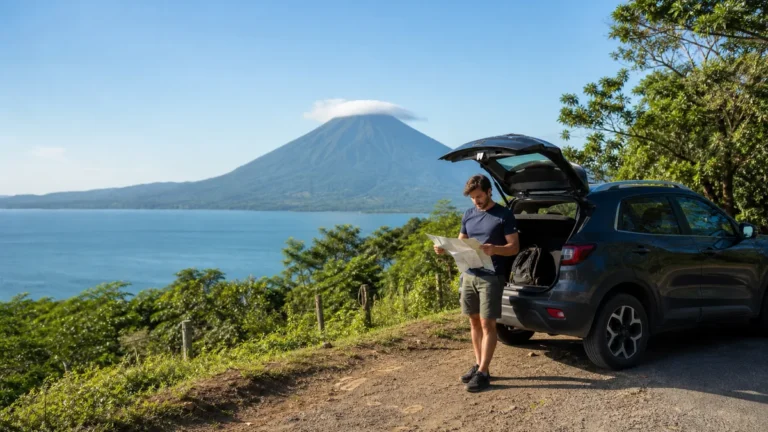
Travel insurance for Nicaragua from USA trips must be checked against the current advisory, exact volcano activity and limited medical capacity outside Managua. A Granada stay, Ometepe hike and Pacific surf stop can require different roads, providers and evacuation decisions. Build the policy test around those real stages rather than a generic country label.
Key takeaways
- Read the current U.S. advisory before purchase and again before departure.
- Name every volcano, trail, guide, altitude and closure condition.
- Distinguish rural stabilization from appropriate care in Managua or abroad.
- Verify whether security, unrest and official-advisory exclusions affect the route.
- Keep alerts, coordinates, medical records, refunds and assistance approvals.
Planning information reviewed August 16, 2026. Advisories, entry practices, volcanic conditions, road access, medical services and insurance wording can change. Verify official information for the exact travel dates.
Start with the advisory and itinerary together
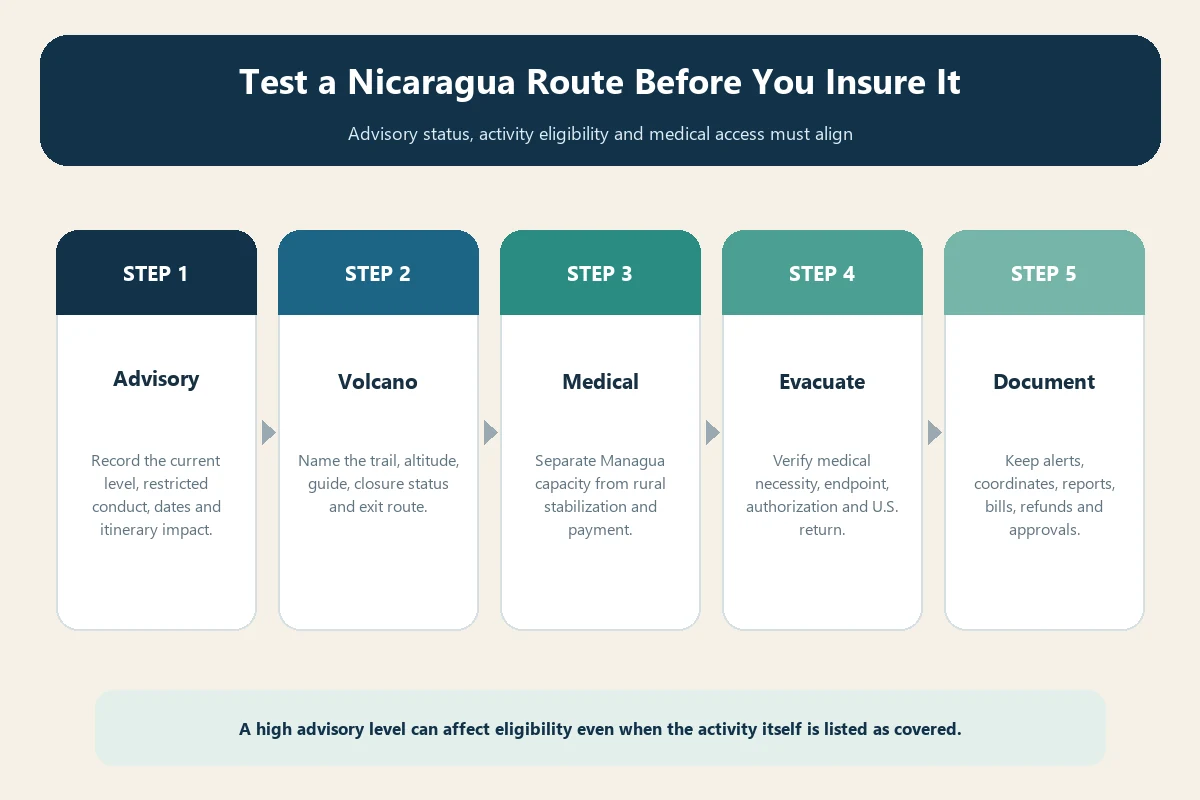
List every city, island, road, domestic transport, volcano, beach and prepaid booking. Note the first trip payment, planned guide and realistic medical facility for each overnight. Then place the current advisory language beside the route.
The U.S. Department of State’s current Nicaragua travel information is Level 3, “Reconsider travel,” because of crime, health, wrongful detention and arbitrary enforcement of local laws. It states that comprehensive quality care is available only in Managua and that medical evacuation to the United States may be the only option in some cases.
Find the policy’s advisory and security clauses
Search the issued wording for government advisory, high-risk area, civil disorder, political evacuation, unlawful acts, detention and travel contrary to official advice. Ask whether eligibility depends on the advisory level on the purchase date, departure date or loss date. Request a written page reference.
Ordinary trip cancellation does not always cover fear, a changed advisory or an unpredictable entry decision. “Cancel for any reason” benefits, when offered, have their own purchase deadline, insured-cost rule, cancellation window and partial reimbursement. The country exclusion and advisory guide provides a contract-language audit that applies beyond Europe.
Insurance cannot remove detention, entry or security risk. Follow official advice and keep an independent departure plan that does not rely on U.S. government transport.
Identify the volcano and permitted route
Write the volcano name, trail, altitude, start point, guide, overnight plan and exit route. A crater visit, guided day hike, sandboarding tour and technical climb can receive different treatment. Check exclusions for altitude, off-trail travel, mountaineering, speed activity, motorized access and travel against a closure.
Nicaragua’s territorial studies institute provides official volcano monitoring information and real-time camera views for active volcanoes. Its geophysics directorate explains the country’s permanent volcanic monitoring system, including how unusual activity is reported and passed to emergency authorities.
Save the current bulletin or official status for the named volcano, not a general screenshot. A calm camera image does not override a closure or guide instruction.
Match adventure wording to the exact activity
Ask about guided volcano hiking, boarding, surfing, kayaking, diving, horseback riding and any motorized tour by exact name. Include certification, supervision, maximum altitude or depth and equipment. If an endorsement is needed, compare its medical, rescue and equipment limits.
The adventure-activity exclusion guide helps test the exact facts. An activity can appear on an eligible list yet fail because the route is closed, the operator is not qualified or the traveler exceeds the stated limit.
Map care from the activity to Managua
For every remote overnight, identify the first available clinic, an appropriate hospital and the road, boat or aircraft between them. Ask whether the assistance company has a provider arrangement and whether the facility expects cash or another upfront payment.
Call the U.S. health plan about foreign emergency care, claim order, authorization and prescriptions. The health insurance abroad guide shows why a domestic card may not solve provider access or payment.
Carry a concise medical summary, prescription list, allergies and emergency contacts offline. The State Department advises travelers with pre-existing conditions or ongoing medical needs to reconsider travel because of limited services.
Separate rural extraction, transfer and U.S. evacuation
A response may begin with a guide or local vehicle, continue by ambulance to a basic facility, then require an aircraft to appropriate care. Return to the United States may be the medically necessary endpoint, but the insurer usually controls the determination and arrangements.
Ask who decides medical necessity, selects the receiving facility, approves each movement and communicates with a companion. Confirm search-and-rescue limits separately. The remote evacuation guide provides a stage-by-stage authority checklist.
Audit roads, ferries and night travel
The State Department notes poor road conditions and lighting and advises precautions consistent with avoiding most driving outside Managua after dark. Build transfers in daylight, allow buffer time and identify a safe overnight alternative. Ask a shuttle whether it publishes a schedule and cancellation terms.
For a rental, verify permitted roads, island ferry transport, liability, collision protection, towing and replacement procedures. The rental car abroad guide separates vehicle damage and roadside help from trip benefits.
| Event | First wording to inspect | Evidence |
|---|---|---|
| Guided hiking injury | Medical and activity eligibility | Guide report, diagnosis and bill |
| Trail extraction | Rescue and evacuation clauses | Coordinates, responder and authorization |
| Road closure | Delay or interruption definition | Official notice and timed route effect |
| Rental damage | Rental agreement or collision benefit | Photos, report and assessment |
| Entry denial | Cancellation or interruption exclusions | Official record and supplier refunds |
Plan for hurricanes, earthquakes and flooding
Nicaragua can experience hurricanes, earthquakes, floods and volcanic eruptions. The U.S. National Hurricane Center publishes official tropical cyclone preparedness information and current advisories. Save the notice affecting the actual coast or flight path.
A forecast, watch, carrier cancellation, road closure and mandatory evacuation are different facts. The weather-delay coverage guide helps connect the official event to a defined carrier delay, closure or threshold.
Classify each trip loss by timing
If a covered event prevents departure, cancellation may apply. After departure, unused arrangements and added transport may fall under interruption. Waiting for a replacement carrier can be delay. Ask suppliers for refunds and credits before calculating the remaining loss.
The delay, interruption and cancellation guide maps costs to event timing. A roadblock or demonstration is not automatically covered; examine the specific listed cause and exclusions.
Review pre-existing-condition requirements early
A recent medication change, pending test or chronic condition can interact with a look-back period. A waiver may require purchase soon after the first trip payment, insurance of required nonrefundable costs and medical eligibility on the purchase date.
Use the pre-existing-condition waiver guide before the deadline closes. A waiver does not create medical facilities where none are available.
Compare plans with one Nicaragua scenario
Give every insurer the same facts: a U.S. traveler visits Granada and Ometepe, joins a permitted guided volcano hike, needs rural stabilization and later evacuation, and also faces a storm-related ferry cancellation. Ask how the Level 3 advisory affects every benefit.
- Which advisory, security or political-risk exclusions apply?
- Is the named activity eligible under current official status?
- Who approves extraction and chooses the receiving facility?
- Can evacuation reach the United States when medically required?
- Which ferry or road event can trigger a trip benefit?
- What payment, notice and evidence rules apply?
Build the evidence file immediately
Save official advisories, volcano status, route coordinates, guide records, medical notes, itemized bills, proof of payment, transport approvals, carrier notices and supplier refunds. Record when each event occurred and who gave each instruction.
The travel insurance claim guide provides a chronology for coordinating the U.S. plan, travel insurer and suppliers without duplicate reimbursement.
Create an independent exit and communication plan
Store the passport copy, entry record, policy, assistance number, airline contacts and embassy details offline. Give a trusted contact the route and a scheduled check-in time. Carry backup power and more than one way to communicate because rural mobile coverage can be unreliable.
Identify two lawful departure options that do not depend on an insurer or U.S. government transport. Record the change rules for the international ticket and the latest practical route to the airport. A political or security evacuation benefit, when present, may use an approved assembly point or safe destination rather than the traveler’s preferred flight.
If officials delay, search or confiscate property, record events only when doing so is safe and lawful. Contact the embassy and insurer as appropriate. Do not argue that an insurance policy grants immunity from local enforcement.
Audit operators and payment records
For each guide, ferry and shuttle, save the legal name, payment receipt, meeting point, cancellation terms and emergency contact. Ask who monitors volcano status, who can cancel and whether a refund, credit or replacement date is offered. Photograph cash receipts immediately.
Keep deposits separate by supplier. If an advisory change affects only one region, unrelated services may remain available. A precise supplier ledger prevents the claim from treating the whole trip as lost when only one stage failed.
Prepare a companion for medical decisions
Choose a companion or contact who can locate the policy, describe medical history and speak with assistance. Ask whether the plan includes bedside travel, companion lodging, dependent return or transport of remains. These benefits have separate conditions and limits.
Write down who may receive medical information and who holds payment access. A clear role plan reduces delay when the traveler cannot make calls personally.
Bottom line
The strongest Nicaragua plan survives three demanding tests: the current advisory, the exact volcano or remote activity and the medical route to appropriate care. Verify all three before paying, recheck official conditions before departure and preserve evidence for every change.