
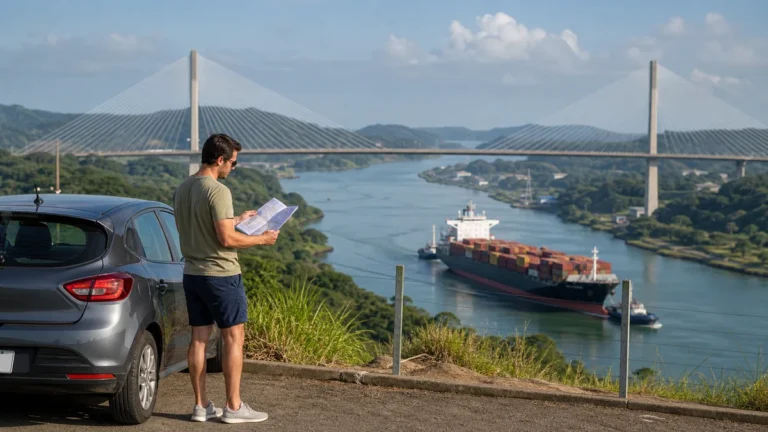
Travel insurance for Panama from USA trips should distinguish city care, canal excursions, island transfers and genuinely remote territory. Panama City may offer private hospitals, while rural, maritime and Darién-area stages can create longer and more complex response paths. Test each itinerary segment rather than applying one national assumption.
Key takeaways
- Map city, canal, coast, island and remote stages separately.
- Verify upfront payment, ambulance reach and the appropriate hospital.
- Classify every boat as a carrier, tour craft or medical transport.
- Check heat, rainfall and maritime notices against named policy triggers.
- Keep coordinates, notices, provider records, refunds and approvals.
Planning information reviewed August 16, 2026. Official alerts, medical access, marine conditions, road status and policy wording can change. Verify current information for the exact province, island, route and travel date.
Divide the itinerary into response zones
List the international airport, Panama City hotel, canal visit, domestic flight, road transfer, island boat, coastal stay and any remote community. Record how emergency services reach each location and where a patient would realistically be taken. Add every nonrefundable booking and its cancellation terms.
The U.S. Department of State’s current Panama travel information says private hospitals in Panama City can provide high-quality care but rural facilities are limited. It notes that providers may require upfront payment and that ambulance service is less reliable outside Panama City, Colón and the Pan-American Highway corridor.
Test city medical care and payment
Identify two realistic hospitals for the city portion and ask the insurer whether its assistance provider can coordinate with them. Confirm whether the traveler pays first, whether a guarantee of payment is possible and which itemized documents are required. Emergency treatment eligibility does not guarantee cashless service.
Call the U.S. health plan with the destination and plan name. Ask about foreign providers, emergency notification, reimbursement, claim forms and prescriptions. The health insurance abroad guide helps identify network and authorization limits.
Carry a medical summary, allergy list and assistance number offline. For a long stay, ask a provider about payment before a nonurgent visit rather than discovering the process at discharge.
Map rural treatment and medical transfer
A rural clinic may stabilize a traveler without offering the needed specialist or imaging. For each overnight outside the city corridor, identify road, boat or air movement to appropriate care. Record estimated time, seasonal access and a communication backup.
Ask who determines medical necessity, selects the receiving hospital and approves transport. Confirm whether evacuation ends at the nearest appropriate facility or can later include return to the United States. The remote evacuation guide explains the authority sequence.
The State Department advises avoiding parts of the Darién Region and areas of the Mosquito Gulf because of crime and limited emergency response. Treat official do-not-travel boundaries as route constraints. Insurance should never be used to justify entering a restricted area.
Classify canal and boat activities correctly
A scheduled ferry, domestic water taxi, canal tour, fishing charter and medical boat are not interchangeable. Check whether the policy defines a common carrier by published schedule or license. Ask the operator about passenger capacity, communications, emergency equipment, cancellation and the landing point used during a medical problem.
For kayaking, diving, surfing or sport fishing, name the activity and circumstances. Review water-depth, motorized, guide, competition and equipment exclusions. The adventure-activity exclusion guide provides a sport-by-sport audit.
An operator cancellation can create a supplier refund rather than an insurance loss. Save the original terms and request the operator’s written response before claiming.
Audit rental roads and territory
Confirm permitted provinces, road types, border restrictions, third-party liability, collision protection, towing and replacement-car procedures. A road that appears on a map may not be allowed under the rental agreement. Photograph the vehicle and signed contract at pickup.
Assign vehicle damage, mechanical failure, medical injury and unused bookings to their separate contracts. The rental car abroad guide helps avoid treating travel insurance as universal motor coverage.
| Event | First wording to inspect | Evidence to keep |
|---|---|---|
| City treatment | Travel medical and U.S. health plan | Diagnosis, itemized bill and payment |
| Rural transfer | Ambulance and evacuation clauses | Medical necessity and authorization |
| Boat cancellation | Carrier definition and delay benefit | Schedule, operator notice and refund |
| Rental damage | Rental contract or collision protection | Agreement, photos and report |
| Official evacuation | Cancellation or interruption covered cause | Authority, boundary, time and supplier response |
Use SINAPROC notices as location-specific evidence
Panama’s National Civil Protection System publishes current official alerts. Save the notice, issue time, affected provinces or coasts and later update. A nationwide weather headline can hide very different local effects.
SINAPROC also issues hazard-specific notices, such as advisories for high temperatures and heat index or adverse Caribbean waves. Use the current notice for the travel dates; an older example explains the format but not present conditions.
Follow official instructions for safety. For insurance, also identify the defined effect on the booking: a carrier cancellation, closure, evacuation or minimum delay.
Separate discomfort from a covered disruption
Heat, rain or rough water can make an outing unpleasant without activating a benefit. Ask whether the policy requires a formal cancellation, inaccessible destination, common-carrier delay or mandatory evacuation. Record the actual event rather than relying on a forecast.
The weather-delay coverage guide connects the official notice, threshold and covered cause. If the traveler changes plans voluntarily, preserve the safety reason but expect the contract analysis to differ.
Match the cost to cancellation, delay or interruption
A covered event before departure may fall under cancellation. After the trip starts, unused services and added return transport may be interruption. Waiting for a replacement carrier can be delay. One storm can create expenses under more than one benefit, each with its own limit.
Request supplier refunds and credits first. The delay, interruption and cancellation guide helps map costs to event timing without double counting.
Test a multi-zone medical scenario
Give every insurer the same case: a U.S. traveler becomes seriously ill during an island stay, needs boat or aircraft movement, is stabilized at a regional facility and then requires a specialist in Panama City. Ask who coordinates each stage and whether later return to the United States is separate.
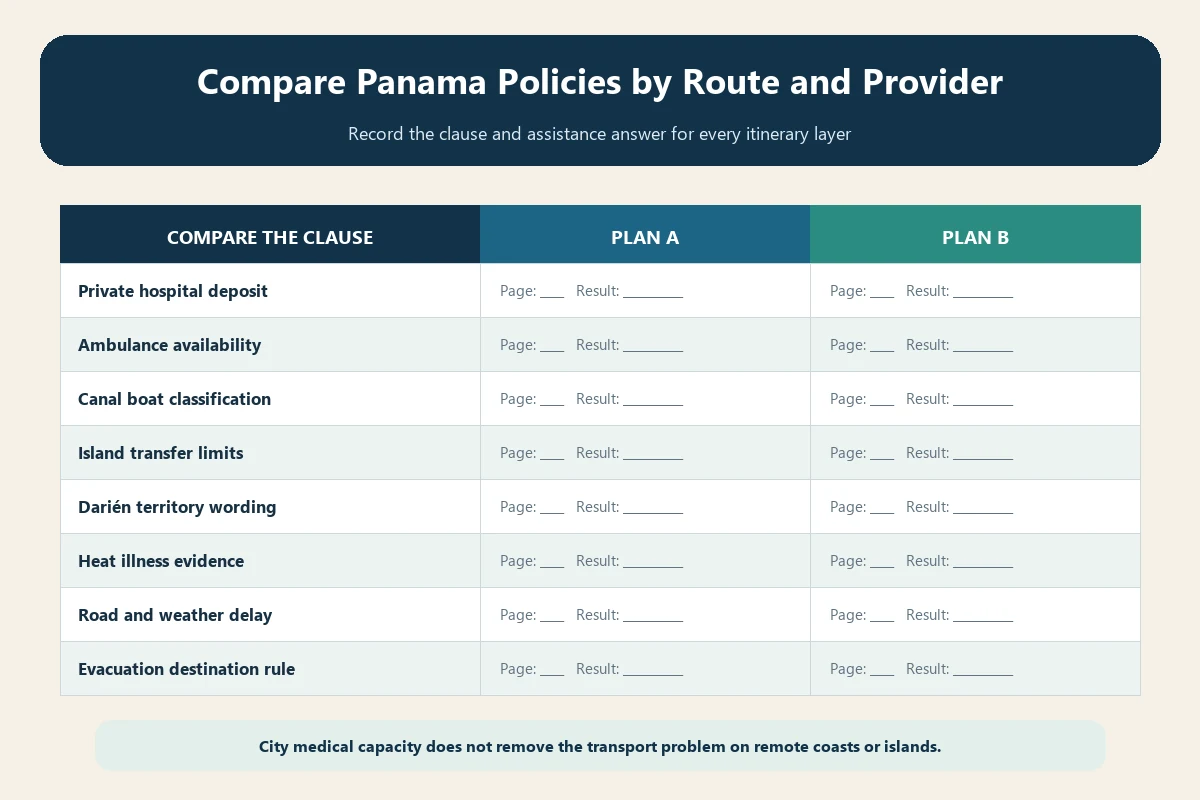
Request the page and clause for medical maximum, ambulance, evacuation, companion travel, preauthorization and payment. A high evacuation limit means little if the first boat movement is not eligible or the traveler cannot contact assistance.
Test the assistance line’s practical role
Ask whether the assistance team can communicate in Spanish, identify an appropriate provider, arrange payment, contact a companion and coordinate transport. Confirm the fallback if the traveler has weak mobile service. Save the international dialing method and policy number offline.
The assistance line versus claims guide distinguishes incident coordination from the claim examiner’s later eligibility decision. Assistance can help without guaranteeing coverage.
Compare contracts with one Panama worksheet
Keep the traveler ages, dates, insured cost and itinerary identical. Include a Panama City stay, canal excursion, rental segment, island transfer, rural medical event, official marine notice and missed flight.
- How are private hospitals paid or reimbursed?
- Who approves rural transport and chooses the receiving facility?
- Which boats qualify as common carriers?
- Are the exact water activities eligible?
- Which official notice and trip effect can trigger a benefit?
- What documentation and notice deadlines apply?
Use the policy comparison method to score definitions, exclusions and response authority rather than package names. The method is destination-neutral even though the example page began with Europe.
Build one evidence file across providers
Record the location, time, symptoms, provider, case number, transport decision and instruction received. Keep itemized bills, proof of payment, medical records, official notices, carrier schedules, cancellations, refunds and replacement receipts. Preserve the original currency and converted amount used by the payer.
The travel insurance claim guide provides a chronology for coordinating the U.S. plan, travel insurer and suppliers. Disclose other reimbursement and claim only the remaining eligible loss.
Check the route again before each transfer
Recheck official alerts, road or maritime status, operator instructions and the next connection. Store key documents offline and share the route with a trusted contact. When the itinerary adds a new island, rural lodge or activity, repeat the medical and policy audit.
For families, ask about dependent return, bedside visits and companion lodging. For travelers with ongoing conditions, carry enough prescription medication for disruption and a clinician summary.
Protect connections between separate tickets
A domestic flight, island boat and U.S.-bound ticket may be purchased from different suppliers. Record the minimum connection, last departure and backup route. Ask whether the policy requires a delay by a defined common carrier and whether a missed connection benefit applies when tickets are separate.
If a transfer fails, contact the next supplier immediately and ask for a written no-show, change or refund statement. Save the original schedule, actual departure time and replacement receipt. A policy may reimburse only reasonable additional transport after available supplier remedies.
Keep one night of medication and essential documents in hand baggage. When checked baggage travels on a different carrier, preserve every tag and property report because responsibility may change at each handoff.
Bottom line
The strongest Panama plan follows the traveler across distinct response zones. Verify city payment, rural transfer, boat classification, rental territory, official hazard notices and the evidence needed for each benefit. The useful policy is the one that still works at the most remote stage, not merely the one with the largest headline number.
