
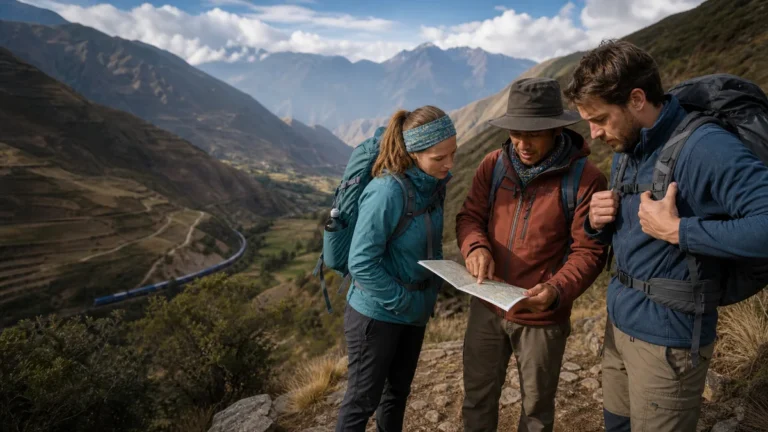
Travel insurance for Peru from USA trips should be tested against altitude, the exact trek and the complete extraction route. A policy can cover emergency treatment yet exclude a planned activity, nonmedical rescue or an avoidable connection loss. Build the itinerary first, then compare the clauses that control each stage.
Key takeaways
- Record sleeping elevations and allow a staged ascent before exertion.
- Give the insurer the named trail, maximum altitude and operator facts.
- Separate trail extraction, ambulance transfer and medical evacuation.
- Preserve official tickets, operator contracts and refund decisions.
- Protect domestic flights, trains and U.S. connections by contract.
Planning information reviewed August 16, 2026. Advisories, site access, operators, transport and policy wording can change. Recheck official sources and suppliers for the exact dates.
Map altitude by sleeping night
Peru routes can move quickly from Lima to Cusco, the Sacred Valley, Lake Titicaca or a high trail. The U.S. Department of State’s official Peru travel information identifies several high-altitude cities and advises travelers to take precautions.
The CDC Yellow Book chapter for Peru lists approximate elevations including Cusco at 3,339 meters, Lake Titicaca at 3,812 meters and the Salkantay Pass at about 4,630 meters. These figures show why a single “Peru” label cannot describe the medical exposure.
Create a table with arrival elevation, sleeping elevation, planned exertion and access to lower ground for every day. The CDC’s high-altitude guidance explains gradual ascent and symptoms requiring descent or care. Discuss personal risks with a clinician; fitness does not eliminate altitude illness.
Ask how the policy treats altitude illness
Check whether emergency treatment for altitude illness is covered and whether the planned elevation or activity changes eligibility. Review physician-advice exclusions, pre-existing-condition wording and requirements to follow reasonable medical instructions.
A traveler who becomes ill before a trek may face several decisions: rest, descend, seek a clinic, cancel the tour or interrupt the trip. Ask which decision requires a physician’s written certification and when assistance must be contacted. The pre-existing condition waiver guide explains purchase deadlines and look-back rules.
Do not assume that “medical” in a marketing summary covers every descent cost. An ordinary train, horse, porter team or vehicle used to leave a trail may be classified differently from an ambulance. Ask for the controlling definition in writing.
Name the trail and activity precisely
“Hiking in Peru” is too vague for an insurance answer. State the route, dates, maximum and sleeping elevations, number of days, group size, operator, guide, equipment and whether technical climbing is involved. Ask whether the policy uses altitude thresholds or excludes mountaineering, remote expeditions or professional participation.
Peru’s official SERNANP page for the Historic Sanctuary of Machupicchu says entry to the Inca Trail network is through authorized travel agencies. Verify an operator against the current official list rather than relying on a reseller badge.
Peru’s National Quality Institute describes technical safety standards for adventure tourism, including trekking and other activities. Insurance does not certify an operator. Check licensing, guide qualifications, communications, equipment, risk plan and evacuation procedure separately.
The adventure activity exclusions guide provides a fact pattern for comparing policies. Ask about search and rescue, nonmedical extraction and the effect of using an unapproved guide or entering a closed route.
Build the extraction chain before departure
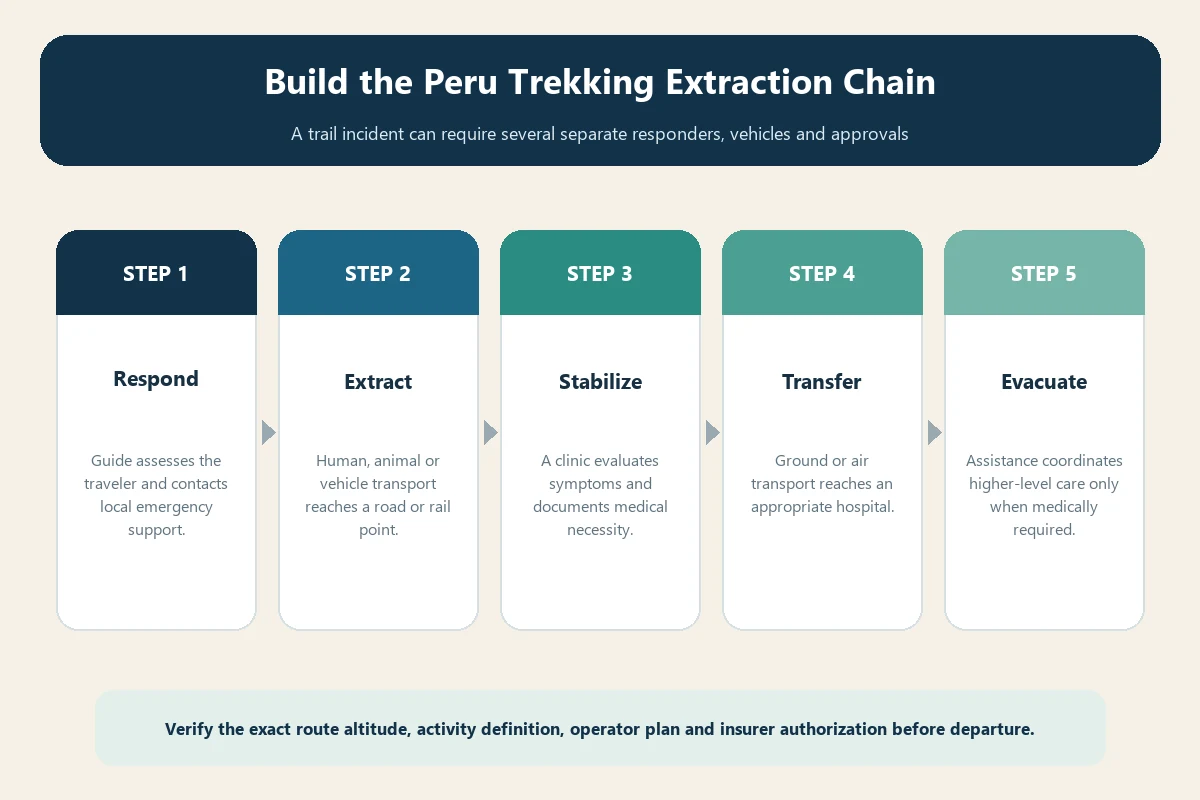
Break a serious trail incident into five stages. First, the guide or companion assesses the traveler and communicates. Second, local responders move the patient to a road, rail or landing point. Third, a clinic stabilizes and documents the condition. Fourth, ground or air transport reaches an appropriate hospital. Fifth, assistance considers higher-level or international evacuation.
Ask the operator who pays and who controls each stage. Ask the insurer whether guide-arranged rescue is eligible, whether prior authorization is required when communications work and what happens when delay would threaten health. Record phone and satellite contact procedures.
The emergency medical evacuation guide distinguishes medically necessary transport to adequate care from a traveler’s wish to fly home. Confirm receiving-facility selection, medical escort, companion travel and repatriation language.
Test a realistic trekking case with assistance
Give each insurer the same case: after two nights near Cusco, a traveler develops symptoms on a permitted trail several hours from vehicle access. The guide recommends extraction, a clinic evaluates the patient and a physician requests transfer to a larger hospital.
Ask who authorizes extraction, how a receiving bed is confirmed and whether an operator invoice is enough. Then ask what changes if the incident occurs where no phone signal exists. A useful answer identifies the emergency exception, notification deadline and documentation requirement.
Finally, ask whether unused tour days, a missed train, extra lodging and a changed international flight fall under medical, interruption or delay benefits. One incident can create multiple claim sections with different limits and evidence.
Protect Machu Picchu and tour deposits
Peru’s Ministry of Culture has an official Machu Picchu ticket service that requires a selected circuit, route, date and entry time. Keep the official ticket and purchase record. A tour reseller’s package may combine that nontransferable access with lodging, rail and guide services under different refund rules.
Make a cost ledger showing supplier, payment date, nonrefundable amount, cancellation deadline and credit rights. If an official site closes, obtain the official notice plus each supplier’s refund decision. A closure does not make the entire package an insured loss when parts are refunded or still usable.
The trip cancellation guide explains named reasons and purchase timing. “I cannot use my preferred circuit” is not automatically the same as destination closure or trip cancellation.
Separate civil disruption from supplier failure
Strikes, demonstrations, road blocks, rail interruption and an operator cancellation may look similar to a stranded traveler but trigger different contract language. Save the dated official notice, carrier message, operator instruction and refund offer.
Ask whether civil disorder, common-carrier delay, road closure or destination inaccessibility is a covered event. Check when the event became known. Coverage purchased after a disruption is foreseeable may not apply to that event.
If the itinerary can be rerouted, obtain the supplier options before buying replacements. Preserve why a route was unavailable, when assistance was called and which alternative was reasonably available. A voluntary preference change is harder to document than a carrier or authority decision.
Audit trains, domestic flights and separate tickets
List every legal carrier, ticket number, baggage rule and connection. A train into the Machu Picchu area, a Cusco–Lima domestic flight and a U.S.-bound ticket may be three independent contracts. Record the final service of the day and a realistic buffer.
Ask whether the train or bus qualifies as a common carrier and which missed-connection minimum applies. Determine whether delay benefits require a stated number of hours. The delay, interruption and cancellation guide helps assign each added cost to the right section.
Keep the original schedule, boarding document, delay confirmation, replacement ticket and every refund or credit. If a domestic carrier changes the time well before travel, ask what rebooking it offers before claiming a new international flight.
Plan medical payment and coordination
Identify clinics near acclimatization stops and hospitals in the larger cities on the route. Ask about hours, deposits and payment methods. Call the U.S. health plan about overseas emergency treatment, prior authorization and claim order.
The health insurance abroad guide supplies the questions. The assistance line versus claims guide explains why a 24-hour service may coordinate care without guaranteeing that the policy will reimburse every bill.
Carry prescription details, allergies, policy number and secure access to funds. If treatment occurs, obtain a diagnosis, itemized bill, proof of payment and discharge instruction. Translate only copies and preserve the original Spanish record.
Compare policies with one Peru itinerary
Use identical ages, dates and prepaid amounts. Include Lima, staged acclimatization, a named trek, official ticket, rail segment, domestic flight, clinic assessment, trail extraction and hospital transfer.
- Is the exact route and maximum elevation eligible?
- What pays for nonmedical extraction or search and rescue?
- Who authorizes ambulance and medical evacuation stages?
- Which tour and ticket costs qualify after a medical event?
- How are rail and separately ticketed flight delays treated?
- Which records and notification deadlines control the claim?
Read the certificate, exclusions and endorsements. Record each answer with a page reference. A larger evacuation limit is not a substitute for eligible activity wording and a workable authorization process.
Build a chronological claim packet
Keep the itinerary, operator license evidence, route and elevation, ticket, guide report, medical note, extraction log, transport invoice, assistance case number, carrier notice, refund and added-expense receipt. Record currency and actual conversion.
The travel insurance claim guide explains how to coordinate suppliers, the U.S. health plan and travel insurer. Disclose all refunds and credits. Label every expense by date and benefit so extraction, treatment and interruption are not confused.
Prepare an offline trek communication packet
Give the guide and a companion the policy number, assistance contacts, allergies, medications and emergency consent. Store the itinerary, passport copy and clinician summary offline. Record the operator’s base contact, local emergency number and the point where satellite or radio communication becomes available.
Agree that urgent care comes first when delay would threaten health, but document why prior contact was impossible. As soon as communication returns, open a case and record the instruction. This preparation cannot guarantee reimbursement, yet it creates a credible chronology when the trail itself prevents ordinary authorization.
Bottom line
A strong Peru plan connects gradual ascent, exact activity eligibility, a licensed operator, the trail extraction chain and protected transport contracts. Verify those facts before purchase, then preserve the official and medical evidence that explains every decision.
