

Travel insurance for Aruba should cover emergency medical care paid in cash, medical evacuation off the island, and the water sports you actually plan to do. The U.S. Department of State says Aruba has no decompression chamber, so a diver with decompression sickness must be medically evacuated for treatment, and most overseas providers do not accept U.S. health insurance. This guide shows how to test a policy against those facts, plus marine advisories, boat cancellations, rental vehicles and separate-ticket connections, before the first dive.
Key facts
- The U.S. Department of State reports Aruba has no decompression chamber; decompression sickness requires medical evacuation off the island.
- Most hospitals and doctors overseas do not accept U.S. insurance, and many accept only cash, per the State Department.
- Medicare usually does not cover health care outside the U.S., so a separate travel medical benefit matters (Medicare.gov).
- CDC notes medical evacuation from a remote area to a quality hospital could cost more than $100,000 without coverage.
- Aruba's meteorological department publishes an official marine forecast with wind, wave and small-craft advisories to use as dated evidence.
- Entry approval through Aruba's official ED card portal and insurance eligibility are separate; verify both at the source before departure.
Key takeaways
- Check diving and every water sport by certification, depth and supervision.
- Verify current chamber treatment and off-island transport arrangements.
- Confirm cash payment, provider access and assistance coordination.
- Use Aruba’s marine forecast for safety and timed evidence.
- Keep logs, operator reports, advisories, bills, refunds and approvals.
Planning information reviewed August 16, 2026. Entry processes, marine conditions, provider services, chamber access and policy wording can change. Verify current official information and assistance arrangements for the exact dates.
Map the island itinerary and connections
List the flights, hotel, rental vehicle, dive operator, boat trips, water sports and any onward island. Record separate tickets, last departures, baggage rules, cancellation terms and the first nonrefundable payment. Add the nearest realistic care for each activity.
The U.S. Department of State’s official Aruba travel information says access to quality medical care is limited and may not meet U.S. expectations. It specifically states that Aruba has no decompression chamber and that a person with decompression sickness must be medically evacuated for proper treatment.
Audit the exact dive plan
Provide the certification, planned depth, supervision, number of dives and whether the itinerary includes wreck, night, freediving, rebreather or technical activity. Ask whether an optional sports endorsement is needed and which limits apply to medical care, rescue and equipment.
Check exclusions for diving beyond certification, solo dives, technical gases, paid instruction, competition and alcohol. The adventure-activity exclusion guide helps replace a marketing answer with a clause-level test.
Follow operator and certifying-agency guidance, including conservative surface intervals and medical evaluation when symptoms appear. Coverage does not make an unsafe dive acceptable.
Verify the operator and emergency chain
Record the operator’s legal name, boat, guides, emergency oxygen, communications, passenger count, departure point and cancellation terms. Ask which provider evaluates a suspected dive injury, how the patient reaches it and who arranges off-island treatment.
Keep the booking description, waiver, safety briefing and dive log. An operator’s liability policy, a dive-membership service and the travel policy are separate contracts.
Test chamber treatment and evacuation together
Because there is no decompression chamber on Aruba, ask the insurer where a medically necessary patient may be sent, which carrier or aircraft is used and who must approve it. Confirm whether stabilization, aircraft movement, chamber treatment and later repatriation share one limit.
Ask whether the nearest appropriate facility, rather than the traveler’s preferred U.S. hospital, controls the endpoint. The remote evacuation guide provides questions about medical necessity, receiving facility and companion travel.
Prepare for cash medical payment
The State Department notes that most hospitals and doctors overseas do not accept U.S. insurance and many providers accept only cash. Call the U.S. plan about foreign emergency treatment, claim forms, authorization and reimbursement.
The health insurance abroad guide helps identify network and payment gaps. Ask the travel insurer whether its assistance provider can arrange a guarantee of payment.
Carry a medical summary, prescriptions, allergies and emergency numbers offline. Keep enough medicine in hand baggage for a delayed return.
Understand primary and secondary payment
A primary travel medical benefit may accept eligible expenses before the U.S. plan, while a secondary benefit can require the domestic insurer’s decision first. Neither label guarantees direct provider payment or immediate aircraft approval.
The primary versus secondary medical guide separates claim order from care access. Record the deductible, currency conversion method and proof required.
Check marine weather and trip-disruption triggers
Aruba’s meteorological department publishes an official marine forecast with wind, wave height, direction, period and small-craft advisories. Save the product for the actual day and coast. Conditions on sheltered southern water can differ from exposed northern and eastern sections.
A small-craft advisory, operator cancellation, port closure and traveler’s voluntary decision are different facts. Follow safety instructions first. For reimbursement, identify the defined event and effect on the booking.
Check tropical systems beyond Aruba itself
Aruba sits south of many common Atlantic cyclone tracks, but distant storms can still affect flights, cruise schedules, waves or an onward island. The U.S. National Hurricane Center publishes official preparedness and storm information.
The weather-delay coverage guide helps connect a dated advisory to a carrier cancellation, closure or minimum delay. Do not treat “outside the hurricane belt” as a coverage guarantee.
Separate water-sport losses by contract
| Event | First wording to inspect | Evidence |
|---|---|---|
| Dive injury | Medical and scuba eligibility | Dive log, operator report and diagnosis |
| Chamber transfer | Evacuation authority and endpoint | Medical necessity and approval |
| Boat cancellation | Supplier terms and carrier definition | Schedule, notice and refund |
| Damaged rental gear | Operator contract or baggage benefit | Rental form, photos and assessment |
| Missed flight | Delay or missed-connection benefit | Actual times and replacement receipt |
Parasailing, kitesurfing, windsurfing, jet skiing, sailing and snorkeling also need exact checks. Motorized and wind-powered activities can have different exclusions from recreational scuba.
Audit the rental jeep and remote coast
Confirm permitted roads and park areas, third-party liability, collision protection, tires, towing and replacement procedures. A travel policy generally does not replace the rental contract. Photograph the vehicle and signed agreement at pickup.
The rental car abroad guide separates vehicle damage, roadside assistance, injury and unused bookings. Do not enter a road prohibited by the rental company because the vehicle appears capable.
Classify an interrupted island trip
A covered event before U.S. departure may be cancellation. After arrival, unused dives, hotel nights and added return transport may be interruption. Waiting for a replacement flight or boat can be delay. Supplier refunds reduce the claimed loss.
The delay, interruption and cancellation guide maps each expense to event timing. Keep original and changed itineraries.
Verify entry information at the source
Aruba’s official online embarkation and disembarkation card portal provides the current traveler process. Check it before departure rather than relying on an old article that may still describe expired insurance rules.
Entry approval and insurance eligibility are separate. A policy may exclude documentation problems or deny coverage for a known issue even when the medical benefit is otherwise valid.
Compare Aruba policies with a dive scenario
Give each insurer the same facts: a properly certified traveler develops symptoms after an eligible recreational dive, receives local evaluation and needs off-island chamber care. Ask who identifies the facility, approves transport, helps with payment and communicates with a companion.
Then test a marine-advisory boat cancellation followed by a missed separate-ticket flight. The assistance line versus claims guide distinguishes immediate coordination from later claim review.
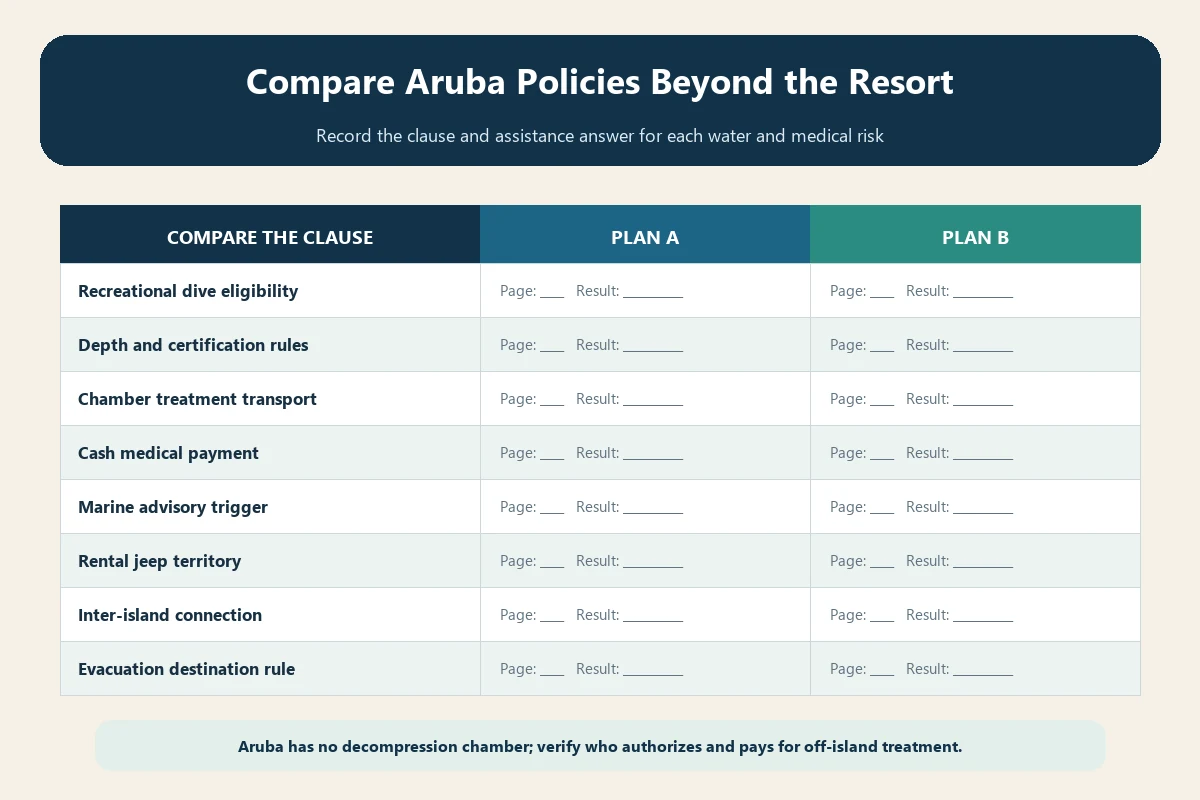
Run one Aruba policy comparison
Use identical ages, trip dates, insured cost and activities. Record exact pages for dive eligibility, chamber treatment, evacuation, provider payment, marine triggers, rental territory and connection protection.
- Is the planned depth and certification eligible?
- Where can chamber treatment occur and who authorizes transport?
- How are local providers paid?
- Which boat and flight definitions apply?
- What marine or storm event can trigger a benefit?
- What notice and evidence deadlines apply?
Build the claim file during the incident
Save the dive profile, operator report, symptoms, medical notes, itemized bills, proof of payment, transport authorization, official forecasts, carrier notices, refunds and replacement receipts. Record every assistance case number.
The travel insurance claim guide provides a chronology. Disclose U.S. health-plan and supplier reimbursement and claim only the remaining eligible amount.
Protect the final-dive departure window
Place each dive, surface interval, medical check and flight on one timeline. Follow operator, certifying-agency and clinician guidance about flying after diving. A schedule that leaves only the minimum connection can fail when a boat returns late or a cautious no-fly interval extends.
If symptoms develop, stop diving and record the depth profile, time, oxygen and medical restriction. Written clinical advice not to fly is stronger evidence than a traveler’s undocumented choice to delay. Safety takes priority regardless of reimbursement.
Track equipment across every carrier
Photograph owned dive gear, serial numbers and condition before the trip. Check airline limits and any inter-island carrier separately. Keep essential medicine, documents and the dive computer within permitted hand baggage when practical.
If baggage is delayed or damaged, obtain the carrier report before leaving. A rental shop charge, airline liability and baggage benefit may each use a different valuation and deductible. Save repair estimates, rental replacements and every settlement.
Plan the companion’s off-island route
An evacuated patient may travel by a medical route that cannot carry a companion. Ask about bedside travel, companion airfare, lodging and dependent return. Confirm who books each service and whether approval is required before purchase.
Give the companion access to the policy, medical summary, consent and payment method. Assign one person to preserve the incident chronology while assistance coordinates the receiving facility.
Before an onward Caribbean trip, repeat the medical and transport audit for the next island. Aruba’s provider access, carrier network and marine conditions do not describe Curaçao, Bonaire or another destination. Confirm that territorial coverage includes every stop and that a medical transfer is not mistaken for an ordinary inter-island itinerary. Save each separate ticket and cancellation rule.
Bottom line
The strongest Aruba plan connects the exact water activity to realistic local care and an authorized off-island treatment route. Verify marine conditions, provider payment, carrier definitions and evacuation authority before the first dive—not after symptoms begin.
Sources and further reading
- Aruba – Traveler view | Travelers' Health | CDC — CDC advises travelers to Aruba to consider purchasing travel health and medical evacuation insurance and to review what their health plan covers during the trip.
- Travel Insurance | Travelers' Health | CDC — Medical evacuation from a remote area to a high-quality hospital could otherwise cost more than $100,000; travel health insurance is especially important for adventure activities such as scuba diving; current medical insurance may not cover care in another country.
- Travel outside the U.S. — Medicare usually doesn't cover health care while traveling outside the U.S.; Medigap policies may cover emergency care abroad; travelers may buy a separate travel insurance policy.
